Peptide Medix product catalog

Peptide Medix

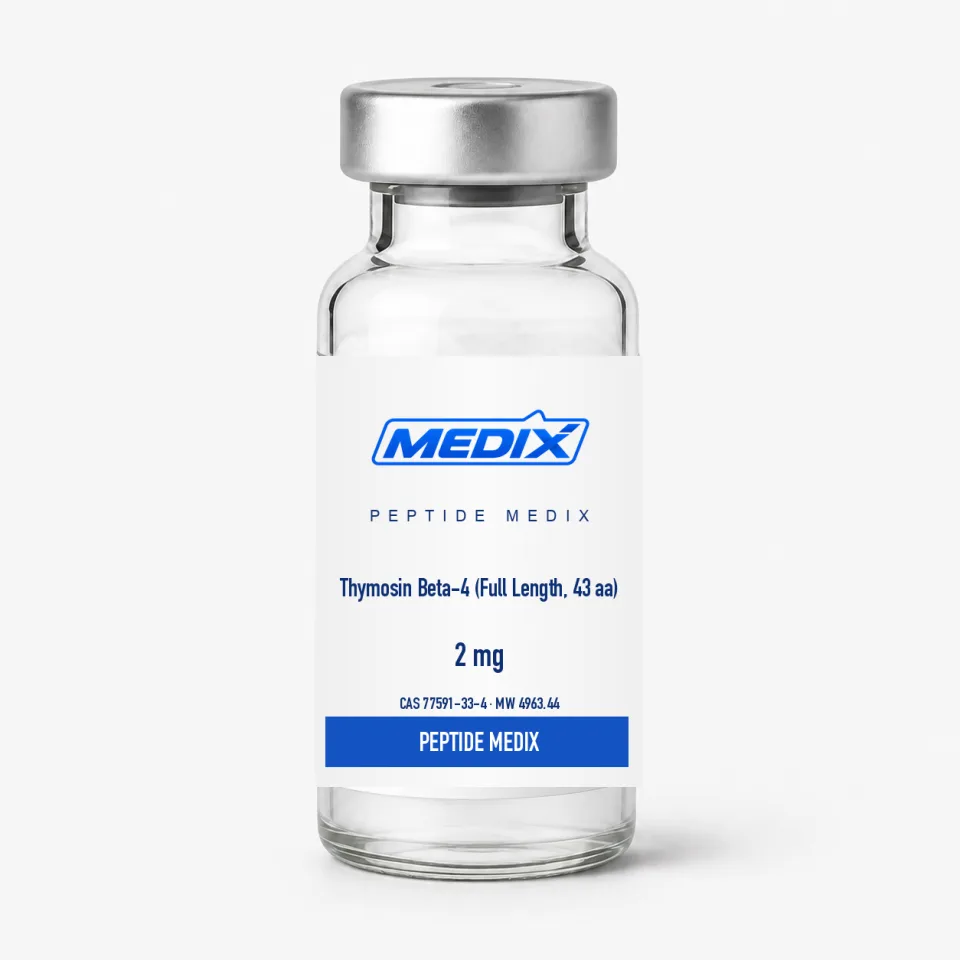
Thymosin Beta-4 (Full Length, 43 aa)

Full 43-residue acetylated thymosin beta-4, the intact actin-sequestering protein

Review catalog details Secure payments
Available to order · 2 of 2 options available
$97.00 $115.00 15% OFF

Choose an option

1
Categories: thymosin beta-4 , tb4 full length , actin sequestering

Choose your delivery method

Standard Shipping is automatically selected at checkout. Customers can upgrade to a faster delivery option anytime.

Overview

This is the complete 43-amino-acid thymosin beta-4 sequence with its native N-terminal acetylation — not the seven-residue actin-binding fragment sold as TB-500. Thymosin beta-4 is one of the most abundant intracellular proteins in mammalian cells and the principal G-actin sequestering protein, binding monomeric actin in a one-to-one complex and thereby holding a reserve pool that regulates how quickly filaments can polymerise.

The distinction from the fragment matters experimentally. TB-500 reproduces the central actin-binding motif LKKTETQ, but the full-length protein carries additional structure implicated in interactions beyond actin, including reported binding partners in cell migration, angiogenesis and inflammatory signalling. Studies that ask whether an observed effect depends on the whole protein or only on the binding motif need both molecules, which is why laboratories usually run them side by side.

Specifications

Brand Peptide Medix
Category Tissue Repair & Healing Peptides
Form Lyophilized powder, sealed glass vial with crimped stopper
Purity ≥99% by HPLC; lot-matched COA available
Available sizes 2 mg, 5 mg
CAS number 77591-33-4
Molecular weight 4963.44 g/mol
Chain length 43 amino acids, N-terminally acetylated
Amino acid sequence Ac-Ser-Asp-Lys-Pro-Asp-Met-Ala-Glu-Ile-Glu-Lys-Phe-Asp-Lys-Ser-Lys-Leu-Lys-Lys-Thr-Glu-Thr-Gln-Glu-Lys-Asn-Pro-Leu-Pro-Ser-Lys-Glu-Thr-Ile-Glu-Gln-Glu-Lys-Gln-Ala-Gly-Glu-Ser
Peptide class Beta-thymosin family; G-actin sequestering protein
Key motif LKKTETQ actin-binding motif at residues 17–23
Relationship to TB-500 TB-500 is the acetylated 17–23 fragment of this sequence
Research areas Actin dynamics, cell migration, wound closure, angiogenesis, cardiac and corneal repair
Solubility Readily soluble in sterile or bacteriostatic water; highly hydrophilic and acidic
Storage (lyophilized) −20 °C, sealed and protected from light and moisture
Storage (reconstituted) 2–8 °C, protected from light; aliquot for longer holds
SKU THYMOSIN-BETA-4-FULL-2-MG

Highlights

  • Complete 43-residue sequence with native N-terminal acetylation, not the TB-500 fragment
  • The principal G-actin sequestering protein, binding actin monomers one to one
  • ≥99% purity by HPLC with mass-spectrometric identity confirmation per lot
  • Two research sizes: 2 mg and 5 mg lyophilized vials
  • Contains the LKKTETQ motif plus the flanking structure absent from TB-500
  • Used in cell migration, wound closure, angiogenesis and cardiac repair models
  • Synthesised and shipped from a United States facility

What's Included

  • The vial option and size selected above
  • Final item and quantity confirmed in cart
  • Laboratory-research-use labeling

Research Overview

Actin sequestration

Cell migration and wound models

Because actin turnover drives lamellipodial protrusion, thymosin beta-4 appears throughout the migration literature. Scratch-wound and Boyden chamber assays, corneal epithelial models and dermal wound-closure studies in rodents have all been used to examine reported effects on migration rate, re-epithelialisation and matrix remodelling markers.

Angiogenesis and cardiac work

  • Endothelial cell tube formation and migration assays
  • Reported effects on vascular endothelial growth factor signalling in cultured cells
  • Cardiac injury models examining epicardial cell activation and capillary density
  • Comparisons with the LKKTETQ fragment to test motif sufficiency

Full-length versus fragment

A recurring experimental question is whether the seven-residue motif accounts for the reported biology or whether flanking sequence contributes independently. The full-length protein also has a documented N-terminal tetrapeptide degradation product, Ac-SDKP, with its own literature in fibrosis research, which the fragment cannot generate. Running both molecules with matched controls is the standard way to separate these contributions.

Analytical notes

The sequence is highly acidic and disordered in solution, so it behaves unusually on size-exclusion chromatography and migrates anomalously on SDS-PAGE. Mass spectrometry is the reliable identity check, and the internal methionine is the residue most often monitored for oxidative degradation.
Handling & Storage

Let the sealed vial equilibrate to room temperature before opening so the cake does not draw moisture. Add sterile or bacteriostatic water gently down the vial wall and swirl until clear; the peptide is very hydrophilic and dissolves readily, so vigorous mixing is unnecessary and adds foam. At these small fill weights, take care to recover the full contents — briefly tapping the vial before opening brings down powder caught on the stopper. Store reconstituted stock at 2–8 °C protected from light, and prepare single-use aliquots for studies spanning several sessions. Record lot number and reconstitution date. Research use only.

Thymosin Beta-4 (Full Length, 43 aa) FAQ

How is this different from TB-500?
TB-500 is the acetylated seven-residue fragment corresponding to residues 17 to 23 of this sequence. The material here is the complete 43-amino-acid protein, which carries that motif plus all the flanking structure. Laboratories use both to test whether the motif alone accounts for a given effect.
Why are the vial sizes smaller than TB-500 vials?
Synthesising a 43-residue peptide at high purity is considerably more demanding than a seven-residue fragment, so full-length thymosin beta-4 is supplied in 2 mg and 5 mg vials. On a molar basis the difference is larger still, since the full protein is about five and a half times heavier.
What purity and documentation are supplied?
Each lot is tested by HPLC to at least 99% purity with identity confirmed by mass spectrometry, and a lot-matched certificate of analysis is available. Mass spectrometry matters especially here, because the acidic disordered sequence behaves anomalously on gels and size-exclusion columns.
What does it do at the molecular level?
It binds monomeric G-actin in a one-to-one complex and holds it out of the polymerising pool, acting as the main intracellular actin buffer. That role places it at the centre of research on cytoskeletal dynamics, cell migration and processes that depend on rapid filament turnover.
How should it be stored?
Keep the sealed lyophilized vial at −20 °C, protected from light and moisture. Once reconstituted, store at 2–8 °C for short study windows or aliquot and freeze for longer holds. Avoid repeated freeze-thaw cycles and monitor the internal methionine for oxidation in long-running work.

This catalog listing is for laboratory research use only. It is not represented as a drug, food, supplement, cosmetic or diagnostic product, and it is not offered for human or veterinary use.

Customer Reviews

0 reviews
5 star
0%
4 star
0%
3 star
0%
2 star
0%
1 star
0%

Leave Your Review

Rating

No reviews yet — be the first!

Leave Your Review

Rating

Keep exploring

Related Products & Shopping Guides

Compare Thymosin Beta-4 (Full Length, 43 aa) with relevant categories, product topics, and practical shopping information.

Often researched together

Related research peptides, blends and lab supplies frequently ordered with Thymosin Beta-4 (Full Length, 43 aa).

15% OFF
BPC-157

Peptide Medix

BPC-157

bpc-157

7 options

$34.00 $40.00

View options and product details

15% OFF
GHK-Cu (Copper Peptide)

Peptide Medix

GHK-Cu (Copper Peptide)

ghk-cu

5 options

$25.00 $30.00

View options and product details

15% OFF
BPC-157 Cream

Peptide Medix

BPC-157 Cream

bpc-157 cream

2 options

$68.00 $80.00

View options and product details

15% OFF
Pentosan Polysulfate Sodium

Peptide Medix

Pentosan Polysulfate Sodium

pentosan polysulfate

2 options

$72.00 $85.00

View options and product details