Peptide Medix product catalog

Peptide Medix

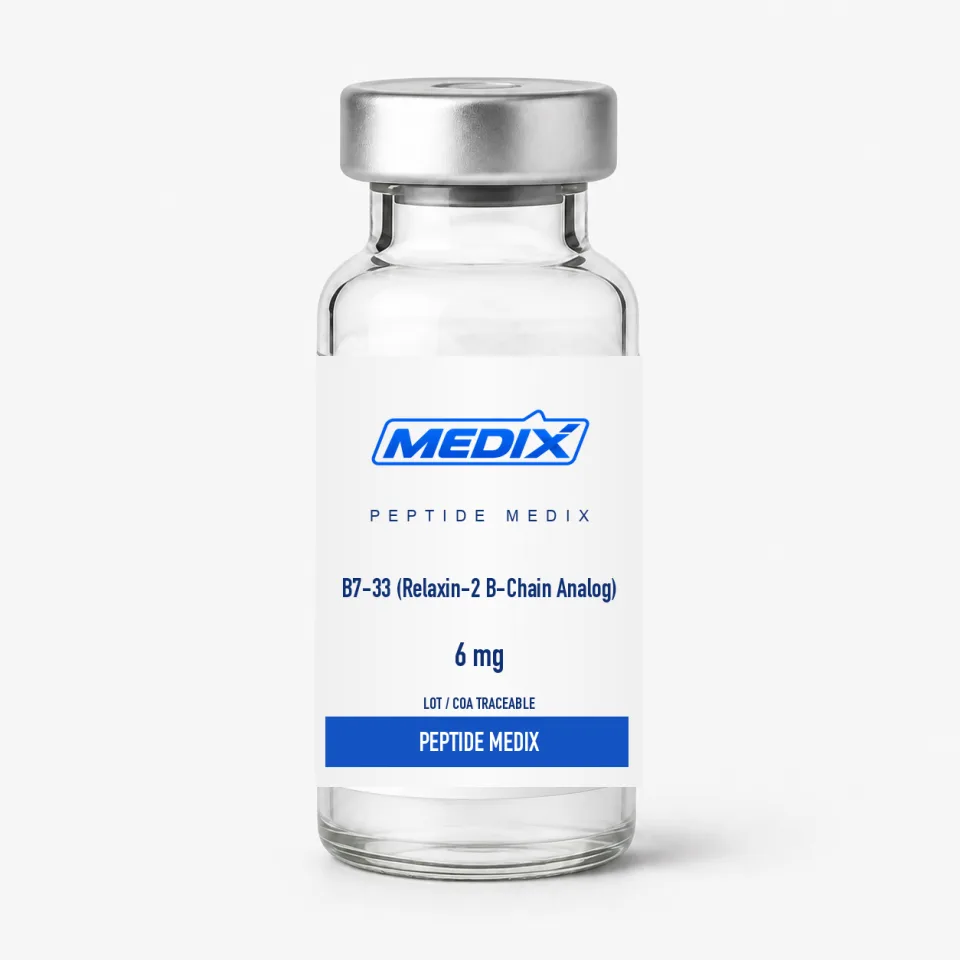
B7-33 (Relaxin-2 B-Chain Analog)

Linear 27-residue relaxin-2 B-chain analog studied as an RXFP1 agonist

Review catalog details Secure payments
Available to order
$63.00 $75.00 15% OFF
1
Categories: b7-33 , relaxin-2 analog , rxfp1

Choose your delivery method

Standard Shipping is automatically selected at checkout. Customers can upgrade to a faster delivery option anytime.

Overview

B7-33 is a synthetic, single-chain peptide derived from the receptor-binding region of the human relaxin-2 B chain. Its 27-residue sequence retains the arginine-rich motif used by relaxin family peptide receptor 1 (RXFP1) while avoiding the two-chain, three-disulfide architecture of the native hormone. The name records that span, corresponding to positions 7 through 33 of the B chain, and because the sequence carries no cysteine it requires no oxidative folding step. The result is a linear research analog that is easier to synthesize and characterize than full relaxin-2.

Specifications

Brand Peptide Medix
Category Tissue Repair & Healing Peptides
Form Lyophilized powder, sealed glass research vial
Available size 6 mg
Purity ≥99% by HPLC; mass-based identity confirmation; lot-matched COA available
Chain length 27 amino acids
Amino acid sequence Val-Ile-Lys-Leu-Ser-Gly-Arg-Glu-Leu-Val-Arg-Ala-Gln-Ile-Ala-Ile-Ser-Gly-Met-Ser-Thr-Trp-Ser-Lys-Arg-Ser-Leu
Peptide class Linear human relaxin-2 B-chain analog
Primary research target Relaxin family peptide receptor 1 (RXFP1)
Research areas RXFP1 signaling bias, fibroblast biology, extracellular-matrix turnover, fibrosis and vascular-response models
Distinction Not native relaxin-2 or serelaxin; contains one engineered linear chain and no disulfide-linked A chain
Solubility Water-soluble research peptide; buffer compatibility should be validated for the selected assay
Storage (lyophilized) −20 °C, sealed and protected from light and moisture
Storage (in solution) 2–8 °C for a defined study window; aliquot for longer holds
SKU B7-33-6-MG

Highlights

  • Linear 27-residue analog derived from the human relaxin-2 B chain
  • Designed around the RXFP1-binding motif rather than native relaxin's two-chain structure
  • Single 6 mg lyophilized research-vial format
  • ≥99% purity by HPLC with mass-based identity confirmation and lot-matched COA
  • Studied in RXFP1 signaling, fibroblast and extracellular-matrix models
  • Distinct from serelaxin and full-length human relaxin-2
  • Store sealed at −20 °C, protected from light and moisture

What's Included

  • The vial option and size selected above
  • Final item and quantity confirmed in cart
  • Laboratory-research-use labeling

Research Overview

Why the B chain was isolated

Human relaxin-2 is an insulin-family hormone formed from separate A and B chains connected by disulfide bonds. Binding studies identified key arginine and isoleucine residues in the B chain as major contacts for the leucine-rich repeat region of RXFP1. B7-33 was engineered to preserve that interaction surface in a single linear sequence, creating a smaller reagent for structure-activity and receptor-signaling studies. RXFP1 is itself an unusual class A receptor, pairing those leucine-rich repeats with an N-terminal LDLa module reported to be necessary for activation rather than for binding, so ligand engagement and receptor activation can be probed as separate steps.

Chemistry and analytical handling

Having no cysteine removes the disulfide-isomer and chain-scrambling questions that complicate work with two-chain relaxin preparations. The sequence carries five basic residues against a single glutamate, so the peptide is strongly cationic near neutral pH and can adsorb to glass and plastic at low working concentrations. One methionine and one tryptophan make oxidation and light exposure the chemical liabilities most worth controlling, and that single tryptophan is also the only strong ultraviolet chromophore in the molecule.

Functional selectivity

The original characterization compared B7-33 with native relaxin across cells expressing RXFP1. Results were interpreted as signaling bias: the analog could engage ERK1/2-associated pathways strongly in physiologically relevant cells while producing a different cyclic-AMP profile from the two-chain hormone. That profile varies with receptor density and cell background, so direct comparisons require the same expression system, passage and exposure window. Bias is a quantitative claim rather than a descriptive one, and supporting it normally means full concentration–response curves for each pathway, a reference agonist run in the same cells, and an analysis that separates genuine pathway preference from differences in assay amplification.

  • RXFP1 binding and activation in engineered and endogenous receptor systems
  • Collagen production and matrix-remodeling markers in fibroblast cultures
  • Cardiac, pulmonary, renal and scar-associated fibrosis models
  • Vascular reactivity and endothelial-function endpoints in isolated tissue and animal work
  • Controlled-release coatings and biomaterial interfaces where local fibrotic encapsulation is measured
  • Species and orthologue comparisons, since relaxin-family pharmacology is not identical across species
Controls and interpretation

B7-33 (Relaxin-2 B-Chain Analog) FAQ

What is B7-33?
B7-33 is a 27-amino-acid synthetic analog derived from the B chain of human relaxin-2. It retains the main RXFP1-binding motif in one linear chain, making it structurally simpler than native relaxin, which has separate A and B chains joined by disulfide bonds.
What does B7-33 target in research models?
Its primary reported target is RXFP1, the cognate receptor for relaxin-2. Studies examine receptor signaling, fibroblast matrix output, fibrotic remodeling and vascular endpoints, with results depending on cell type, receptor density and experimental design.
What purity documentation is available?
The peptide is released at ≥99% purity by reversed-phase HPLC with identity checked against the expected mass. A certificate of analysis matched to the vial's lot number is available for study records.
How should B7-33 be stored?
Keep the sealed lyophilized vial at −20 °C, dry and protected from light. After preparation, refrigerate short-term working stocks and use aliquots for longer study windows so the same solution is not repeatedly frozen and thawed.

This catalog listing is for laboratory research use only. It is not represented as a drug, food, supplement, cosmetic or diagnostic product, and it is not offered for human or veterinary use.

Customer Reviews

0 reviews
5 star
0%
4 star
0%
3 star
0%
2 star
0%
1 star
0%

Leave Your Review

Rating

No reviews yet — be the first!

Leave Your Review

Rating

Keep exploring

Related Products & Shopping Guides

Compare B7-33 (Relaxin-2 B-Chain Analog) with relevant categories, product topics, and practical shopping information.

Often researched together

Related research peptides, blends and lab supplies frequently ordered with B7-33 (Relaxin-2 B-Chain Analog).

15% OFF
ARA-290 (Cibinetide)

Peptide Medix

ARA-290 (Cibinetide)

ara-290

2 options

$85.00 $100.00

View options and product details

15% OFF
BPC-157

Peptide Medix

BPC-157

bpc-157

7 options

$34.00 $40.00

View options and product details

15% OFF
Vesugen

Peptide Medix

Vesugen

vesugen
$63.00 $75.00

View options and product details

15% OFF
BPC-157 Cream

Peptide Medix

BPC-157 Cream

bpc-157 cream

2 options

$68.00 $80.00

View options and product details