Research Overview
Why the sublingual route is studied
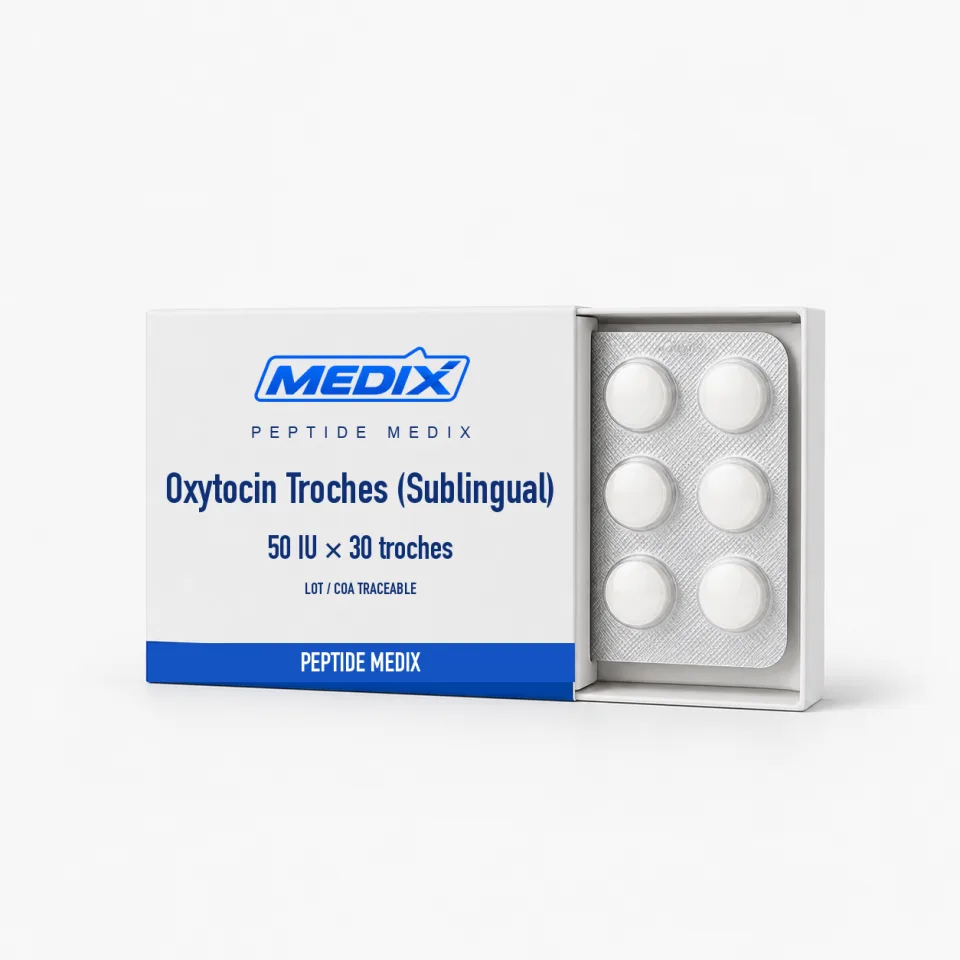
Peptides taken orally are largely destroyed before they reach circulation: gastric acid denatures them, pancreatic and brush-border proteases cleave them, and whatever survives is subject to hepatic first-pass extraction. The floor of the mouth offers a different proposition — a thin, non-keratinised, highly vascular epithelium draining directly into the jugular circulation. Research into buccal peptide delivery has focused on whether formulation can hold material against that surface long enough for meaningful absorption to occur.
Formulation variables in troche research
- Dissolution and erosion profile of the base under simulated salivary conditions
- Peptide content uniformity across a manufacturing lot
- Hardness, friability and moisture content, which drive both dissolution and stability
- Solid-state stability of a disulfide-containing peptide within an excipient matrix
Oxytocin pharmacology in brief
The peptide itself acts at the oxytocin receptor, a Gq-coupled class A GPCR expressed peripherally on uterine and mammary smooth muscle and centrally in limbic and reward-related regions. The behavioural literature — social recognition, affiliative behaviour, stress reactivity — is drawn largely from animal models and from human intranasal work whose methodology remains under active discussion. Route of delivery changes exposure, not receptor identity.
Stability in a solid matrix
Solid-state formulation generally protects peptides better than aqueous solution, but oxytocin's disulfide bridge remains vulnerable to reduction and disulfide scrambling, and moisture uptake by the troche base can accelerate deamidation of its asparagine and glutamine residues. Cool, dry, light-protected storage is therefore the operative control, and content should be re-verified analytically if packs are held for extended periods.