Research Overview
Design and structure–activity origins
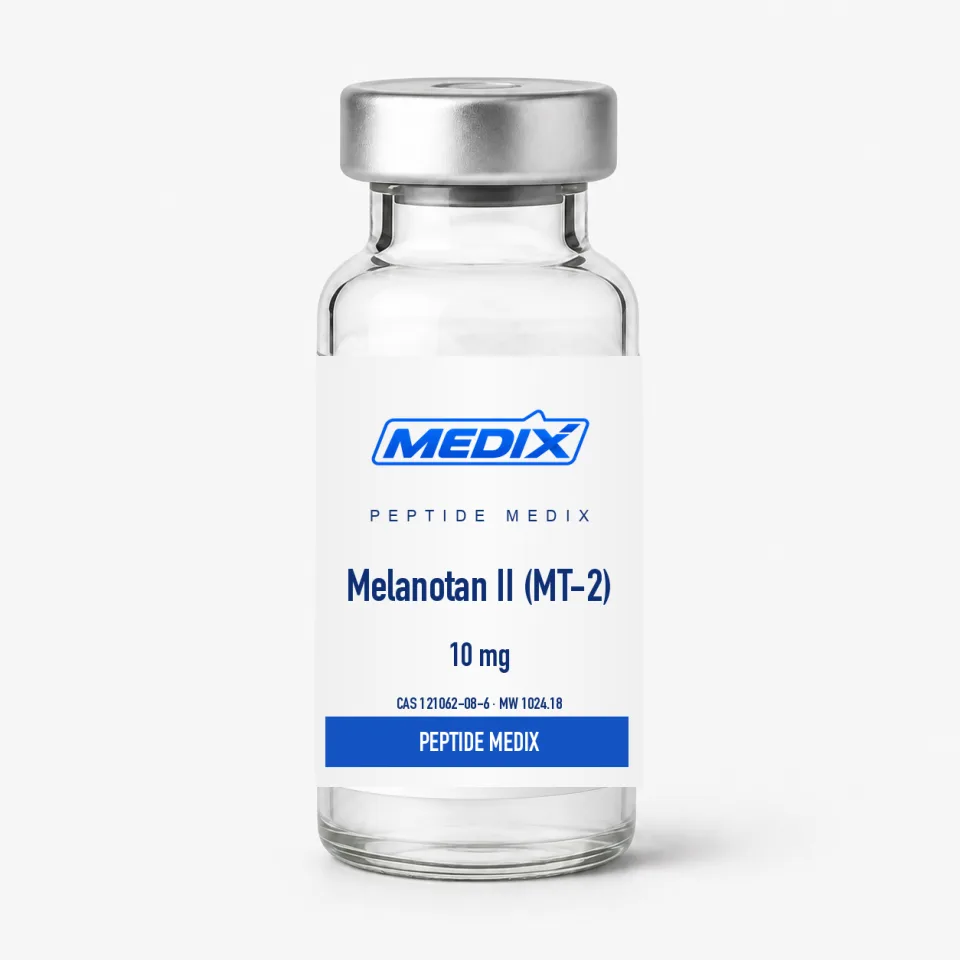
Melanotan II came out of systematic efforts to stabilise α-MSH, a linear tridecapeptide with a very short half-life. Truncating to the core message sequence, substituting D-Phe for L-Phe at the critical position, replacing methionine with norleucine to remove an oxidation site, and closing a lactam bridge between Asp and Lys produced a molecule with dramatically improved potency and stability. Melanotan II is still routinely cited as the benchmark superpotent α-MSH analogue in structure–activity papers.
Pigmentation and MC1R work
MC1R on melanocytes couples to adenylate cyclase; agonism raises intracellular cAMP and upregulates tyrosinase, the rate-limiting enzyme of eumelanin synthesis. Cell-culture and animal studies have used Melanotan II to probe that cascade, including work on how melanin content relates to UV response. Reported effects in the literature also include darkening of existing naevi in human studies, which is one reason melanocortin analogues are discussed in dermatology risk literature rather than presented as cosmetic agents.
Central melanocortin research
Through MC3R and MC4R, Melanotan II has been used extensively in feeding-behaviour models. Rodent studies report reduced food intake and altered energy expenditure after central melanocortin agonism, findings that helped establish MC4R as a target in obesity pharmacology. Arousal-pathway studies overlap heavily with the PT-141 literature, since PT-141 is the deaminated metabolite of this compound.
- MC4R agonism and hypothalamic feeding circuits
- Melanocortin contributions to thermoregulation and energy expenditure
- Receptor subtype selectivity comparisons against selective analogues
Analytical and stability notes
The cyclic scaffold resists proteolysis well, but the tryptophan residue remains oxidation-sensitive and the peptide can adsorb to plastic at dilute concentrations. Investigators generally confirm mass by MS, purity by reverse-phase HPLC against the COA, and prepare fresh working dilutions in low-binding tubes rather than storing very dilute stocks.