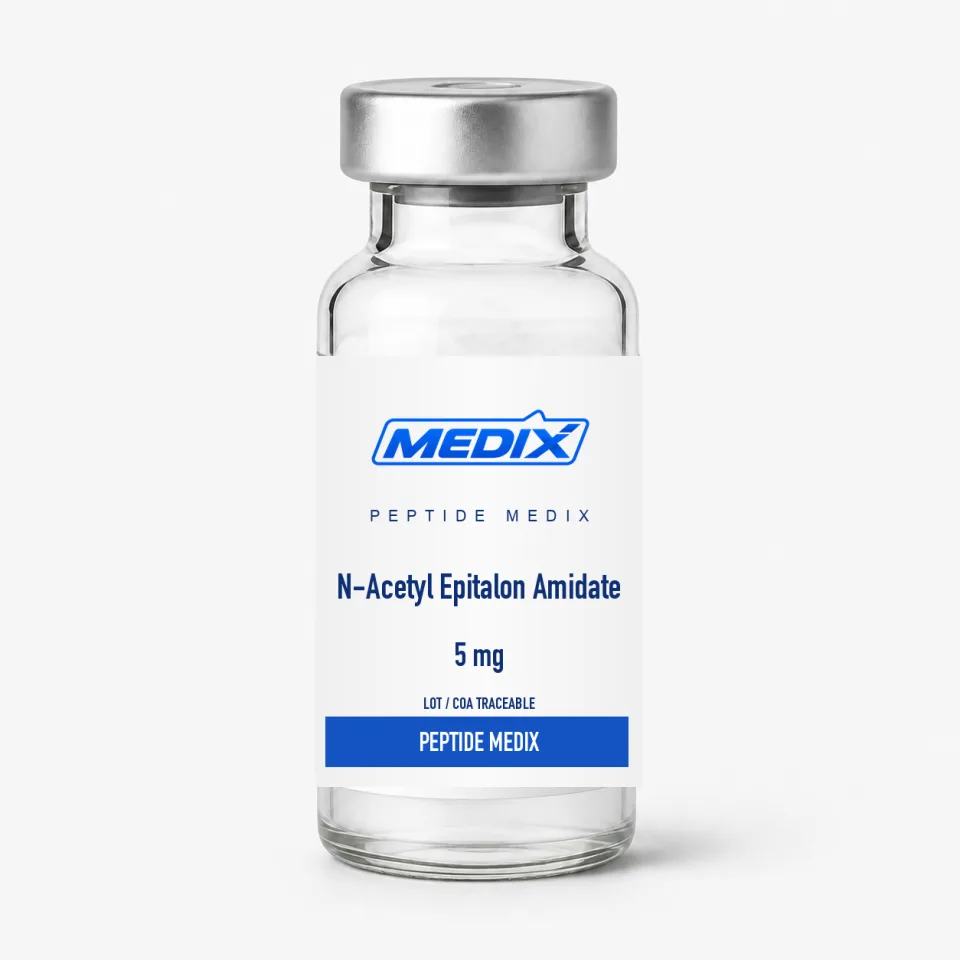
Peptide Medix product catalog

Peptide Medix

N-Acetyl Epitalon Amidate

Terminally protected epitalon analog: Ac-Ala-Glu-Asp-Gly-NH2 research vials

Review catalog details Secure payments
Available to order · 2 of 2 options available
$55.00 $65.00 15% OFF

Choose an option

1
Categories: n-acetyl epitalon amidate , epitalon analog , aedg peptide

Choose your delivery method

Standard Shipping is automatically selected at checkout. Customers can upgrade to a faster delivery option anytime.

Overview

N-Acetyl Epitalon Amidate is a chemically protected version of epitalon, the Ala-Glu-Asp-Gly tetrapeptide first developed as a synthetic analogue of the pineal preparation epithalamin. Two modifications are made to the parent sequence and neither changes the residue order: an acetyl group caps the free N-terminal amine, and the C-terminal carboxyl is converted to a primary amide, giving Ac-Ala-Glu-Asp-Gly-NH2.

Both changes are standard medicinal-chemistry protection strategies. Free termini are the preferred substrates of aminopeptidases and carboxypeptidases, so capping them removes the most accessible points of enzymatic attack. Blocking the charged termini also alters the net charge and polarity of an already very small, highly hydrophilic peptide, which is why terminally protected analogues appear in permeability and mucosal-transit experiments as well as in straightforward stability work.

Specifications

Brand Peptide Medix
Category Telomere & Senolytic Peptides
Form Lyophilized white to off-white powder in a sealed glass vial
Purity ≥99% by HPLC; lot-matched COA available
Available sizes 5 mg, 10 mg
Amino acid sequence Ac-Ala-Glu-Asp-Gly-NH2
Molecular formula C16H25N5O9
Molecular weight ≈431.4 g/mol
Parent peptide Epitalon (epithalon, AEDG), CAS 307297-39-8, 390.35 g/mol
Modifications N-terminal acetyl cap; C-terminal carboxyl converted to a primary amide
Peptide class Terminally protected synthetic bioregulator tetrapeptide
Synthesis Solid-phase peptide synthesis with preparative reversed-phase HPLC purification
Research areas Peptide stability and degradation kinetics, telomerase and senescence models, circadian and pineal signalling
Solubility Readily soluble in sterile or bacteriostatic water
Storage (lyophilized) −20 °C, sealed and protected from light and moisture
Storage (reconstituted) 2–8 °C; aliquot to avoid repeated freeze-thaw cycles
SKU N-ACETYL-EPITALON-AMIDATE-5-MG

Highlights

  • Terminally protected epitalon analog with the sequence Ac-Ala-Glu-Asp-Gly-NH2
  • N-terminal acetyl cap and C-terminal primary amide shield both exopeptidase entry points
  • Same AEDG residue order as the parent tetrapeptide — no sequence change
  • Supplied as lyophilized powder in sealed 5 mg and 10 mg glass vials
  • ≥99% purity by HPLC with a lot-matched certificate of analysis
  • Chosen for stability, degradation-kinetics and delivery-route research questions
  • Filled and shipped from a United States facility

What's Included

  • The vial option and size selected above
  • Final item and quantity confirmed in cart
  • Laboratory-research-use labeling

Research Overview

What the modifications do

Acetylation and amidation are the two most common terminal protections applied to short synthetic peptides. Aminopeptidases require a free α-amino group and carboxypeptidases a free α-carboxyl, so capping each terminus removes their recognition points. In serum-stability assays this typically extends measured half-life relative to the unprotected sequence, although the magnitude of the difference depends heavily on the assay matrix, temperature and the proteases present.

The parent peptide's research record

Why researchers pick a protected analogue

  • Comparative degradation kinetics against the unprotected tetrapeptide in plasma or homogenate
  • Formulation shelf-life studies where hydrolysis at the termini is the failure mode
  • Permeation work, since removing terminal charges changes polarity and partitioning
  • Long-incubation cell assays where parent-peptide loss confounds the readout

Interpreting comparative data

A protected analogue is not automatically more active. Terminal groups can contribute to receptor or target engagement, so greater metabolic stability sometimes comes with reduced intrinsic potency. The standard design therefore runs both peptides in the same experiment, measuring intact-peptide concentration by LC-MS alongside the functional endpoint, so that stability and activity can be separated rather than inferred from a single result.

Analytical characterisation

Identity is confirmed by mass spectrometry, where the acetyl and amide groups shift the observed mass predictably relative to epitalon, and purity by reversed-phase HPLC. Because both modifications are small, high-resolution methods are needed to resolve partially modified species from fully protected material.
Handling & Storage

Bring the sealed vial to room temperature before opening so condensation does not settle on the cake. Reconstitute by directing the diluent stream down the vial wall rather than onto the powder, then swirl gently; do not shake, as foaming drives interfacial degradation. Small tetrapeptides dissolve quickly and the solution should be clear and colourless. Aliquot into low-binding tubes for freezer storage rather than freeze-thawing the stock vial repeatedly, and keep solutions protected from light. Record lot number, diluent, concentration and reconstitution date on the vial. Handle under your laboratory's chemical hygiene plan; research use only.

N-Acetyl Epitalon Amidate FAQ

How does this differ from standard epitalon?
The amino acid sequence is identical — Ala-Glu-Asp-Gly. The difference is chemical protection at both ends: an acetyl group on the N-terminus and a primary amide at the C-terminus. Those caps block exopeptidase attack, which is the reason laboratories choose this analogue for stability-oriented work.
Is the protected analogue more potent?
Not necessarily. Greater metabolic stability and greater intrinsic potency are separate properties, and terminal groups can participate in target binding. The only reliable way to compare is to run both peptides in the same assay with intact-peptide quantification alongside the functional readout.
What purity documentation is provided?
Each lot is released at ≥99% purity by reversed-phase HPLC with mass-spectrometric identity confirmation, and a lot-matched certificate of analysis is available. Keeping the COA with your experimental record preserves traceability between the material and the data generated with it.
What diluent should be used?
The peptide is highly hydrophilic and dissolves readily in sterile or bacteriostatic water; aqueous buffers also work for cell-culture applications. Choose the diluent that matches your assay chemistry, and note that benzyl alcohol in bacteriostatic water is unsuitable for some cell-based systems.
How should reconstituted material be stored?
Refrigerate at 2–8 °C for short working periods and aliquot at −20 °C or below for longer holds. Repeated freeze-thaw cycles and prolonged room-temperature standing are the main causes of measured potency drift in small peptides, so single-use aliquots are preferable.

This catalog listing is for laboratory research use only. It is not represented as a drug, food, supplement, cosmetic or diagnostic product, and it is not offered for human or veterinary use.

Customer Reviews

0 reviews
5 star
0%
4 star
0%
3 star
0%
2 star
0%
1 star
0%

Leave Your Review

Rating

No reviews yet — be the first!

Leave Your Review

Rating

Keep exploring

Related Products & Shopping Guides

Compare N-Acetyl Epitalon Amidate with relevant categories, product topics, and practical shopping information.

Often researched together

Related research peptides, blends and lab supplies frequently ordered with N-Acetyl Epitalon Amidate.

15% OFF
Epitalon (Epithalon)

Peptide Medix

Epitalon (Epithalon)

epitalon

4 options

$63.00 $75.00

View options and product details

15% OFF
Pinealon

Peptide Medix

Pinealon

pinealon
$63.00 $75.00

View options and product details

15% OFF
Epitalon Capsules

Peptide Medix

Epitalon Capsules

epitalon capsules
$68.00 $80.00

View options and product details

15% OFF
PNC-27

Peptide Medix

PNC-27

pnc-27

2 options

$97.00 $115.00

View options and product details

15% OFF
FOXO4-DRI

Peptide Medix

FOXO4-DRI

foxo4-dri
$182.00 $215.00

View options and product details