Peptide Medix product catalog

Peptide Medix

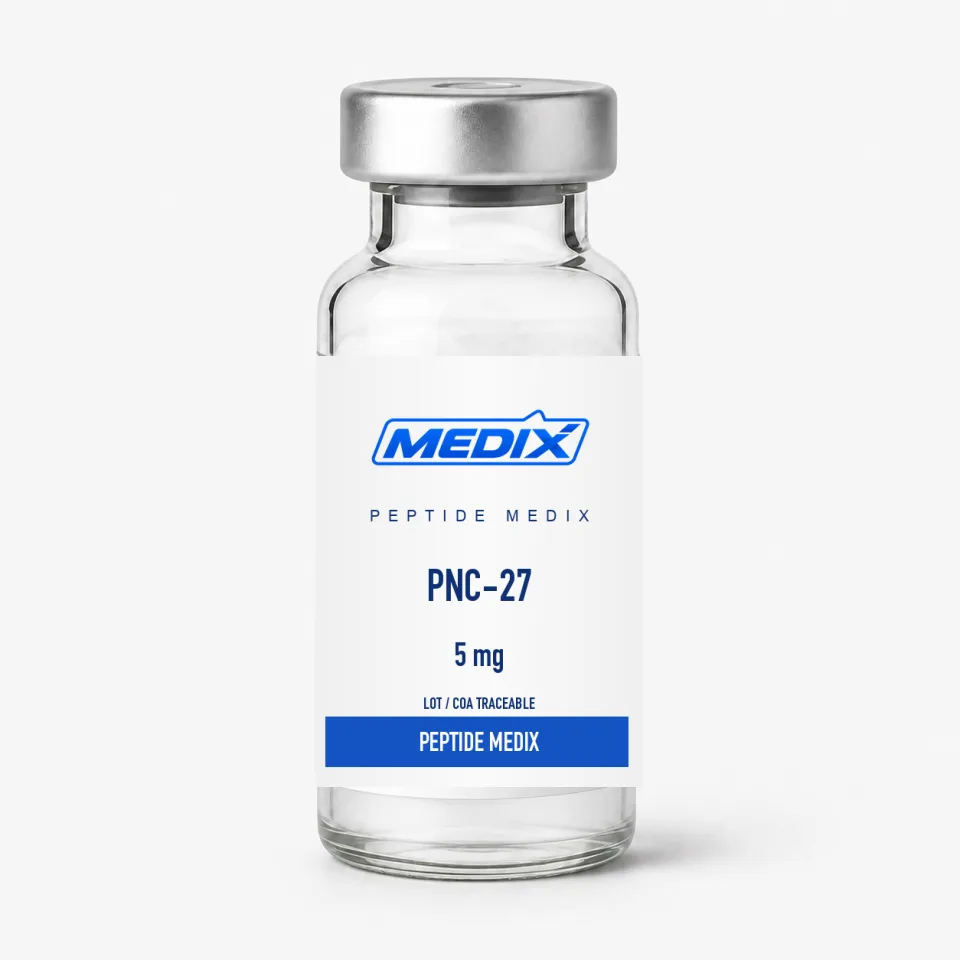
PNC-27

32-residue p53-derived chimeric peptide with a membrane-resident domain

Review catalog details Secure payments
Available to order · 2 of 2 options available
$97.00 $115.00 15% OFF

Choose an option

1
Categories: pnc-27 , p53 peptide , hdm-2

Choose your delivery method

Standard Shipping is automatically selected at checkout. Customers can upgrade to a faster delivery option anytime.

Overview

PNC-27 is a synthetic 32-amino-acid chimeric peptide assembled from two functional halves. The N-terminal segment reproduces residues 12–26 of the human p53 tumour-suppressor protein — the stretch that contacts the HDM-2 (human MDM2) oncoprotein — while the C-terminal segment is a membrane-resident peptide (MRP) derived from the leader sequence of HIV-1 gp41. Joining the two produces a molecule designed to be delivered into and held within a lipid bilayer while presenting the p53 recognition motif.

The peptide came out of work by Pincus, Michl and colleagues, who were probing how the p53–HDM-2 interaction behaves when it is forced to occur at a membrane rather than in the nucleus. Reports from that programme describe HDM-2 being detectable in the plasma membrane of transformed cell lines but not in the corresponding untransformed lines, and PNC-27 has been used as a probe for that difference in cell-culture systems.

Specifications

Brand Peptide Medix
Category Telomere & Senolytic Peptides
Form Lyophilized powder, sealed glass vial with flip-off seal
Purity ≥99% by HPLC; lot-matched COA available
Available sizes 5 mg, 10 mg
Chain length 32 amino acids (chimeric construct)
Amino acid sequence Pro-Pro-Leu-Ser-Gln-Glu-Thr-Phe-Ser-Asp-Leu-Trp-Lys-Leu-Leu-Lys-Lys-Trp-Lys-Met-Arg-Arg-Asn-Gln-Phe-Trp-Val-Lys-Val-Gln-Arg-Gly
Domain 1 p53 residues 12–26 — the HDM-2 binding region
Domain 2 Membrane-resident peptide (MRP) from the HIV-1 gp41 leader sequence
Peptide class Chimeric p53-derived membrane-active research peptide
Molecular target studied HDM-2 (human MDM2), including membrane-associated pools
Related analogue PNC-28, which uses p53 residues 17–26 with the same MRP
Research areas p53–HDM-2 interaction, membrane pore formation, necrosis versus apoptosis in transformed cell lines
Solubility Sterile or bacteriostatic water; dilute aqueous buffers for assay work
Storage (lyophilized) −20 °C, sealed and protected from light and moisture
Storage (reconstituted) 2–8 °C, protected from light; use within the study window
SKU PNC-27-5-MG

Highlights

  • 32-residue chimeric peptide: p53 residues 12–26 fused to a gp41-derived membrane-resident peptide
  • Third-party HPLC tested to ≥99% purity with a lot-matched COA for the batch shipped
  • Supplied as lyophilized powder in sealed 5 mg and 10 mg glass vials
  • Used as a probe for membrane-associated HDM-2 in cell-culture comparisons
  • Research context: p53–HDM-2 recognition, membrane permeabilisation, apoptosis-independent cell death models
  • Soluble in sterile or bacteriostatic water; dilute buffers used where assay pH matters
  • Stored and shipped cold from a US facility with insulated packaging

What's Included

  • The vial option and size selected above
  • Final item and quantity confirmed in cart
  • Laboratory-research-use labeling

Research Overview

Design rationale

p53 signals growth arrest and cell death, and HDM-2 restrains it by binding the p53 transactivation domain and marking p53 for degradation. Peptides copying the p53 12–26 region compete for that interface in vitro, but on their own they are poorly membrane permeant. PNC-27 addresses that by appending a membrane-resident peptide from the gp41 leader sequence, giving a construct that partitions into lipid bilayers while still displaying the p53 motif.

What has been examined in cell culture

Published work from the originating groups reports that PNC-27 causes rapid membrane disruption and non-apoptotic cell death in a range of cancer-derived cell lines, and that untransformed control lines were markedly less affected under the same conditions. Those reports associate the selectivity with detection of HDM-2 in the plasma membrane of the transformed lines. Independent replication is limited, mechanistic interpretation remains debated, and the observations are confined to laboratory systems.

Membrane biophysics

  • Liposome and model-membrane studies have been used to ask whether PNC-27 forms discrete transmembrane pores or acts as a general lytic agent.
  • Leakage assays, electron microscopy and lactate dehydrogenase release have been reported as readouts of membrane integrity.
  • Comparisons against scrambled or MRP-only control peptides are standard, since the MRP itself is surface active.

Typical experimental controls

Because the construct is amphipathic and membrane active, careful design matters: investigators generally include a scrambled-sequence peptide, an MRP-only peptide, a non-transformed cell line, and a viability method that distinguishes membrane lysis from apoptotic signalling. HDM-2 surface expression is often measured directly rather than assumed.
Status of the evidence

Handling & Storage

Keep vials at −20 °C, sealed and protected from light and moisture, and allow them to reach room temperature before opening so that condensation does not enter the powder. Reconstitute by directing sterile or bacteriostatic water slowly down the inner wall of the vial and letting the cake dissolve; do not shake, since this amphipathic sequence foams readily and foam traps peptide at the air–liquid interface. Because the construct is membrane active, avoid contact with skin and eyes, use gloves and eye protection, and prepare working dilutions in a designated area. Store reconstituted solution at 2–8 °C, record the lot and reconstitution date, and dispose of residues under your institution's chemical waste procedure.

PNC-27 FAQ

What exactly is PNC-27 made of?
It is a single 32-residue chain combining two segments: p53 residues 12–26, which form the HDM-2 binding motif, and a membrane-resident peptide taken from the HIV-1 gp41 leader sequence. The MRP half anchors the construct in lipid bilayers so the p53 motif is presented at the membrane.
How does PNC-27 differ from PNC-28?
They share the same membrane-resident peptide but carry different p53 fragments — PNC-27 uses residues 12–26 and PNC-28 the shorter 17–26 region. Both are used in the same class of experiments, and researchers often run them side by side to test how much of the p53 segment is required.
Is PNC-27 third-party tested, and is a COA available?
Yes. Every lot is third-party analysed by HPLC to confirm ≥99% purity along with identity testing, and a lot-matched Certificate of Analysis is available for the batch you receive. Check that the lot number on the vial matches the COA before recording any data.
How should it be stored and reconstituted?
Store the lyophilized powder at −20 °C away from light and moisture. Reconstitute gently with sterile or bacteriostatic water down the vial wall without shaking, then hold the solution at 2–8 °C and use it within your validated study window.
Does PNC-27 kill cancer cells?
Published cell-culture reports describe rapid membrane disruption and non-apoptotic death in several cancer-derived lines, with less effect on untransformed controls. That is a laboratory observation in specific systems, not a demonstrated therapy, and independent confirmation remains limited.

This catalog listing is for laboratory research use only. It is not represented as a drug, food, supplement, cosmetic or diagnostic product, and it is not offered for human or veterinary use.

Customer Reviews

0 reviews
5 star
0%
4 star
0%
3 star
0%
2 star
0%
1 star
0%

Leave Your Review

Rating

No reviews yet — be the first!

Leave Your Review

Rating

Keep exploring

Related Products & Shopping Guides

Compare PNC-27 with relevant categories, product topics, and practical shopping information.

Often researched together

Related research peptides, blends and lab supplies frequently ordered with PNC-27.

15% OFF
FOXO4-DRI

Peptide Medix

FOXO4-DRI

foxo4-dri
$182.00 $215.00

View options and product details

15% OFF
Epitalon (Epithalon)

Peptide Medix

Epitalon (Epithalon)

epitalon

4 options

$63.00 $75.00

View options and product details

15% OFF
SS-31 (Elamipretide)

Peptide Medix

SS-31 (Elamipretide)

ss-31

3 options

$72.00 $85.00

View options and product details

15% OFF
N-Acetyl Epitalon Amidate

Peptide Medix

N-Acetyl Epitalon Amidate

n-acetyl epitalon amidate

2 options

$55.00 $65.00

View options and product details

15% OFF
Epitalon Capsules

Peptide Medix

Epitalon Capsules

epitalon capsules
$68.00 $80.00

View options and product details

15% OFF
NAD+

Peptide Medix

NAD+

nad+

4 options

$38.00 $45.00

View options and product details