Research Overview
Design of the molecule
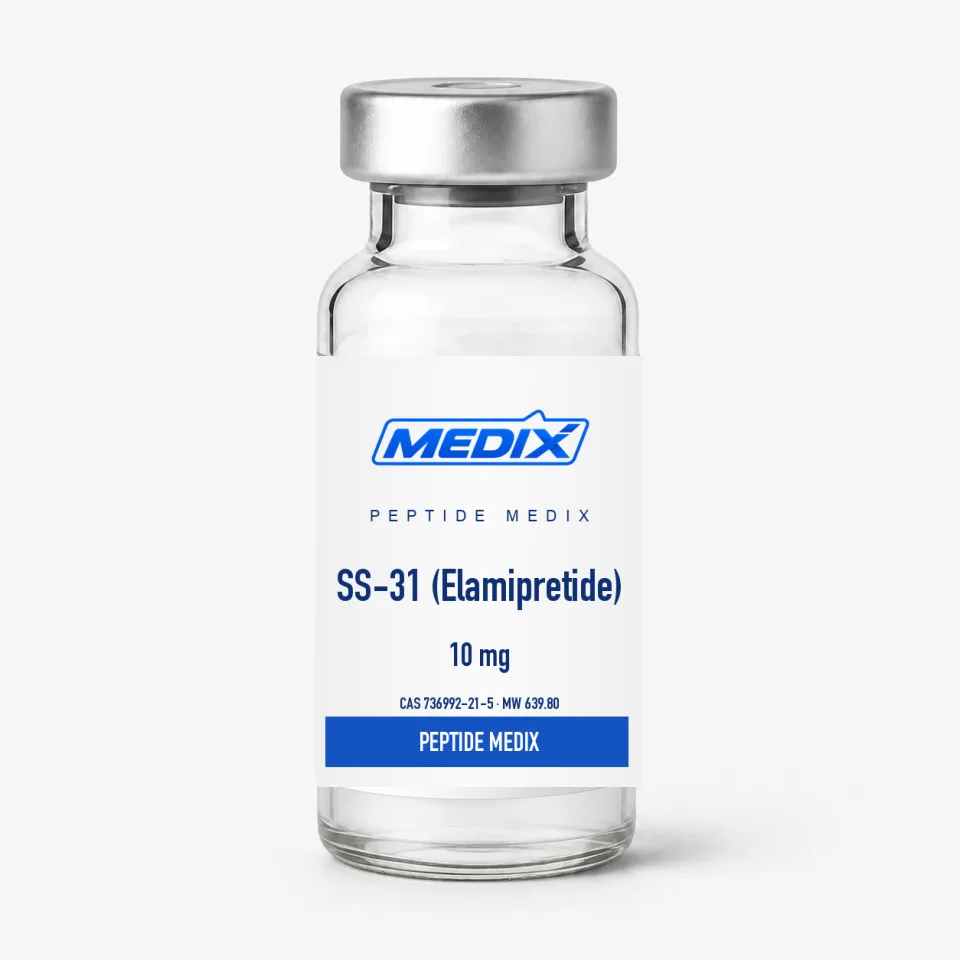
The Szeto–Schiller series was developed around an alternating aromatic–cationic motif that carries a net positive charge at physiological pH. Substituting D-arginine at position one and dimethyltyrosine at position two produces a peptide that resists aminopeptidase degradation while retaining the charge distribution thought to drive membrane association. At 639.80 g/mol it is one of the smallest peptides in routine mitochondrial research use.
Cardiolipin and membrane studies
Reported mechanisms in the peer-reviewed literature include:
- Selective association with cardiolipin in the inner mitochondrial membrane, independent of membrane potential
- Effects on cristae curvature and membrane packing observed by electron microscopy in isolated mitochondria
- Modulation of cytochrome c peroxidase activity when cytochrome c is complexed with cardiolipin
- Reduced mitochondrial reactive oxygen species output in stressed preparations
Analytical and stability notes
The peptide is highly water-soluble and stable in solution relative to longer sequences, but the free tyrosine-like Dmt residue is still light-sensitive. Purity is verified by reverse-phase HPLC and identity by ESI-MS against the expected 639.8 Da monoisotopic profile.
Because the tetrapeptide is small and highly soluble, it is often used as a positive control when benchmarking newer mitochondria-targeting chemotypes, and its behaviour in isolated mitochondria is well enough characterised that deviations usually point to a preparation problem rather than to biology. Investigators comparing lots typically confirm retention time and mass before pooling material across experiments.