Peptide Medix product catalog

Peptide Medix

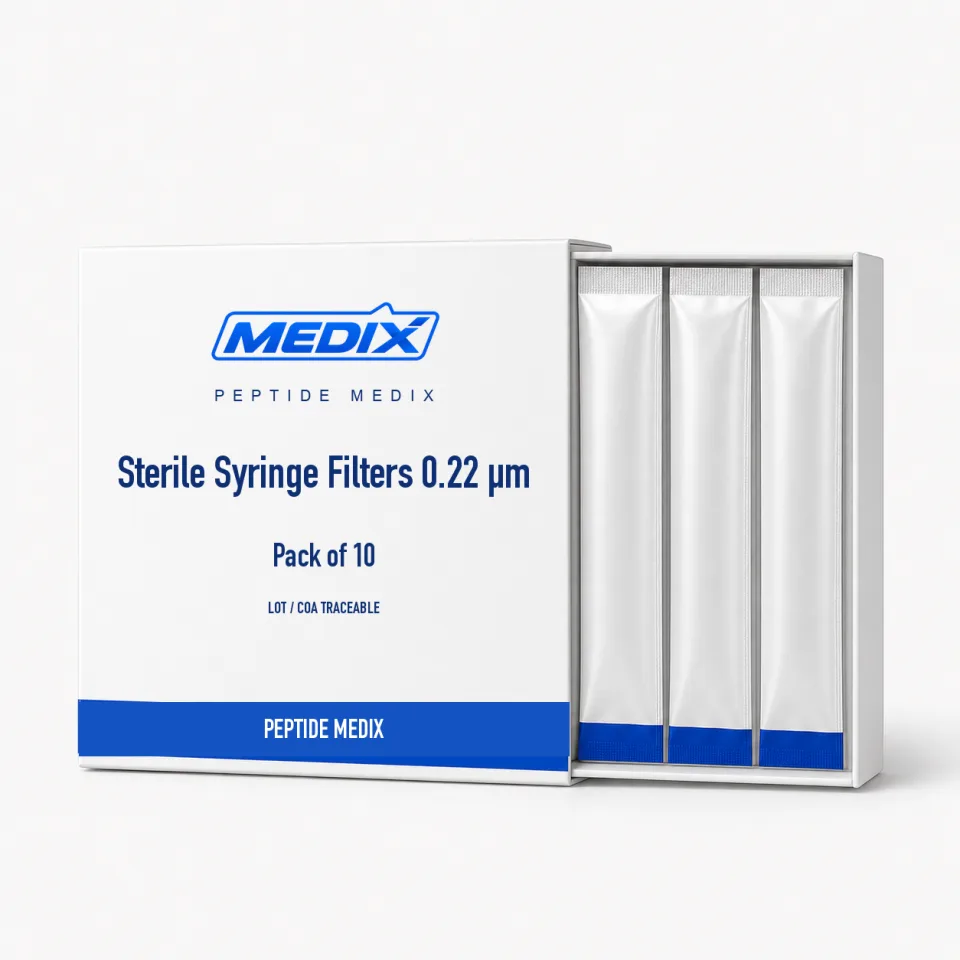
Sterile Syringe Filters 0.22 µm

0.22 µm PES membrane, luer-lock, individually sterile-packed filters

Review catalog details Secure payments
Available to order · 2 of 2 options available
$12.00 $15.00 15% OFF

Choose an option

1
Categories: syringe filters , 0.22 micron filter , sterile filtration

Choose your delivery method

Standard Shipping is automatically selected at checkout. Customers can upgrade to a faster delivery option anytime.

Overview

A syringe filter is the standard way to sterilise a small volume of solution that cannot be autoclaved. Heat destroys peptides, so filtration through a 0.22 µm membrane is the only practical route to a sterile peptide preparation in a general laboratory. These filters use a polyethersulfone membrane in a polypropylene housing with a female luer-lock inlet and male luer slip outlet, and each unit arrives individually wrapped and sterile.

The 0.22 µm rating is not arbitrary. It is the pore size conventionally accepted as sterilising-grade because it retains the small bacteria used as the industry challenge organism, notably Brevundimonas diminuta. A 0.45 µm filter clarifies a solution and removes particulates but is not considered sterilising, and neither rating removes viruses, mycoplasma or endotoxin — those require different technology entirely.

In peptide workflows these filters appear at two points: sterilising a reconstituted solution before it is transferred into a sealed vial for storage, and clarifying a solution that shows fine particulate or slight haze before analysis. Polyethersulfone is the usual membrane choice for both because it has low protein binding, which matters when the solute is present at low concentration and any adsorption to the membrane represents a real loss of material.

Specifications

Brand Peptide Medix
Category Syringes, Needles & Vials
Product type Single-use sterilising-grade syringe filter
Pore size 0.22 µm (sterilising grade)
Membrane material Polyethersulfone (PES), low protein binding, hydrophilic
Housing Polypropylene, ultrasonically welded, colour-coded
Filter diameter 25 mm
Inlet connection Female luer-lock
Outlet connection Male luer slip
Typical hold-up volume Under about 100 µL for a 25 mm device
Recommended sample volume Up to roughly 100 mL per filter, depending on particulate load
Sterility Sterile as supplied, individually wrapped
Pack sizes Pack of 10; pack of 50
Chemical compatibility Aqueous solutions, buffers and dilute alcohols; not intended for strong organic solvents
Storage Room temperature, dry, in the sealed wrapper until use
Reuse Single use only — do not autoclave, rinse or re-sterilise
SKU SYRINGE-FILTERS-PACK-OF-10

Highlights

  • 0.22 µm sterilising-grade rating, the standard for heat-sensitive solutions
  • Polyethersulfone membrane — low protein binding, minimal peptide loss
  • Female luer-lock inlet and male luer slip outlet fit standard syringes
  • Individually wrapped and sterile; single use, no rinsing or reuse
  • Packs of 10 and 50
  • Used to sterilise reconstituted peptide solutions that cannot be autoclaved
  • Also used to clarify solutions showing fine particulate before analysis

What's Included

  • Selected pack size, sealed and boxed
  • Final item and quantity confirmed in cart

Research Overview

Why 0.22 µm is the sterilising rating

Why membrane choice matters for peptides

Adsorption is the practical risk in filtering a dilute peptide solution. Membranes differ substantially in how much solute they bind, and a high-binding membrane can remove a meaningful fraction of a low-concentration sample before it ever reaches the receiving vessel. Polyethersulfone is favoured in protein and peptide work for its low binding and good flow characteristics. Nylon and some cellulose membranes bind more protein and are better suited to different applications.

Where filtration fits a peptide workflow

  • Sterilising a reconstituted solution before transfer into a sterile empty vial for storage
  • Filtering buffers and diluents prepared in-house before they contact study material
  • Preparing cell culture media additions that cannot be autoclaved

Limits worth stating

Filtration sterilises; it does not purify. The filter removes particulate and microorganisms above its rating and nothing else — degraded peptide, dissolved impurities and endotoxin all pass straight through. Filtering also cannot rescue a solution that has already been microbially contaminated, because the metabolic products and endotoxin left behind remain. It is a step for maintaining the quality of an already-sound preparation, not a corrective measure.
Handling & Storage

Open the wrapper only at the point of use and keep the connections untouched. Draw the solution into a syringe, attach the filter to the luer-lock inlet, expel headspace air, then push slowly and steadily — high pressure risks deforming the membrane or dislodging the housing seal. Discard the first few drops if hold-up volume matters to your quantitation, and remember that a 25 mm device retains a small dead volume, which is significant when the total sample is only a millilitre or two. If flow becomes hard, stop and use a second filter rather than forcing it: resistance means the membrane is loading. Use each filter once, then dispose of it; never autoclave, rinse or reuse.

Sterile Syringe Filters 0.22 µm FAQ

Why filter a peptide solution instead of autoclaving it?
Autoclaving uses steam at 121 °C, which denatures and degrades peptides. Filtration through a 0.22 µm membrane achieves sterilisation at ambient temperature without chemically altering the solute, which makes it the standard route for heat-sensitive solutions in a general laboratory.
What is the difference between 0.22 µm and 0.45 µm?
0.22 µm is the accepted sterilising-grade rating because it retains the small bacteria used as the standard challenge organism. 0.45 µm clarifies a solution and removes visible particulate but is not sterilising. Use 0.22 µm whenever a sterile output is the goal.
Will filtering remove endotoxin?
No. Endotoxin is a lipopolysaccharide fragment far smaller than the pore size and passes straight through, as do viruses and mycoplasma. A filter maintains the microbiological quality of a sound preparation; it cannot repair one that has already been contaminated.
How much peptide is lost to the membrane?
Polyethersulfone is chosen precisely because it binds protein and peptide poorly, so losses are typically small. They are not zero, though, and they matter most at low concentrations and small volumes. Where quantitation is critical, measure concentration after filtration rather than before.
Can a filter be reused if only a small volume passed through?
No. These are single-use sterile devices. Once the wrapper is opened and solution has passed through, sterility of the flow path can no longer be assured, and the membrane may carry retained material. Do not autoclave, rinse or re-sterilise them.
What size syringe should be used with them?
Any standard syringe with a male luer-lock tip fits the inlet. A 25 mm filter suits volumes up to roughly 100 mL depending on particulate load, so 5 mL to 20 mL syringes are the usual pairing. Push slowly and steadily rather than forcing flow.

This catalog listing is for laboratory research use only. It is not represented as a drug, food, supplement, cosmetic or diagnostic product, and it is not offered for human or veterinary use.

Customer Reviews

0 reviews
5 star
0%
4 star
0%
3 star
0%
2 star
0%
1 star
0%

Leave Your Review

Rating

No reviews yet — be the first!

Leave Your Review

Rating

Keep exploring

Related Products & Shopping Guides

Compare Sterile Syringe Filters 0.22 µm with relevant categories, product topics, and practical shopping information.

Often researched together

Related research peptides, blends and lab supplies frequently ordered with Sterile Syringe Filters 0.22 µm.

15% OFF
Bacteriostatic Water

Peptide Medix

Bacteriostatic Water

bacteriostatic water

3 options

$12.00 $15.00

View options and product details

15% OFF
Sterile Empty Vials

Peptide Medix

Sterile Empty Vials

sterile empty vials

2 options

$17.00 $20.00

View options and product details

15% OFF
Alcohol Prep Pads

Peptide Medix

Alcohol Prep Pads

alcohol prep pads

2 options

$8.00 $10.00

View options and product details

15% OFF
Luer-Lock Syringes 3 mL

Peptide Medix

Luer-Lock Syringes 3 mL

luer-lock syringes

2 options

$8.00 $10.00

View options and product details