Research Overview
Why laboratories aliquot
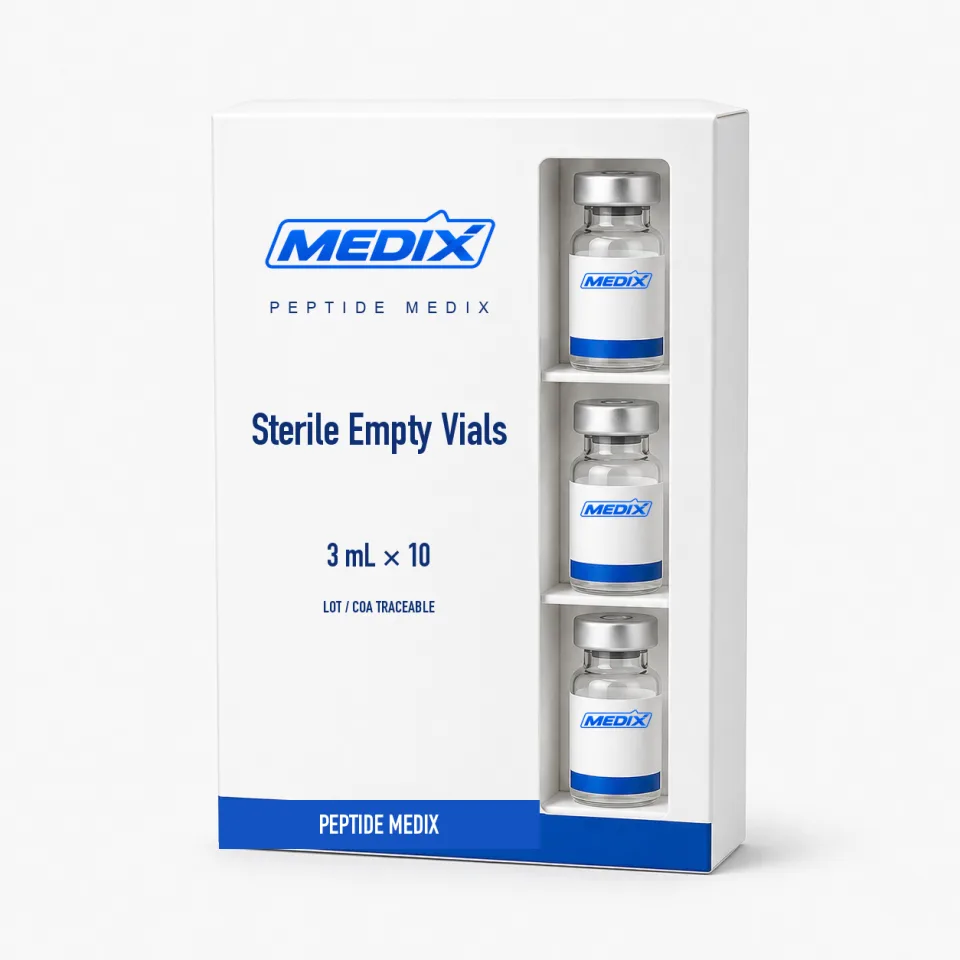
A reconstituted peptide vial is only as clean as its last needle entry. Every puncture introduces a small risk of contamination and, for peptides that are sensitive to temperature cycling, every trip out of the refrigerator or freezer contributes to degradation. Splitting a stock solution into aliquots in sterile empty vials limits both effects: each aliquot is entered only a few times, and unused aliquots stay sealed and cold until needed. Aliquoting is also the standard way to store frozen portions of a peptide that would otherwise be lost if a single vial were repeatedly thawed.
Vial construction
- Glass body: clear borosilicate glass is chemically inert toward aqueous peptide solutions and allows contents to be inspected for clarity, color and particulates.
- Stopper: a resealing rubber stopper accepts fine-gauge needles many times without leaking, and can be swabbed with alcohol before each entry.
- Flip-off cap: the crimped aluminum cap keeps the stopper sterile until first use; the plastic center is removed once and the aluminum ring stays in place.
Filling and labeling
Choosing a size
The 3 mL vial is the workhorse for aliquots of a few hundred microliters to 2 mL and matches the footprint of most peptide vials in the catalog. The 10 mL vial suits dilution series, larger working solutions or holding a portion of bacteriostatic water for a single experiment. Both are compatible with standard vial racks and freezer boxes.