Research Overview
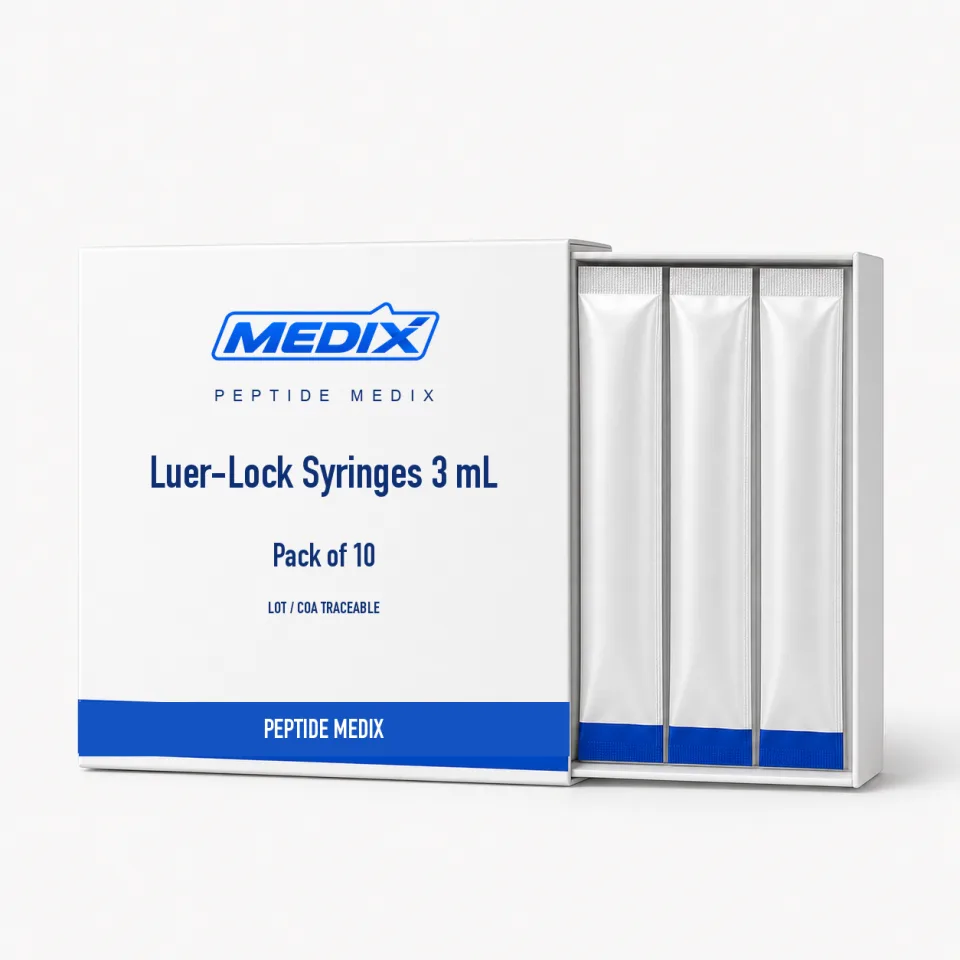
Why luer-lock rather than slip-tip
Both fittings share the same 6% tapered geometry, standardised so that any needle hub mates with any syringe tip. The difference is retention. A slip tip is held by friction between the taper surfaces; a luer-lock adds an outer threaded collar that screws over the hub flange and mechanically captures it. Under low back-pressure the two behave identically. Under high back-pressure — pushing through a fine membrane, a small-bore needle, or a viscous solution — a slip fitting can separate, and separation at pressure means an aerosolised spray of whatever was in the barrel.
Role in a reconstitution workflow
A typical lyophilized peptide preparation involves two distinct volume tasks that call for different syringes:
- Diluent transfer: draw 1–3 mL of bacteriostatic water and deliver it slowly down the wall of the peptide vial. A 3 mL barrel does this in one draw, and 0.1 mL graduations are ample precision for setting a target concentration
- Aliquot withdrawal: remove a small measured volume from the reconstituted vial. This needs 0.01 mL resolution, which is a 1 mL insulin-style syringe's job, not this one
Practical selection notes
Barrel size should be matched to the volume being measured. Accuracy on any syringe is poorest in the bottom fifth of its scale, so measuring 0.2 mL in a 3 mL barrel is a false economy when a 1 mL syringe is on the bench. Low dead space matters less on the diluent side than on the withdrawal side, since diluent left in the hub is simply diluent. For filtration work, check that the filter housing's inlet is luer-lock rather than luer-slip, as mismatched fittings will seat but not thread.
Sterility and single use
These syringes are sterile as packaged and intended for single use. The elastomer plunger seal is not designed to survive autoclaving, and reuse after any liquid contact risks both cross-contamination between preparations and carry-over that will confound analytical results. The wrapper should stay intact until the moment of use, and a damaged or previously opened blister should be discarded.