Research Overview
Where a 0.5 mL syringe fits
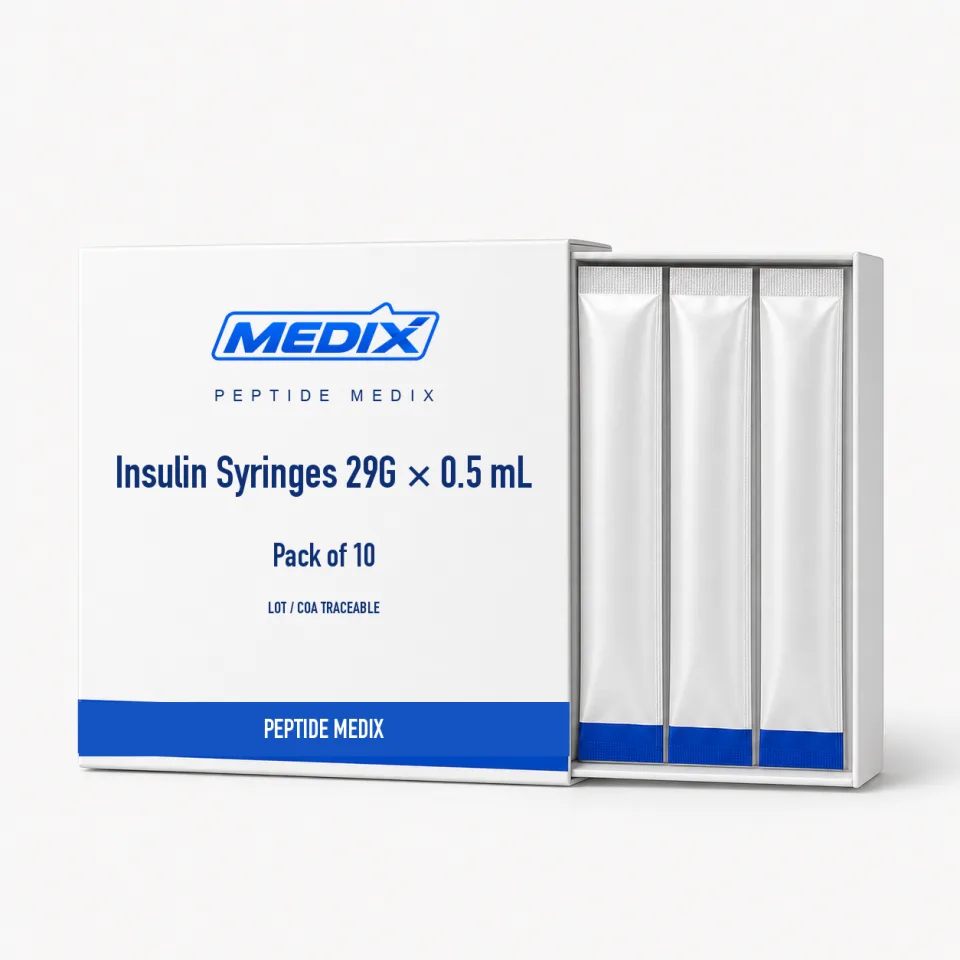
Reconstitution usually begins with a larger diluent volume, but much of the follow-on work in a peptide laboratory involves moving small, precisely measured amounts of solution: splitting a stock vial into aliquots, building a dilution series, or dispensing a defined volume into an assay vessel. A 0.5 mL barrel with 0.01 mL graduations spreads the scale over a shorter length, so each marking is farther apart and easier to read at a glance. That is the main reason many researchers keep this format alongside 1 mL syringes.
Understanding the specifications
- Gauge (29G): the needle has an outer diameter of about 0.33 mm — marginally wider than a 31G — which improves rigidity and eases the flow of more concentrated solutions.
- Length (1/2 in): the longer needle reaches the bottom of 3 mL and 10 mL vials without tilting, useful when drawing the last portion of a stock solution.
- Capacity (0.5 mL): ideal for transfers below half a milliliter; larger draws are better made with the 1 mL model.
Aliquoting and dilution workflows
Choosing between models
The 31G × 1 mL syringe is the more general tool for adding diluent to lyophilized vials. The 29G × 0.5 mL model is preferred for small, precise transfers and for solutions that flow slowly through a finer needle. Both are single-use, sterile and disposed of in the same sharps container.