Research Overview
Why insulin syringes are used in peptide reconstitution
Insulin-style syringes combine three properties that make them well suited to peptide laboratory work: a fine, permanently attached needle, a narrow barrel with fine graduations, and very little dead space between the plunger tip and the needle hub. Together these let a researcher measure fractions of a milliliter reproducibly and transfer solution with minimal loss, which matters when the peptide in a vial is measured in milligrams.
Understanding the specifications
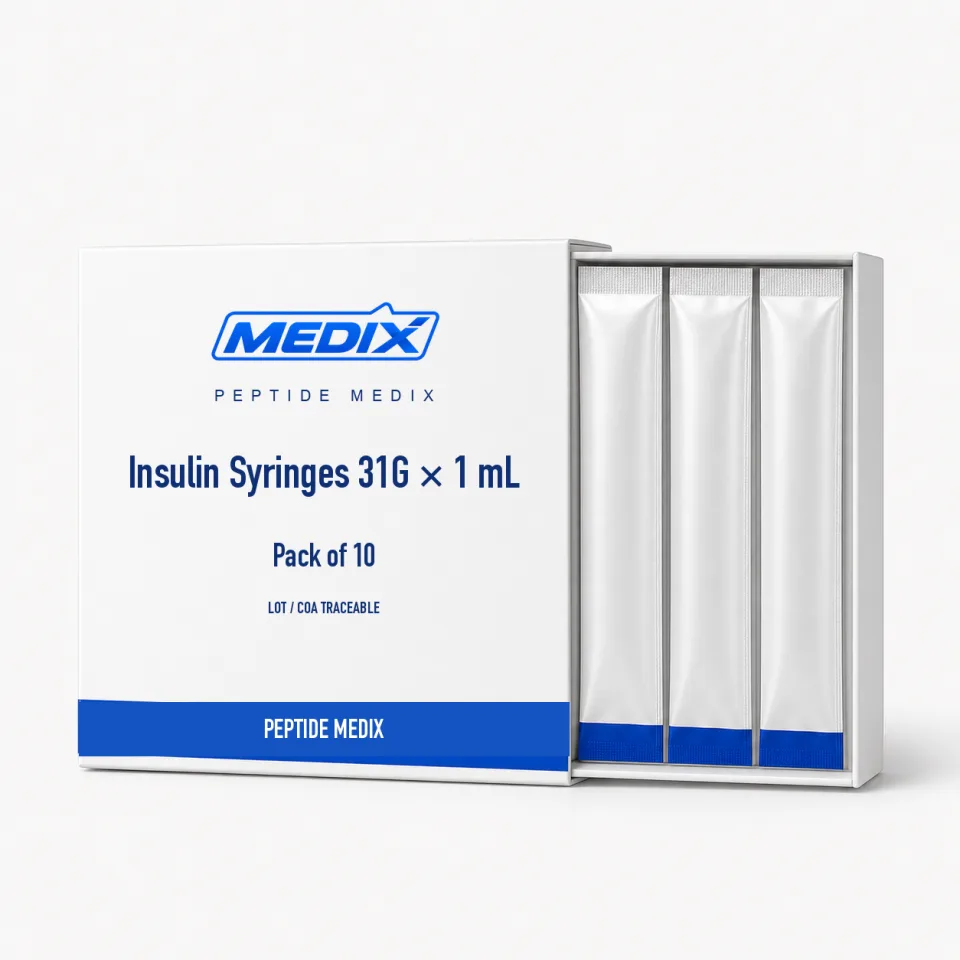
- Gauge (31G): higher gauge means a thinner needle. A 31G needle has an outer diameter of roughly 0.26 mm, small enough to pass through a rubber stopper many times without producing a leaking channel.
- Length (5/16 in): long enough to reach the contents of a standard 3 mL or 10 mL vial when the vial is inverted, short enough to stay rigid.
- Volume (1 mL) and graduations (0.01 mL): the whole barrel is used for reconstitution volumes of up to 1 mL per draw, and 1-unit markings make it straightforward to record exactly how much diluent was added.
Use in a reconstitution workflow
Choosing between 31G × 1 mL and 29G × 0.5 mL
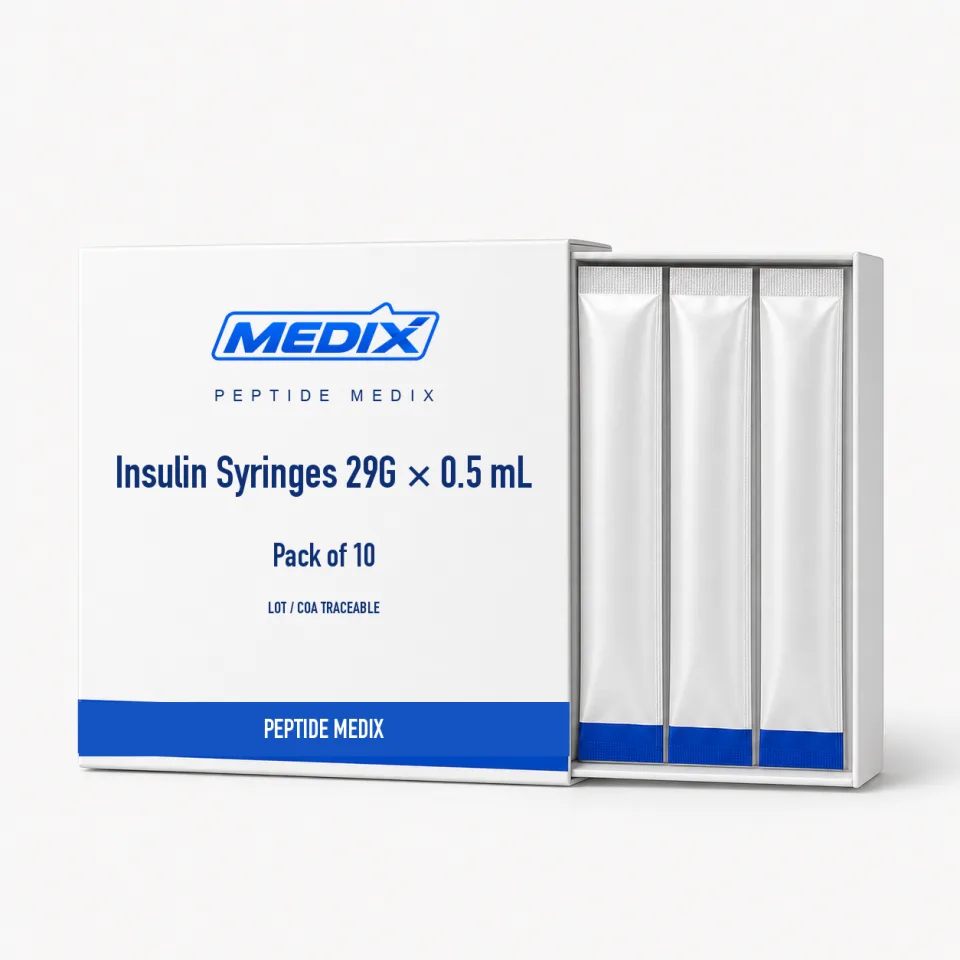
The 1 mL barrel is the more versatile choice for reconstitution because it draws larger diluent volumes in a single pass. The 0.5 mL 29G version, offered separately, has a slightly heavier needle and a scale spread over a shorter volume, which some researchers prefer for small transfers. Many benches keep both on hand.