Research Overview
Two-receptor potency profiling
The first characterization step in most laboratories is a side-by-side cyclic-AMP assay in cells expressing the human glucagon receptor and the human GLP-1 receptor. The resulting potency ratio defines how glucagon-weighted a given dual agonist is, and that ratio is what distinguishes molecules in this class from one another far more than raw potency does.
Hepatic and lipid endpoints
Energy balance in animal models
- Indirect calorimetry for oxygen consumption and respiratory exchange ratio
- Food intake, meal patterning and body-composition endpoints in rodents
- Brown and beige adipose tissue markers of thermogenic activation
Counter-regulatory questions
Because glucagon raises hepatic glucose output while GLP-1 promotes glucose-dependent insulin release, a central research question is how the two arms balance. Studies track glucose excursion, insulin and glucagon dynamics and hepatic enzyme markers to map that interaction across exposure levels.
Comparative use
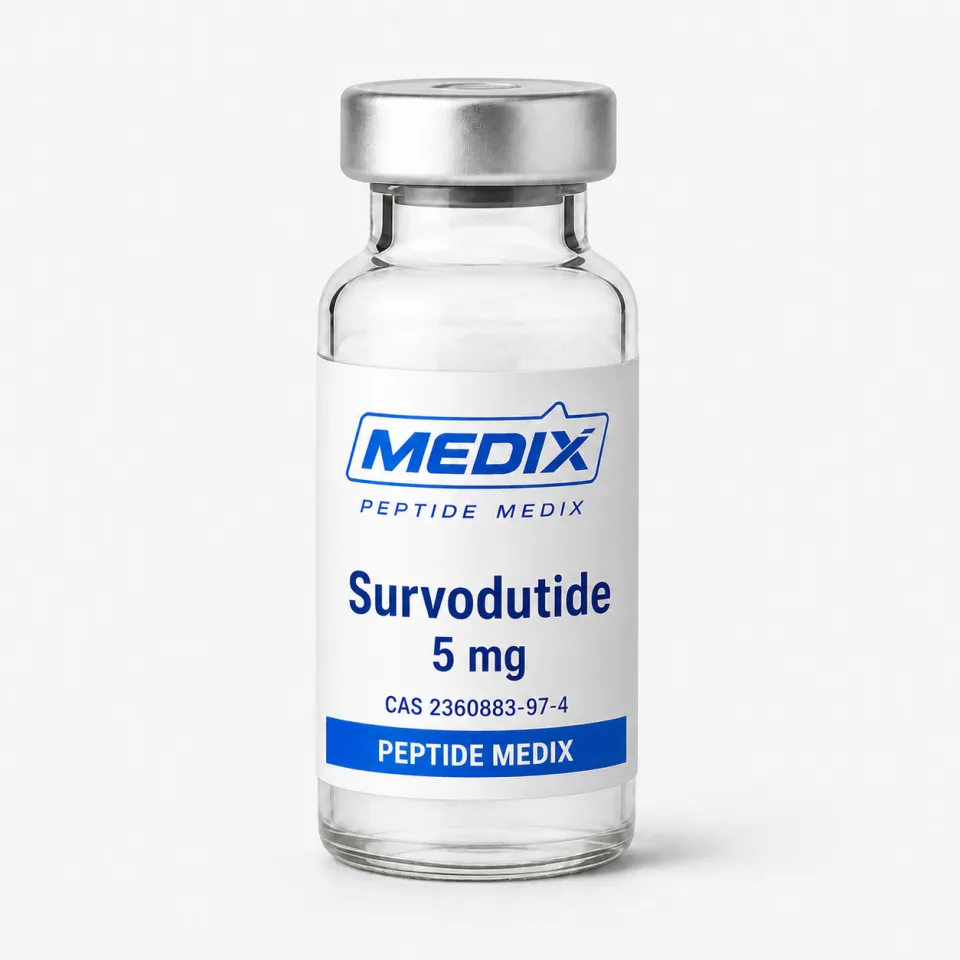
Survodutide is frequently run against tirzepatide, retatrutide and mazdutide in matched designs. Selective receptor antagonists or knockout tissue let investigators subtract one arm at a time, which is the cleanest way to attribute an observed phenotype to glucagon versus incretin signaling. Longer exposure designs add a further question: whether either receptor arm desensitizes at a different rate, and whether the balance a molecule shows acutely still holds after weeks of repeated exposure in an animal model.
Analytical considerations
As with other long acylated peptides, the hydrophobic side chain complicates reversed-phase separation and plasma protein-binding measurement. Analytical groups use survodutide when developing LC-MS quantification methods and stability-indicating assays for this compound class.