Research Overview
The melanocortin pathway
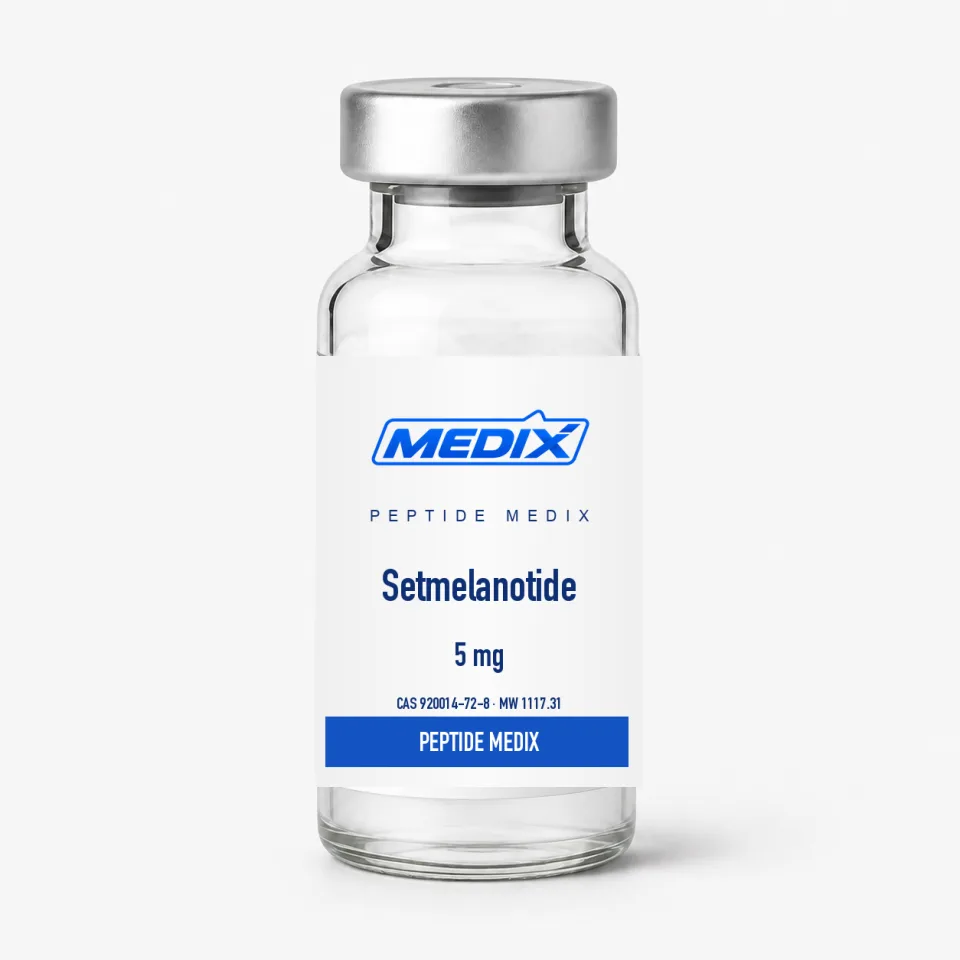
Proopiomelanocortin neurons in the arcuate nucleus release alpha-MSH, which acts on MC4R in downstream hypothalamic nuclei; agouti-related peptide acts as the endogenous antagonist at the same receptor. The system is one of the best-mapped central regulators of energy balance, and MC4R is the point at which several upstream genetic lesions converge. A selective agonist lets researchers probe that node directly rather than through leptin or POMC processing.
Why selectivity mattered in its design
Earlier melanocortin analogues bound MC1R and MC3R alongside MC4R, which complicated interpretation because MC1R engagement drives pigmentation responses that have nothing to do with energy balance. Setmelanotide was developed to shift that balance strongly toward MC4R. Comparative receptor-binding and functional assays across the melanocortin receptor family are therefore a standard part of the published characterisation work.
- Receptor binding affinity and cAMP signalling potency across MC1R, MC3R, MC4R and MC5R.
- Food intake and body-composition endpoints in rodent models, including models carrying defined pathway mutations.
- Pigmentation-related observations arising from residual melanocortin receptor cross-talk.
Handling considerations for a cyclic peptide
The disulfide bridge that closes the ring is the structural feature most at risk in solution. Reducing agents, alkaline buffers and prolonged storage in dilute aqueous solution can all promote disulfide scrambling or reduction, which changes the molecule that is actually present in an assay. Laboratories working with cyclic melanocortins generally verify identity by mass spectrometry after any extended storage.