Research Overview
Discovery and chemistry
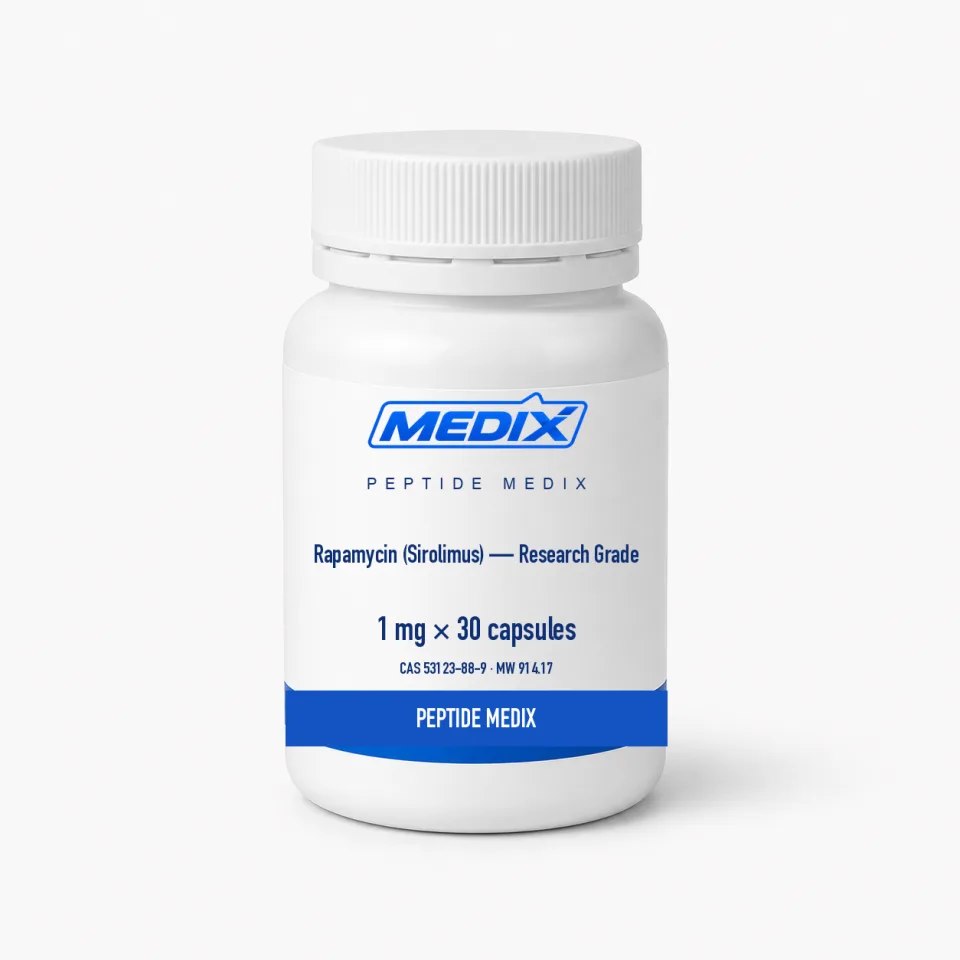
Rapamycin was isolated in the early 1970s from a Streptomyces hygroscopicus strain recovered from a Rapa Nui soil sample, initially characterised as an antifungal agent. Its immunosuppressive properties were recognised later, and the compound became a foundational tool in cell biology. Structurally it is a large macrolactone with a pipecolic acid moiety and a triene region; the molecule is lipophilic, poorly water-soluble and sensitive to light and oxidation, which shapes how it is formulated and stored.
Mechanism of action
Rapamycin does not inhibit mTOR directly. It first binds the abundant cytosolic immunophilin FKBP12, and the resulting binary complex docks onto the FRB domain of mTOR, allosterically inhibiting mTOR complex 1. Downstream, phosphorylation of S6 kinase 1 and 4E-BP1 falls, cap-dependent translation is reduced and autophagy is induced. mTOR complex 2 is largely insensitive to acute exposure, though prolonged exposure can affect it in some cell types — a distinction that matters when interpreting experiments.
- Approved in the US for prophylaxis of organ rejection in renal transplant recipients, typically as part of a combination regimen
- Sirolimus-eluting coronary stents use the same molecule to limit neointimal proliferation
- It carries significant labelled warnings, including immunosuppression-related infection and malignancy risk
Why it appears in aging research
mTORC1 is one of the most conserved nutrient-sensing nodes in eukaryotes, and genetic or pharmacological reduction of mTORC1 signalling has been reported to extend lifespan in yeast, nematodes, flies and mice. Rapamycin is the most-studied pharmacological probe of that pathway, and the NIA Interventions Testing Program reported lifespan extension in mice given the drug in feed. These are preclinical findings in model organisms; they do not establish a human benefit, and rapamycin has no approved indication related to aging. Any human use outside its approved indications is investigational and a matter for a treating clinician, not this listing.