Research Overview
Why these three are grouped
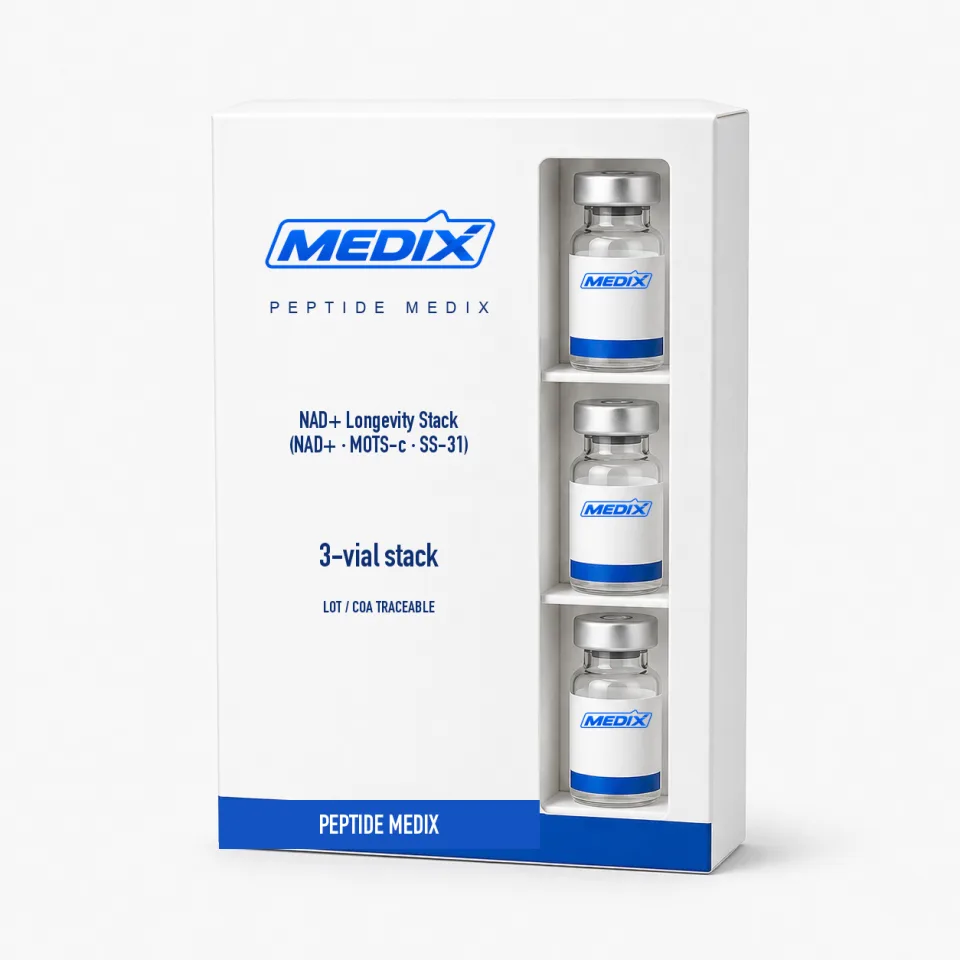
Mitochondrial research rarely turns on a single variable. A study design that changes coenzyme availability, signaling tone and membrane organization can separate effects that look identical when only one read-out is measured. This kit assembles one representative compound for each of those layers.
NAD+ — coenzyme supply
NAD+ carries electrons into complex I and is consumed as substrate by sirtuins, PARP enzymes and CD38. Tissue levels have been reported to decline with age in several species, and manipulating the pool is a standard intervention in bioenergetics studies. Assays typically follow the NAD+/NADH ratio, sirtuin activity or DNA-damage markers.
MOTS-c — metabolic signaling
- Encoded in the mitochondrial 12S rRNA gene and released as a 16-residue peptide
- Reported to associate with AMPK activation and folate–methionine one-carbon cycle intermediates
- Studied in glucose handling, skeletal-muscle metabolism and exercise-response models
SS-31 — membrane structure
Study design considerations
Because the vials are separate, researchers can stagger reconstitution, run each compound alone as its own arm, and combine them only where the protocol calls for it. Molar comparisons matter here: at 639.80 g/mol SS-31 supplies far more molecules per milligram than MOTS-c at 2174.55 g/mol.
Finally, stagger the arms where possible. Running the three compounds concurrently in a single condition makes attribution difficult, whereas single-compound arms plus a combined arm let investigators see whether effects are additive, redundant or interfering within their particular model system.