Research Overview
Reading gauge and length
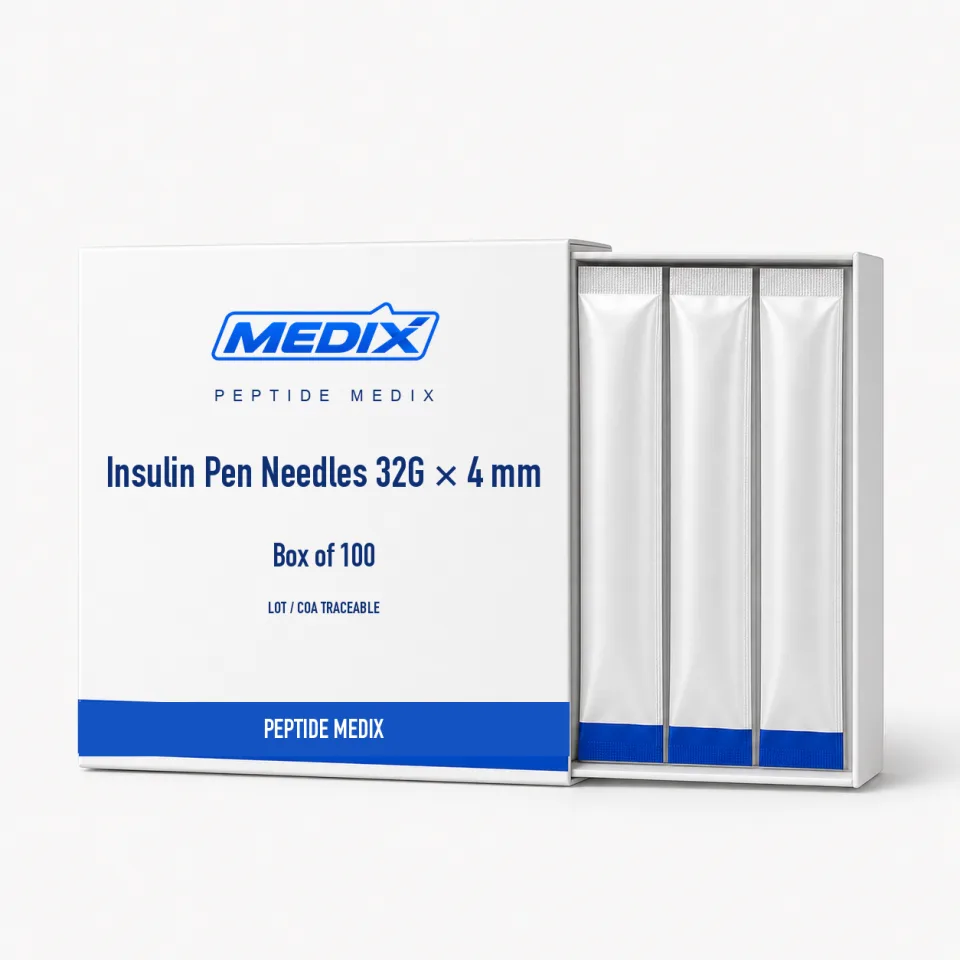
Needle gauge is an inverse scale inherited from wire drawing: the higher the number, the smaller the outer diameter. A 32G needle sits at roughly 0.23 mm outer diameter, finer than the 31G fixed needles on standard insulin syringes and considerably finer than the 25G or 27G cannulas used for viscous transfers. Length is measured from hub face to tip, and 4 mm is at the short end of the pen-needle range.
Why thin-wall construction matters
- Outer diameter is fixed by gauge, but wall thickness is not — thin-wall cannulas retain a larger internal bore at the same gauge
- Flow resistance rises steeply as bore narrows, following the fourth-power relationship in Poiseuille's law, so bore dominates transfer time for anything more viscous than water
- Silicone coating and multi-bevel grinding lower penetration force, which is the main determinant of cannula deformation on repeated puncture
- Fine cannulas are more prone to coring when repeatedly passed through a rubber vial stopper, which is one reason vial access and fine-gauge work are usually separated
Where they fit in a preparation workflow
In peptide-handling protocols the usual sequence is a larger-bore needle for withdrawing reconstituted material from a stoppered vial, and a fine cannula such as this for measured transfers. Pen needles specifically suit pen-format device work, including studies characterising dispensing accuracy, dead-space losses and priming behaviour of pen mechanisms. Dead space matters more than it looks: residual volume left in hub and cannula is a real and measurable source of loss when working with small volumes of expensive material.
Sterility and single-use discipline
The sterile barrier is the sealed paper tab. Once broken, the needle is single-use, and reuse compromises both sterility and tip geometry — electron-microscopy studies of reused needles show visible tip deformation after a single puncture. Used cannulas go directly into an approved sharps container without recapping by hand.