Research Overview
Two mechanisms, deliberately separate
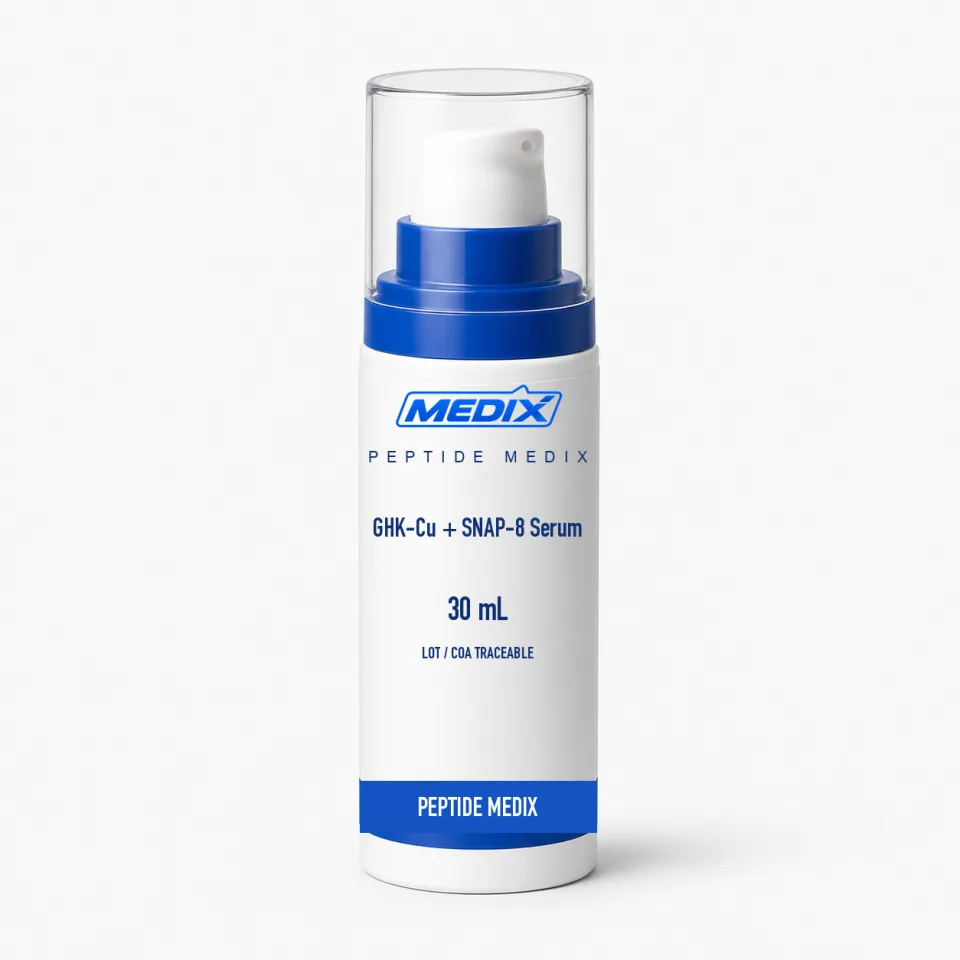
GHK-Cu is a matrix-side active: the literature covers fibroblast responses, collagen and glycosaminoglycan production, metalloproteinase and TIMP balance and copper-dependent antioxidant chemistry. SNAP-8 is a neuro-mimetic: a SNAP-25 N-terminal analog studied for competition at the SNARE assembly interface and for effects on stimulated vesicle fusion. Combining them tests whether structural and dynamic endpoints can be addressed in one preparation.
Formulation compatibility as a research question
A copper complex and a methionine-containing peptide in the same aqueous phase are not automatically compatible. Copper can participate in redox chemistry that promotes methionine oxidation, while competing ligands and pH shifts can strip copper from the tripeptide. Stability programmes for combination serums therefore track both actives separately by chromatography rather than assuming that a stable single-active formula stays stable when paired.
Additivity and co-penetration
Two hydrophilic actives competing for the same delivery route raise questions that single-active studies cannot answer. Diffusion-cell work with combination serums measures flux for each active independently, checks whether one alters the barrier for the other, and compares endpoints against each active applied alone in the identical vehicle.
Typical endpoints
Reconstructed epidermis and skin explant models supply matrix and viability readouts for the GHK-Cu component, while cell-free SNARE assembly assays or secretory-cell preparations address the SNAP-8 component. Cosmetic-science studies of comparable formulations track surface metrology over weeks and report appearance measurements rather than pharmacological claims.
Matched single-active controls
Our GHK-Cu serum and lyophilized SNAP-8 use the same peptide specifications as the actives in this bottle, which makes them the natural single-active control arms for any combination experiment run with this material.