Research Overview
SNARE biology and the SNAP-25 fragment
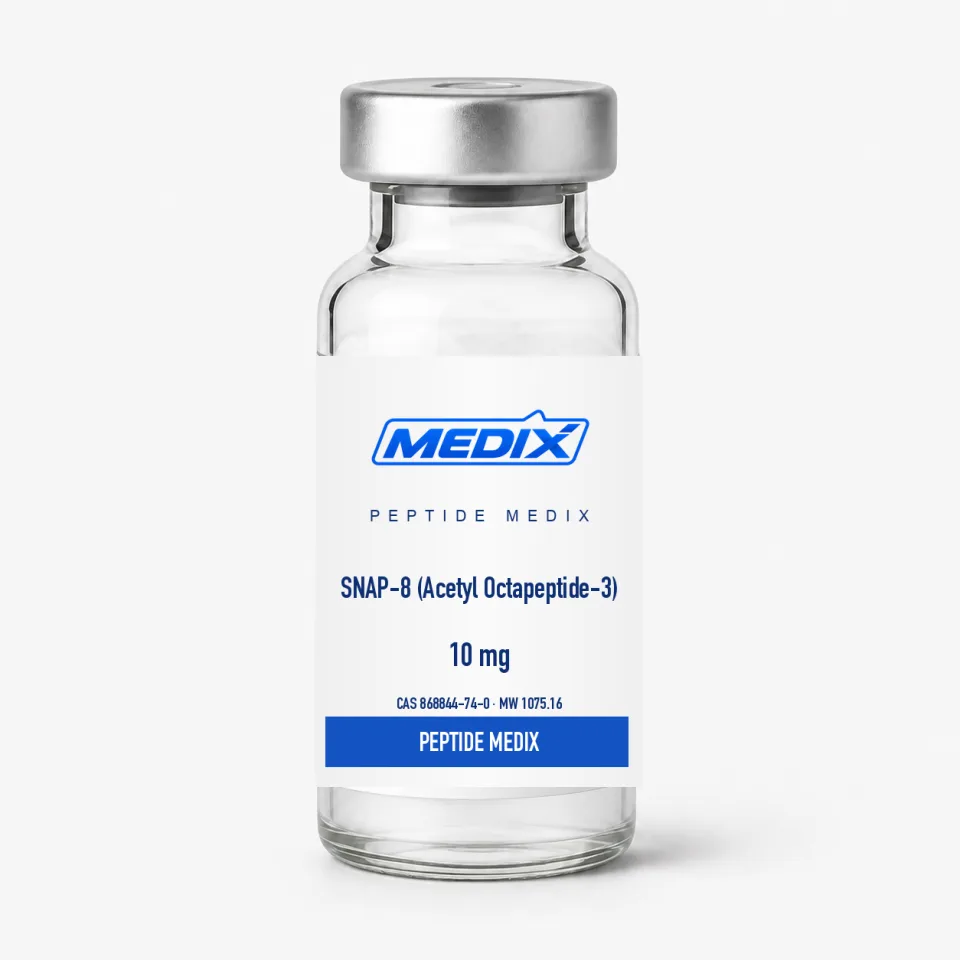
Vesicle fusion at the nerve terminal requires assembly of a four-helix SNARE bundle from syntaxin-1, VAMP-2 and SNAP-25. Peptides derived from the SNAP-25 N-terminus have been used for years as tools to probe that assembly step in vitro. SNAP-8 is one such tool: the acetylated octapeptide competes for the same protein–protein interface, and readouts are typically complex-formation assays or fusion assays rather than tissue endpoints.
Catecholamine and secretion models
Because SNARE-dependent exocytosis is not limited to acetylcholine, work with SNAP-8 has also used chromaffin-cell and related secretory preparations, measuring stimulated catecholamine release as an index of interference with vesicle fusion. These are cell-level measurements and are reported as relative changes in release under defined stimulation.
Cosmetic-science and expression-line research
In cosmetic-ingredient literature SNAP-8 is examined in topical vehicles for its effect on the appearance of dynamic lines, with instrumental profilometry or image analysis as the endpoint. Reported effects in such studies accumulate over weeks of repeated application and are described as cosmetic surface measurements, not as pharmacological muscle blockade.
Comparison with acetyl hexapeptide-8
SNAP-8 shares the EEMQRR core of Argireline and adds Ala-Asp. Head-to-head bench comparisons of the two peptides usually cover relative affinity for the SNARE interface, aqueous stability and behaviour in the same formulation base, which is why the pair is frequently ordered together.
Identity and analysis
The peptide is made by solid-phase synthesis with N-terminal acetylation and C-terminal amidation, then purified chromatographically. The single methionine residue is the main oxidation-sensitive site, so lots are handled under low-oxygen, low-light conditions and released against HPLC purity and mass-confirmation criteria.