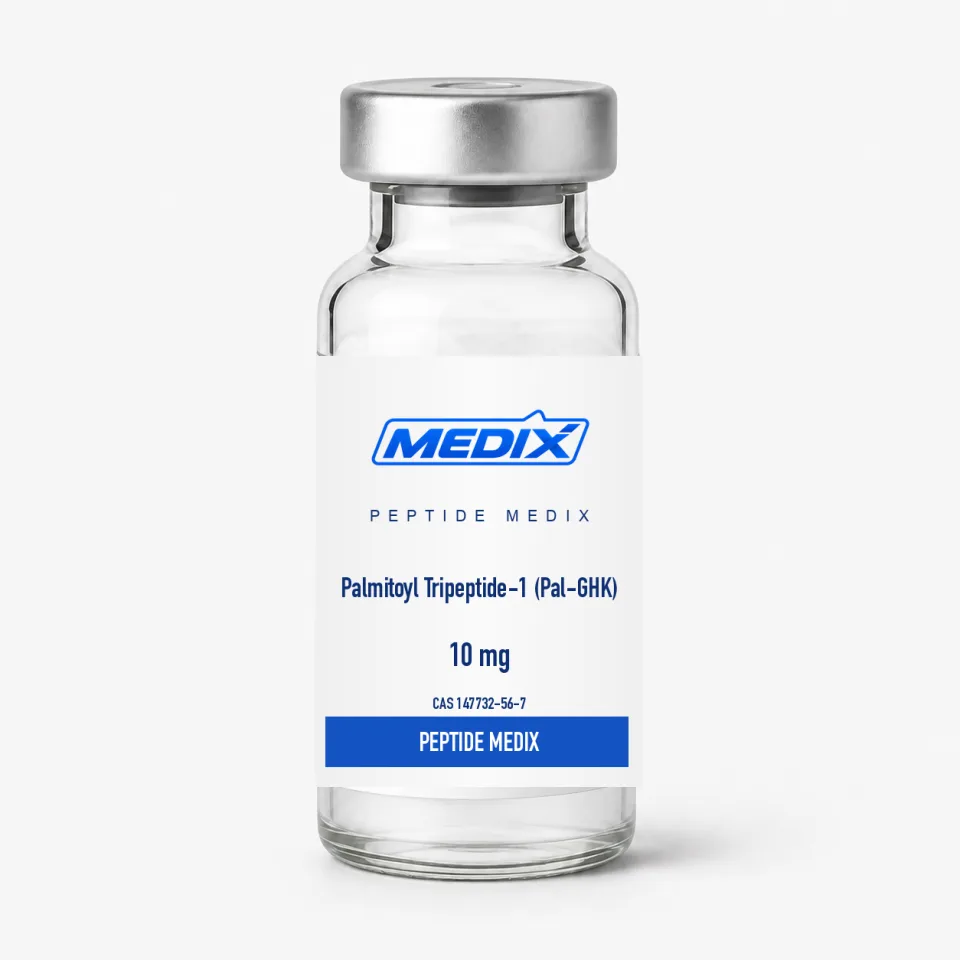
Peptide Medix product catalog

Peptide Medix

Palmitoyl Tripeptide-1 (Pal-GHK)

Palmitoylated Gly-His-Lys matrikine studied in collagen and ECM models

Review catalog details Secure payments
Available to order · 2 of 2 options available
$46.00 $55.00 15% OFF

Choose an option

1
Categories: palmitoyl tripeptide-1 , pal-ghk , cosmetic peptides

Choose your delivery method

Standard Shipping is automatically selected at checkout. Customers can upgrade to a faster delivery option anytime.

Overview

Palmitoyl tripeptide-1 is the tripeptide Gly-His-Lys with a sixteen-carbon palmitic acid chain attached to its N-terminal glycine. The peptide core is GHK, the same matrikine fragment that appears in the catalogue as GHK-Cu, released naturally when extracellular matrix proteins such as collagen I are degraded and recognised by fibroblasts as a signal that repair is needed.

The palmitoyl chain is not decoration. Free GHK is a small, highly polar molecule that partitions poorly into lipid membranes and the stratum corneum, so its usefulness in topical formulation work is limited by penetration. Acylating the N-terminus with palmitic acid roughly triples the molecular weight, drops water solubility sharply and gives the molecule an amphiphilic, surfactant-like character — it will orient at interfaces, associate with lipid bilayers and traverse lipid-rich barriers that the free tripeptide cannot. This lipidation strategy is the same one behind palmitoyl pentapeptide-4 and the wider family of cosmetic matrikine derivatives.

Specifications

Brand Peptide Medix
Category Cosmetic Signal Peptides
Form Lyophilized powder, sealed glass vial
Available sizes 10 mg, 50 mg
Purity ≥98% by HPLC; lot-matched COA available
CAS number 147732-56-7
Molecular formula C30H54N6O5
Molecular weight 578.8 g/mol
Amino acid sequence Palmitoyl-Gly-His-Lys (Pal-GHK)
Also known as Pal-GHK, palmitoyl oligopeptide, N-palmitoyl-Gly-His-Lys
Peptide class Lipidated matrikine tripeptide (cosmetic peptide)
Peptide core GHK — Gly-His-Lys, a matrix fragment released during collagen I degradation
Key modification C16 palmitoyl chain amide-linked to the N-terminal glycine
Research areas Collagen and glycosaminoglycan synthesis, ECM remodelling, fibroblast signalling, transdermal penetration of lipidated peptides
Solubility Poorly soluble in water; commonly dissolved in ethanol, propylene glycol, DMSO or a warmed surfactant-containing vehicle
Storage (lyophilized) −20 °C, sealed and protected from light and moisture
Storage (in solution) 2–8 °C, protected from light, used within the study window
SKU PALMITOYL-TRIPEPTIDE-1-10-MG

Highlights

  • N-palmitoylated Gly-His-Lys matrikine; CAS 147732-56-7
  • Molecular formula C30H54N6O5, molecular weight approximately 578.8 g/mol
  • Lipid chain converts a highly polar tripeptide into an amphiphilic, membrane-associating molecule
  • Peptide core is GHK, a fragment released during collagen I breakdown
  • Supplied lyophilized in 10 mg and 50 mg sealed vials
  • Studied in collagen synthesis, ECM remodelling and skin-penetration models
  • Third-party HPLC tested; lot-matched COA available; ships from the United States
  • Research use only — not a cosmetic, drug or consumer product

What's Included

  • The vial option and size selected above
  • Final item and quantity confirmed in cart
  • Laboratory-research-use labeling

Research Overview

The GHK matrikine

Gly-His-Lys is one of the best-characterised matrikines: short peptide fragments liberated when extracellular matrix proteins are proteolysed, which then act as signals to the cells embedded in that matrix. GHK occurs within the collagen alpha-2(I) sequence and its concentration in plasma has been reported to decline with age. Cell-culture work has examined its effects on fibroblast expression of collagen, elastin, decorin and glycosaminoglycans, and on the balance between matrix metalloproteinases and their tissue inhibitors.

Why the palmitoyl chain matters

Skin penetration is governed largely by lipophilicity and molecular size. Free GHK is small enough but far too polar, so it stays in aqueous phase and on the surface. Amide-linking palmitic acid to the N-terminal glycine raises log P dramatically and produces an amphiphile that will insert into lipid lamellae. Formulation researchers study lipidated peptides such as this one precisely to characterise that trade-off: penetration improves, but so does the tendency to form micelles, adsorb to container surfaces and behave unpredictably in emulsions.

  • Fibroblast collagen and glycosaminoglycan expression in monolayer and three-dimensional dermal-equivalent culture
  • Matrix metalloproteinase and TIMP expression as a readout of ECM turnover balance
  • Franz-cell and ex vivo skin penetration studies comparing lipidated and unmodified matrikines
  • Stability and partitioning behaviour in emulsions, since amphiphilic peptides distribute between oil, water and interface
  • Comparative work against palmitoyl pentapeptide-4 and palmitoyl tetrapeptide-7, with which it is often co-formulated in the cosmetic literature
Interpreting results

Handling & Storage

Warm the sealed vial to room temperature before opening so condensation does not settle on the powder. This peptide is poorly water-soluble — attempting to reconstitute it directly in water usually gives a cloudy dispersion rather than a solution. Common practice is to prepare a concentrated stock in ethanol, propylene glycol or DMSO and dilute into the aqueous working system, or to disperse into a warmed surfactant-containing vehicle with agitation. Because the molecule is amphiphilic it adsorbs to plastic surfaces, so glass or low-binding labware is preferred for stocks. Store the sealed powder at −20 °C, protect solutions from light at 2–8 °C, and record lot number, solvent system and preparation date with every experiment.

Palmitoyl Tripeptide-1 (Pal-GHK) FAQ

How does Pal-GHK differ from GHK-Cu?
Both share the Gly-His-Lys core. GHK-Cu is the copper(II) complex of the free tripeptide, water-soluble and blue, studied largely for copper-dependent effects. Palmitoyl tripeptide-1 has no copper; instead a C16 fatty acid is amide-linked to the N-terminus, making it lipophilic rather than water-soluble.
Why is it so hard to dissolve in water?
The palmitoyl chain dominates the molecule's behaviour. A sixteen-carbon lipid tail on a small tripeptide creates an amphiphile that prefers interfaces and lipid phases. Stocks are usually made in ethanol, propylene glycol or DMSO, then diluted into the aqueous working system rather than dissolved directly.
What purity is the material and is a COA available?
It is supplied at ≥98% by HPLC with a lot-matched certificate of analysis available on request. Lipidated peptides typically carry slightly lower assayed purity than unmodified sequences because the acylation step and the resulting hydrophobicity complicate purification.
Is this the same as Matrixyl?
No. Matrixyl is the trade name most associated with palmitoyl pentapeptide-4 (Pal-KTTKS). Palmitoyl tripeptide-1 is a different, shorter lipidated matrikine. The two appear together in some multi-peptide cosmetic literature, which is why they are cross-listed here.
How should it be stored?
Keep the sealed powder at −20 °C, protected from light and moisture, and let the vial warm to room temperature before opening. Solutions and stocks are stored at 2–8 °C and protected from light. Because the peptide adsorbs to plastic, glass or low-binding containers are preferred.
Can it be used to make a skincare product?
No. Material supplied here is research grade and is not a cosmetic ingredient release — it carries no cosmetic-grade specification, no preservative system and no suitability assessment for consumer formulation. It is for laboratory formulation and cell-culture research only.

This catalog listing is for laboratory research use only. It is not represented as a drug, food, supplement, cosmetic or diagnostic product, and it is not offered for human or veterinary use.

Customer Reviews

0 reviews
5 star
0%
4 star
0%
3 star
0%
2 star
0%
1 star
0%

Leave Your Review

Rating

No reviews yet — be the first!

Leave Your Review

Rating

Keep exploring

Related Products & Shopping Guides

Compare Palmitoyl Tripeptide-1 (Pal-GHK) with relevant categories, product topics, and practical shopping information.

Often researched together

Related research peptides, blends and lab supplies frequently ordered with Palmitoyl Tripeptide-1 (Pal-GHK).

15% OFF
GHK-Cu (Copper Peptide)

Peptide Medix

GHK-Cu (Copper Peptide)

ghk-cu

5 options

$25.00 $30.00

View options and product details

15% OFF
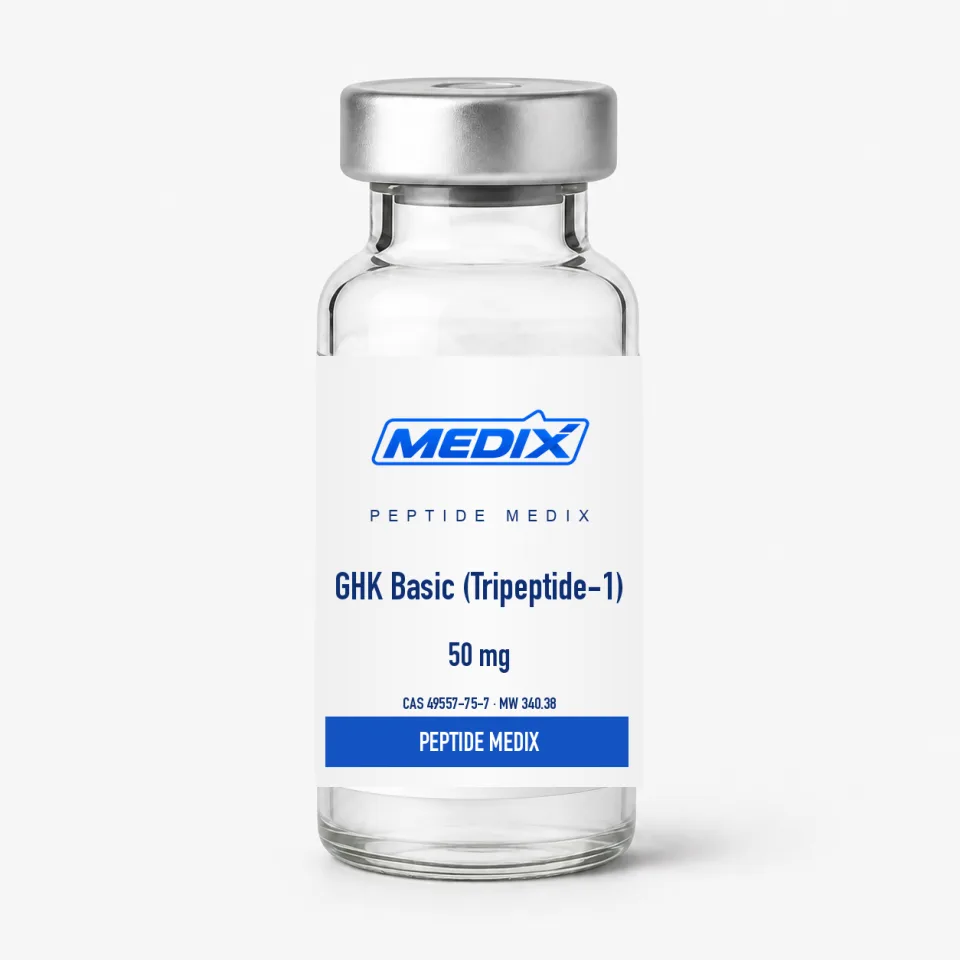
GHK Basic (Tripeptide-1)

Peptide Medix

GHK Basic (Tripeptide-1)

ghk basic

2 options

$51.00 $60.00

View options and product details