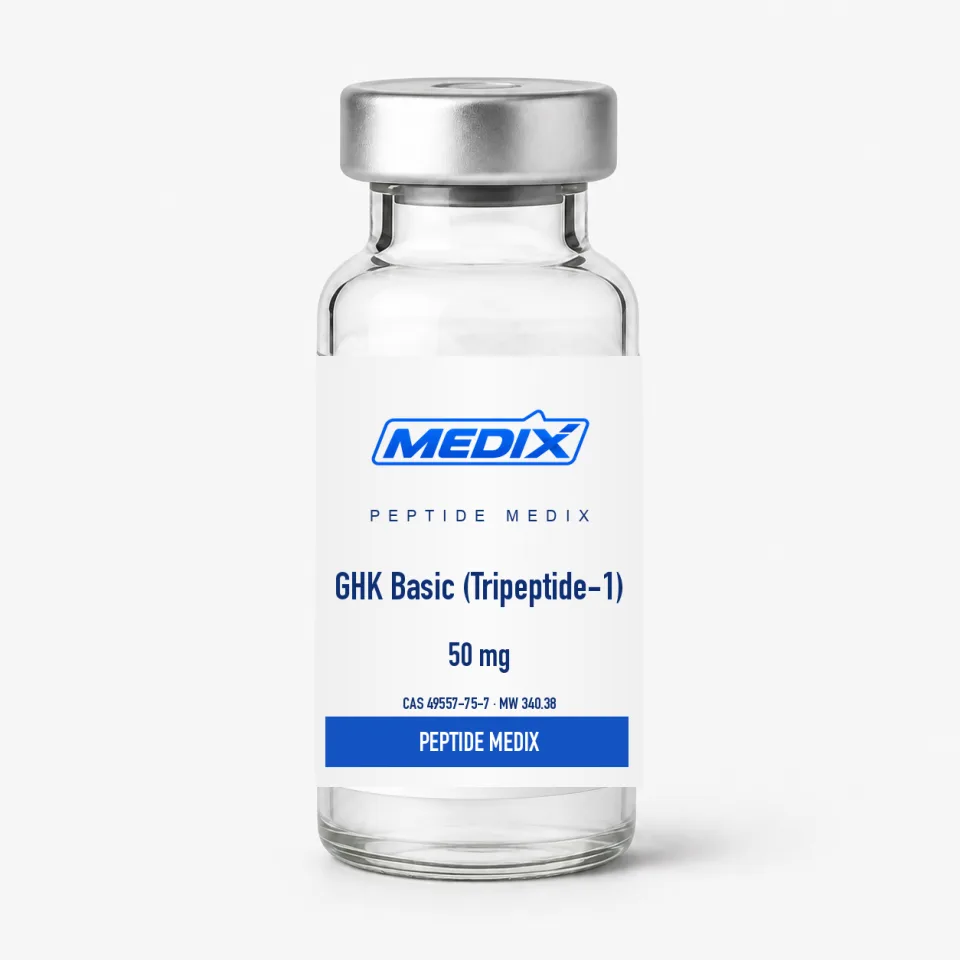
Peptide Medix product catalog

Peptide Medix

GHK Basic (Tripeptide-1)

Copper-free Gly-His-Lys tripeptide for matrix and fibroblast research

Review catalog details Secure payments
Available to order · 2 of 2 options available
$51.00 $60.00 15% OFF

Choose an option

1
Categories: ghk basic , tripeptide-1 , gly-his-lys

Choose your delivery method

Standard Shipping is automatically selected at checkout. Customers can upgrade to a faster delivery option anytime.

Overview

GHK Basic is the copper-free tripeptide glycyl-L-histidyl-L-lysine, also called Tripeptide-1. The distinction from GHK-Cu is chemical rather than cosmetic: GHK Basic contains the three-amino-acid ligand by itself, while GHK-Cu is a coordinated copper(II) complex with different mass, color and redox behavior. The uncomplexed peptide is a white to off-white powder rather than the characteristic blue of the copper form. Cosmetic-ingredient nomenclature keeps the same split, listing the free peptide as Tripeptide-1 and the complex as Copper Tripeptide-1, which is worth checking on supplier paperwork before two datasets are compared.

GHK occurs naturally in human plasma and also appears as a sequence within extracellular-matrix proteins; it was first described in the early 1970s as a low-molecular-weight activity separated from human plasma. Cell and biochemical research has examined its copper-binding equilibrium, fibroblast signaling, extracellular-matrix gene expression, protease regulation and reactive-carbonyl chemistry. Because trace copper in media can convert part of a nominally copper-free preparation into GHK-Cu, careful studies measure or control metal content.

Specifications

Brand Peptide Medix
Category Cosmetic Signal Peptides
Form White to off-white lyophilized powder, sealed glass vial
Available sizes 50 mg, 200 mg
Purity ≥99% by HPLC; lot-matched COA available
CAS number 49557-75-7
Molecular formula C14H24N6O4
Molecular weight 340.38 g/mol
Amino acid sequence Gly-His-Lys (GHK)
Also known as Tripeptide-1, glycyl-L-histidyl-L-lysine, GHK free peptide
Peptide class Endogenous matrix-associated tripeptide and copper-binding ligand
Copper status No coordinated copper added; trace-metal conditions remain an assay variable
Research areas Fibroblast signaling, matrix turnover, copper coordination, protease regulation and reactive-carbonyl chemistry
Solubility Water-soluble; use metal-controlled buffers for copper-comparison studies
Storage −20 °C lyophilized; protect from moisture and use refrigerated solutions within the study window
SKU GHK-BASIC-50-MG

Highlights

  • Copper-free Gly-His-Lys tripeptide — not the blue GHK-Cu complex
  • CAS 49557-75-7; C14H24N6O4; molecular weight 340.38 g/mol
  • Two market-observed research sizes: 50 mg and 200 mg
  • ≥99% purity by HPLC with lot-matched certificate of analysis
  • Studied in fibroblast, extracellular-matrix and metal-binding models
  • Water-soluble short peptide suitable for defined-metal comparison work
  • Pairs with GHK-Cu and Pal-GHK for free, copper-bound and lipidated comparisons
  • Laboratory research use only — not a cosmetic, drug or supplement

What's Included

  • The vial option and size selected above
  • Final item and quantity confirmed in cart
  • Laboratory-research-use labeling

Research Overview

Free peptide versus copper complex

Histidine and the terminal amine give GHK a strong affinity for copper(II), but the free and complexed forms are not interchangeable. GHK Basic has a molecular weight of 340.38 g/mol and no intrinsic blue color; the copper complex has a higher mass and distinct coordination chemistry. Coordination is usually described in terms of the N-terminal amine, the histidine imidazole and a deprotonated backbone amide nitrogen, with the species actually present depending on pH, stoichiometry and competing ligands. Experiments comparing them should report copper concentration, buffer composition and whether chelators are present.

Matrix-associated signaling

GHK was identified during plasma-factor research and has since been examined in fibroblast cultures for changes in collagen, glycosaminoglycan, decorin and matrix-metalloproteinase readouts. Its occurrence within collagen sequences led to its classification as a matrikine-like signal: a short fragment that can carry information about matrix turnover, in principle released locally when proteases act on the surrounding matrix. Much of the literature also uses GHK-Cu, so attribution to the unbound peptide requires careful source checking.

Analytical notes

The tripeptide is small, highly polar and basic, so it is retained poorly on conventional reversed-phase columns and is commonly handled with ion-pairing reagents, polar-retentive phases or hydrophilic-interaction chromatography. It contains no tryptophan, tyrosine or phenylalanine, so there is no strong absorbance near 280 nm and detection generally relies on low-wavelength ultraviolet, mass spectrometry or derivatization. The same short, unprotected structure makes it a plausible substrate for aminopeptidase activity in serum-containing media, which is a reason to verify that the intended species is still present at the end of a long incubation rather than only at the start.

Research applications

  • Free-peptide versus copper-complex comparison in matched cell systems
  • Fibroblast extracellular-matrix expression and protease/TIMP balance
  • Copper-binding constants, metal exchange and competition with albumin or amino acids
  • Reactive-carbonyl and glycation assays using defined peptide controls
  • Comparison with Pal-GHK to test how N-terminal lipidation changes partitioning

Study-design caveat

Standard culture media and serum can contain enough copper to shift speciation during an experiment, and serum is usually the larger contributor because its copper travels bound to protein rather than appearing in the base formulation. A label reading “GHK Basic” describes the material added, not necessarily the fraction remaining metal-free in the well. Metal-controlled media, a copper-salt-only arm at matched molar copper, a chelator arm and an analytical check are appropriate when the difference between GHK and GHK-Cu is central to the conclusion.
Handling & Storage

Bring the sealed vial to room temperature before opening, then prepare stock with water or the assay buffer added gently down the glass. The free tripeptide dissolves readily. For copper-comparison work, use trace-metal-controlled reagents and avoid unreported serum or copper contamination. Store the dry vial at −20 °C, protected from light and humidity. Keep prepared solution at 2–8 °C for the defined study period and aliquot longer-term stocks. Record lot, solvent, pH and metal conditions with the data.

GHK Basic (Tripeptide-1) FAQ

Is GHK Basic the same as GHK-Cu?
No. GHK Basic is the copper-free Gly-His-Lys ligand. GHK-Cu is the coordinated copper(II) complex, which has a different molecular mass, blue color and redox chemistry. They need separate controls and should not share one product identity.
What is Tripeptide-1?
Tripeptide-1 is the cosmetic and catalog name commonly used for glycyl-L-histidyl-L-lysine, abbreviated GHK. The product here is the free peptide with sequence Gly-His-Lys and CAS 49557-75-7.
Why compare GHK Basic with Pal-GHK?
Pal-GHK adds a sixteen-carbon palmitoyl group to the same peptide core. That lipid tail changes solubility, membrane partitioning and surface adsorption. Running both forms helps isolate the effect of lipidation from the underlying GHK sequence.
What purity and documentation are provided?
The material is released at ≥99% purity by reversed-phase HPLC, and a certificate of analysis matched to the vial's lot is available. Studies focused on copper speciation should perform their own metal analysis as well.
What sizes are available?
GHK Basic is listed in 50 mg and 200 mg sealed research vials. Those are the size points observed in current specialist peptide catalogs and support both cell-culture and formulation-development work.

This catalog listing is for laboratory research use only. It is not represented as a drug, food, supplement, cosmetic or diagnostic product, and it is not offered for human or veterinary use.

Customer Reviews

0 reviews
5 star
0%
4 star
0%
3 star
0%
2 star
0%
1 star
0%

Leave Your Review

Rating

No reviews yet — be the first!

Leave Your Review

Rating

Keep exploring

Related Products & Shopping Guides

Compare GHK Basic (Tripeptide-1) with relevant categories, product topics, and practical shopping information.

Often researched together

Related research peptides, blends and lab supplies frequently ordered with GHK Basic (Tripeptide-1).

15% OFF
GHK-Cu (Copper Peptide)

Peptide Medix

GHK-Cu (Copper Peptide)

ghk-cu

5 options

$25.00 $30.00

View options and product details