Research Overview
The molecule
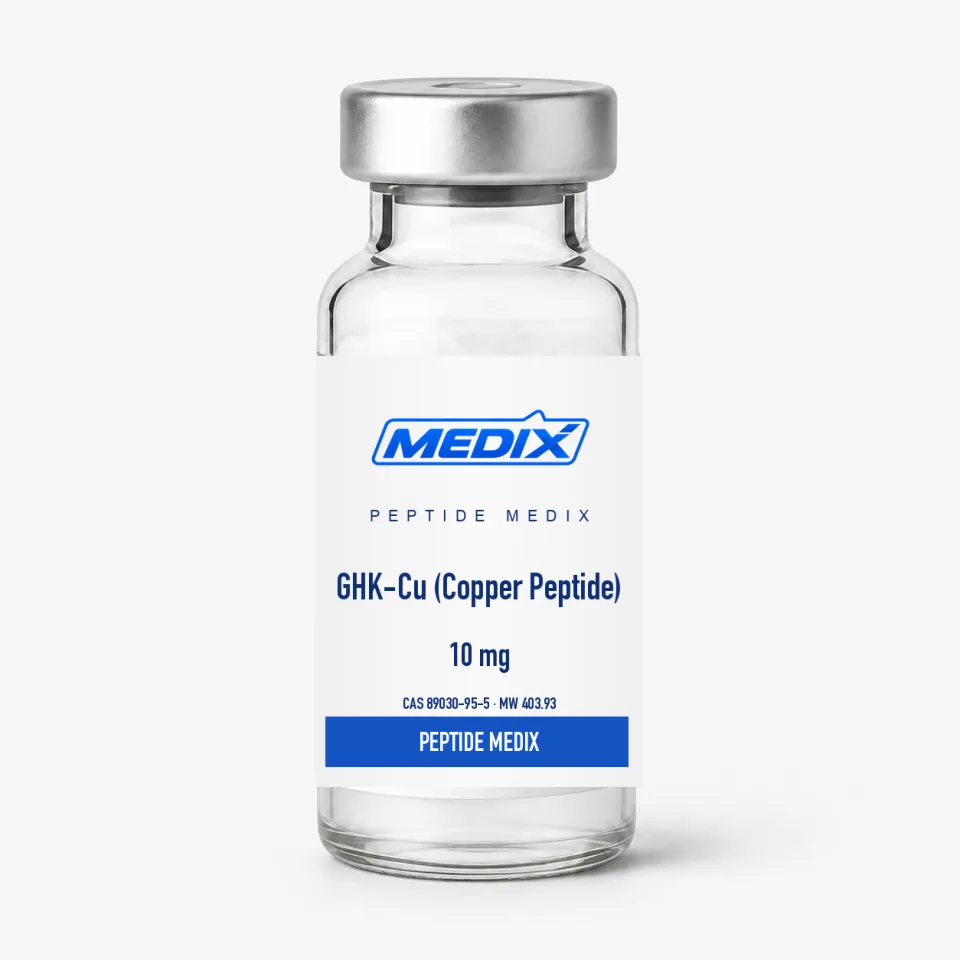
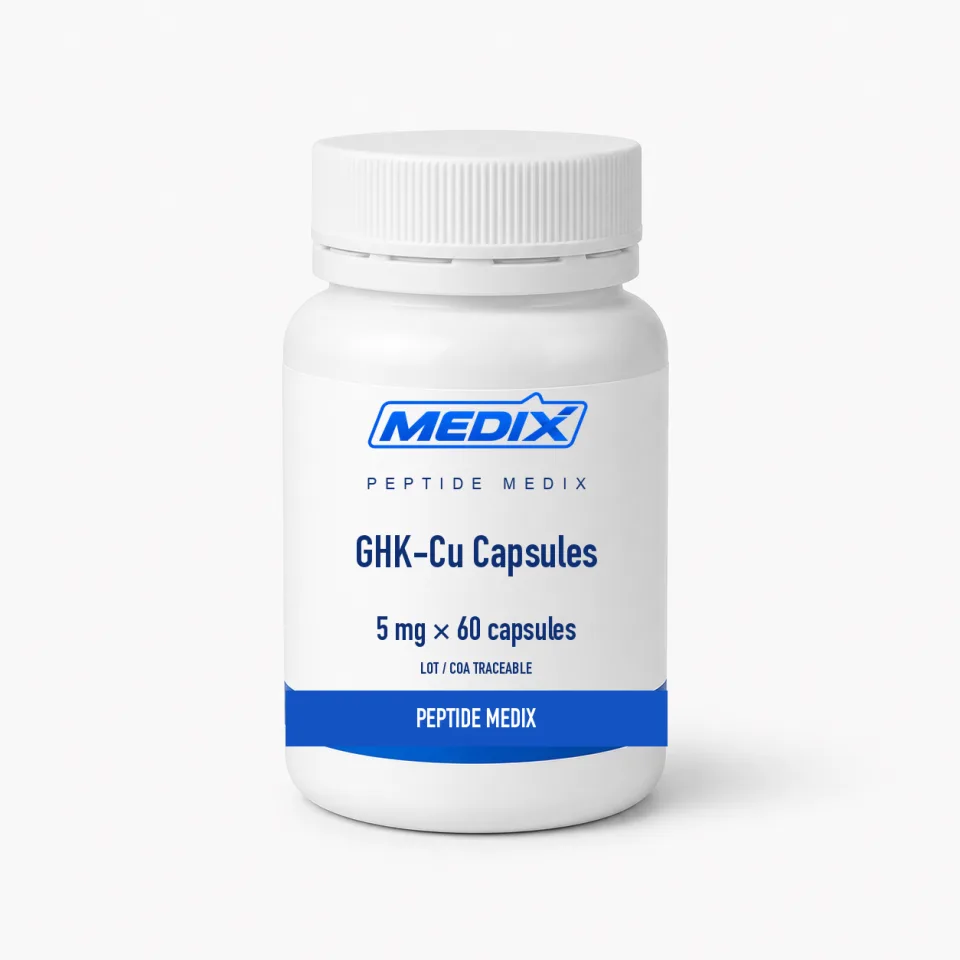
GHK was identified in human plasma in the early 1970s during work on liver tissue culture, and the sequence also occurs within albumin. Its defining property is a very high affinity for copper(II) — high enough to compete for the ion, but arranged so that the metal can still be handed off to cellular carriers rather than being locked away. That exchangeable coordination is why the complexed form dominates the literature over the bare tripeptide, and why the compound is discussed as a copper delivery vehicle as much as a signalling peptide.
What the research record covers
- Collagen, elastin and glycosaminoglycan synthesis in fibroblast culture
- Hair-follicle and dermal-papilla models, and wound-model work in animals
- Antioxidant and metalloenzyme chemistry, given copper's role as a cofactor in lysyl oxidase and superoxide dismutase
- Copper transport, chaperone proteins and cellular copper homeostasis
Why the oral route is a real question
Most GHK-Cu research uses topical application or parenteral delivery, both of which sidestep the gastrointestinal tract. A swallowed tripeptide faces gastric acid, brush-border peptidases and a competitive metal-binding environment where albumin, amino acids and transport proteins all bind copper. The complex may reach the intestine intact, dissociate, or arrive as fragments carrying copper separately. Studies in this area therefore measure the peptide and the metal independently rather than assuming they travel together.
Copper as its own variable
Any oral copper-containing article must be evaluated with total copper exposure in mind, since copper homeostasis is tightly regulated and both deficiency and excess have well-characterised biology. Research designs typically include copper-only and peptide-only control arms so that observed effects can be attributed to the complex rather than to the metal it carries.
Analytical approach
Intact-complex quantification usually pairs LC-MS for the peptide with ICP-MS or atomic absorption for copper. Colour is a useful qualitative check — the characteristic blue reflects intact coordination — but it is not a substitute for quantitative confirmation that the complex has not dissociated.