Research Overview
Why a spray format at all
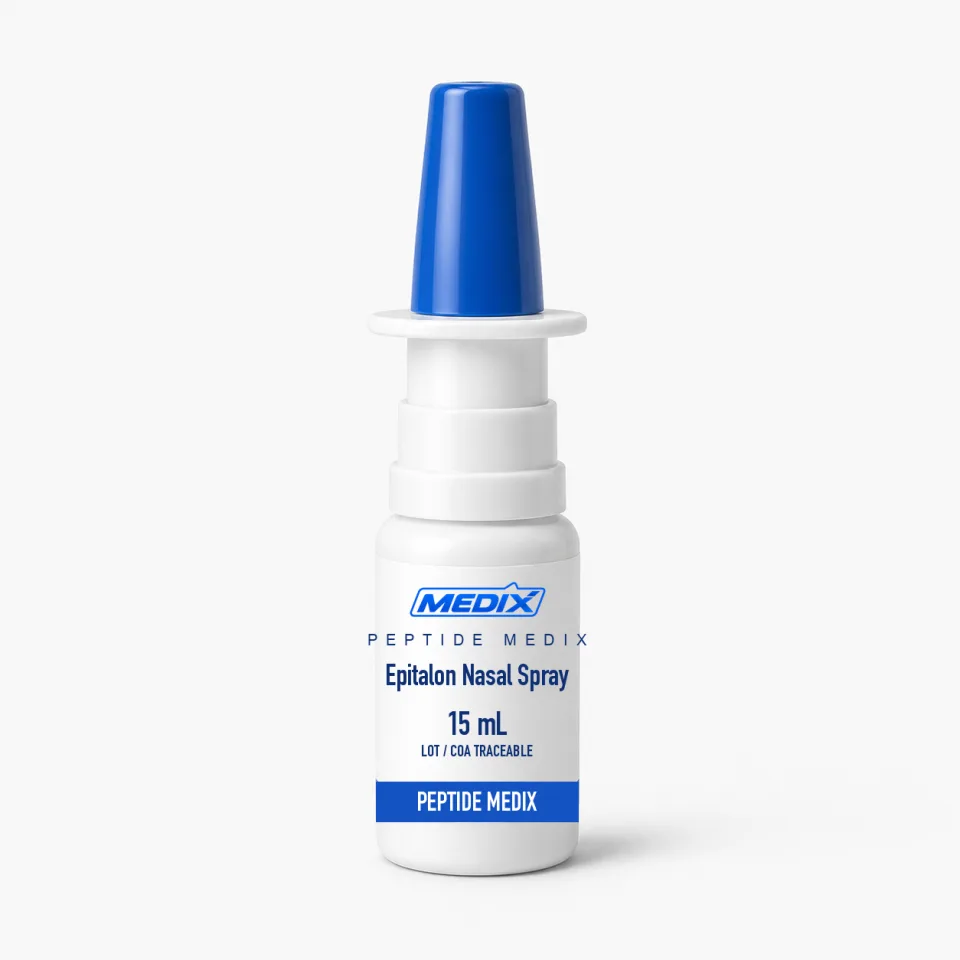
Peptides in the sub-1000 g/mol range are the class most often examined for intranasal transport, because their size allows passage across the olfactory epithelium and along perineural routes without the systemic dilution that follows a parenteral route. Epitalon sits at 390.35 g/mol, near the low end of that range, which is why it appears in delivery-route studies as well as in its own biological literature. The spray is the practical way to hold that route constant across an experiment.
The underlying peptide literature
- Reported induction of telomerase activity and telomere elongation in cultured human somatic cells
- Melatonin rhythm and circadian marker studies in rodents, following the epithalamin work
- Gene-expression and chromatin-interaction studies of the short AEDG sequence
- Senescence and lifespan endpoints reported in aged and senescence-accelerated animal models
Solution versus lyophilate
The trade-off in choosing a pre-mixed spray is stability against convenience. A lyophilized powder held at −20 °C is the more stable presentation; any peptide already in aqueous solution begins a slow degradation clock governed by temperature, pH and light exposure. Epitalon is relatively robust for a peptide — four residues with no cysteine, methionine or tryptophan means no disulfide scrambling and no oxidation-prone side chains — but deamidation and hydrolysis at the acidic residues remain the relevant pathways.
Study design notes
Because the delivered amount per actuation is fixed by the pump rather than measured by the investigator, route-comparison designs should verify actual delivered volume gravimetrically rather than assuming the nominal figure. Comparing this format against the vial form of the same lot is the cleanest way to separate a route effect from a formulation effect.