Peptide Medix product catalog

Peptide Medix

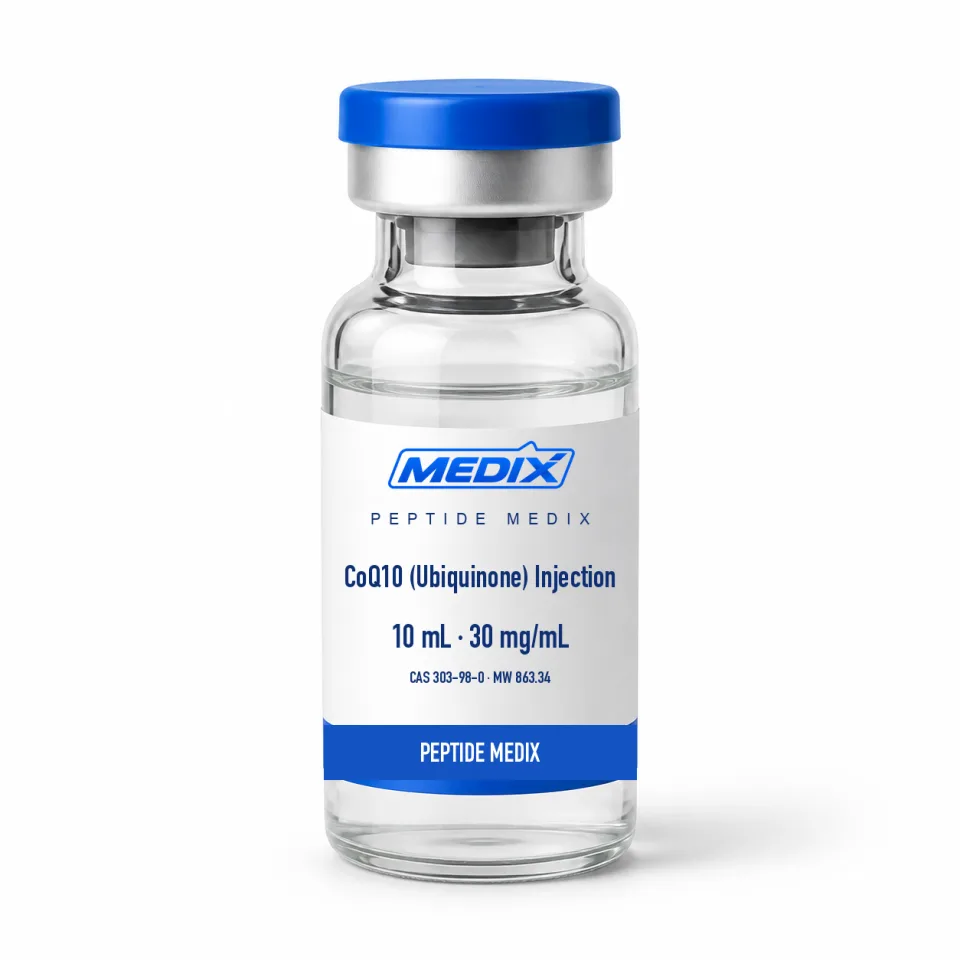
CoQ10 (Ubiquinone) Injection

Solubilized ubiquinone at 30 mg/mL in a 10 mL vial for mitochondrial research

Review catalog details Secure payments
Available to order
$55.00 $65.00 15% OFF
1
Categories: coq10 , ubiquinone , coq10 injection

Choose your delivery method

Standard Shipping is automatically selected at checkout. Customers can upgrade to a faster delivery option anytime.

Overview

Coenzyme Q10, chemically 2,3-dimethoxy-5-methyl-6-decaprenyl-1,4-benzoquinone, is the lipid-soluble electron carrier that shuttles electrons from complexes I and II to complex III in the mitochondrial respiratory chain. Its benzoquinone head cycles between the oxidised ubiquinone form supplied here, the ubisemiquinone radical and the fully reduced ubiquinol, while a ten-unit polyisoprenoid tail anchors it inside the inner mitochondrial membrane.

Specifications

Brand Peptide Medix
Category Vitamins & Cofactors
Concentration 30 mg/mL ubiquinone
Vial size 10 mL (300 mg total content)
CAS number 303-98-0
Molecular formula C59H90O4
Molecular weight 863.34 g/mol
Also known as Coenzyme Q10, ubiquinone, ubidecarenone, CoQ10
Chemical class 1,4-benzoquinone with a ten-unit polyisoprenoid side chain
Redox states Ubiquinone (oxidised) ⇄ ubisemiquinone ⇄ ubiquinol (reduced)
Biochemical role Electron carrier between respiratory complexes I/II and III; membrane-phase antioxidant
Solubility Practically insoluble in water; formulated with a solubilising carrier for aqueous use
Research areas Mitochondrial bioenergetics, oxidative stress and lipid peroxidation, statin-associated CoQ10 depletion, mitochondrial myopathy models
Storage 2–8 °C preferred, tightly sealed and protected from light; do not freeze
SKU COQ10-INJECTION-10-ML-30-MG-ML

Highlights

  • Ubiquinone (oxidised CoQ10) supplied as a solubilized solution at 30 mg/mL
  • Single 10 mL vial — 300 mg total coenzyme Q10 content
  • Formulated with a solubilising carrier system because the molecule is water-insoluble
  • Characteristic yellow-orange colour; protect from light to limit quinone photodegradation
  • Bypasses the poor and variable oral absorption that complicates dietary CoQ10 studies
  • Studied in mitochondrial bioenergetics, oxidative-stress and statin-depletion models
  • Lot-matched COA available; filled and shipped from the United States

What's Included

  • The vial option and size selected above
  • Final item and quantity confirmed in cart
  • Laboratory-research-use labeling

Research Overview

Position in the respiratory chain

Coenzyme Q10 occupies the mobile carrier position between the dehydrogenase complexes and complex III. Electrons entering from NADH through complex I, or from succinate and fatty-acid oxidation through complex II and the electron-transfer flavoprotein, all converge on the ubiquinone pool. That convergence makes the pool's redox state a sensitive reporter of respiratory function, and it is why CoQ measurements appear so frequently in bioenergetic studies alongside oxygen-consumption data.

Antioxidant chemistry

Ubiquinol is one of the few lipid-phase antioxidants synthesised endogenously. It donates hydrogen to lipid peroxyl radicals and can regenerate α-tocopherol from the tocopheroxyl radical, placing it upstream of vitamin E in membrane antioxidant regeneration. The same redox versatility means the ubisemiquinone intermediate can itself contribute to superoxide generation under certain conditions, so the molecule is studied as both an antioxidant and a potential radical source.

Research contexts

  • Biosynthesis via the mevalonate pathway, and depletion in models of HMG-CoA reductase inhibition
  • Primary CoQ10 deficiency arising from mutations in COQ-pathway genes
  • Mitochondrial myopathy and neurodegeneration models where respiratory capacity is the endpoint
  • Cardiac tissue studies, where CoQ10 content is high and declines with age in reported measurements
  • Formulation and delivery science aimed at the molecule's very low aqueous solubility

Analytical notes

Quantification is normally by HPLC with UV or electrochemical detection, and the assay must control for redox state, since ubiquinone and ubiquinol are separately detectable and interconvert during sample handling. Light exposure and oxidation during extraction are the usual sources of analytical error.
Handling & Storage

Store the vial refrigerated, tightly sealed and shielded from light — an amber sleeve, foil wrap or closed carton all work. Do not freeze, since freeze-thaw can break the solubilising system and cause the quinone to separate. Allow the vial to reach room temperature and inspect before use: the solution should be a uniform yellow to orange with no visible separation, cloudiness or particulate. Swirl gently rather than shaking, because vigorous agitation of surfactant-based systems generates persistent foam. Swab the stopper before each entry, record the date of first puncture, and handle under your laboratory's chemical hygiene plan. Research use only.

CoQ10 (Ubiquinone) Injection FAQ

Is this ubiquinone or ubiquinol?
This is ubiquinone, the oxidised form, which is the more stable of the two for storage. Ubiquinol is the reduced form and is readily oxidised in air. Cells interconvert the two enzymatically, so the redox state supplied matters mainly for stability and for analytical work.
Why is light protection emphasised?
The benzoquinone head group is photolabile and degrades on exposure to light, which changes both content and the visible colour of the solution. Keeping the vial in its carton or wrapped, and minimising bench time under lighting, preserves the stated concentration over the working window.
What documentation comes with the vial?
A lot-matched certificate of analysis is available covering identity and content of the coenzyme Q10 used. Retaining that COA with your records lets analytical results be traced back to the specific lot the data were generated with.

This catalog listing is for laboratory research use only. It is not represented as a drug, food, supplement, cosmetic or diagnostic product, and it is not offered for human or veterinary use.

Customer Reviews

0 reviews
5 star
0%
4 star
0%
3 star
0%
2 star
0%
1 star
0%

Leave Your Review

Rating

No reviews yet — be the first!

Leave Your Review

Rating

Keep exploring

Related Products & Shopping Guides

Compare CoQ10 (Ubiquinone) Injection with relevant categories, product topics, and practical shopping information.

Often researched together

Related research peptides, blends and lab supplies frequently ordered with CoQ10 (Ubiquinone) Injection.

15% OFF
NAD+

Peptide Medix

NAD+

nad+

4 options

$38.00 $45.00

View options and product details

15% OFF
MOTS-c

Peptide Medix

MOTS-c

mots-c

4 options

$55.00 $65.00

View options and product details

15% OFF
L-Carnitine Injection

Peptide Medix

L-Carnitine Injection

l-carnitine

2 options

$38.00 $45.00

View options and product details