Peptide Medix product catalog

Peptide Medix

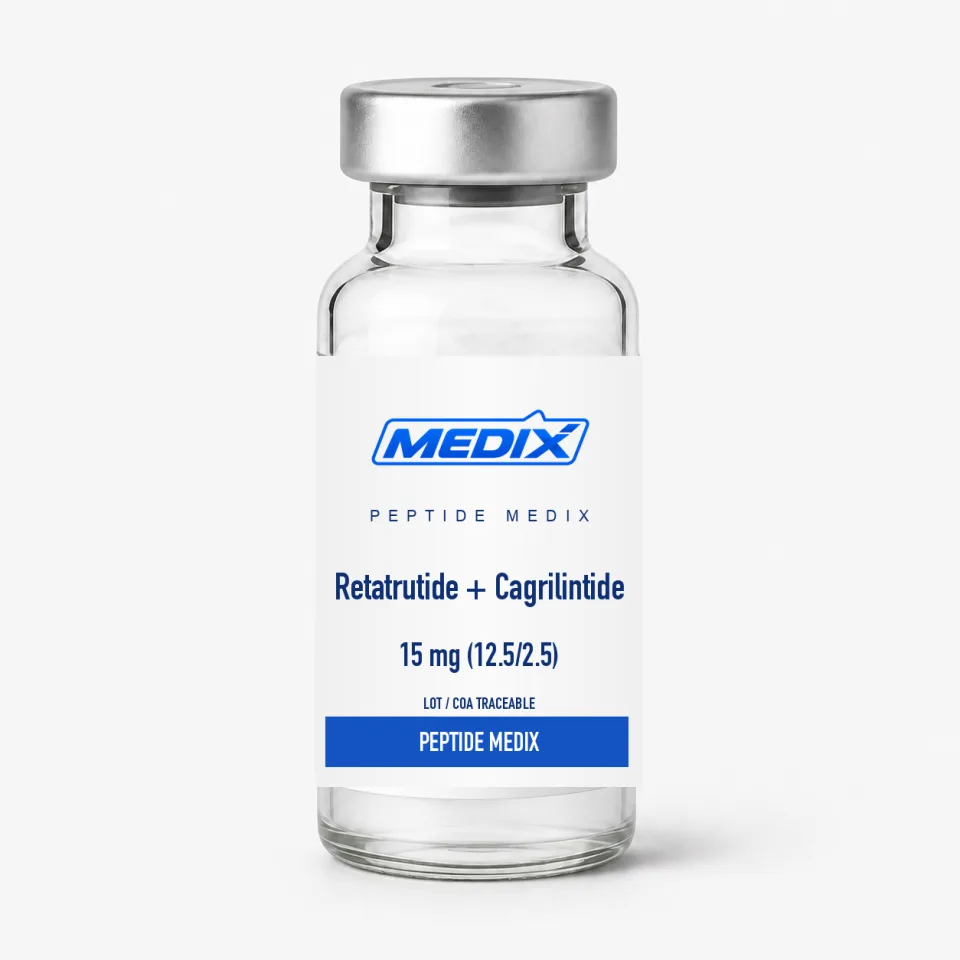
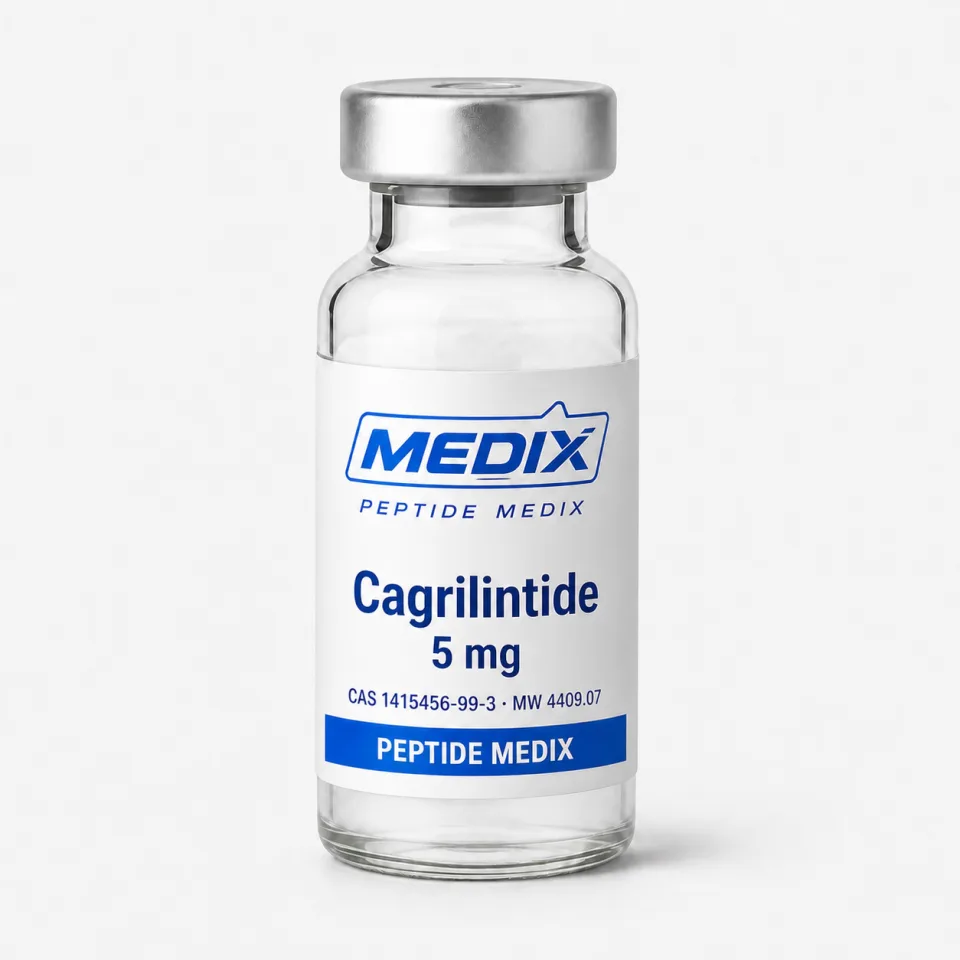
Cagrilintide

Long-acting acylated amylin analog for receptor and metabolic research

Review catalog details Secure payments
Available to order · 2 of 2 options available
$97.00 $115.00 15% OFF

Choose an option

1
Categories: cagrilintide , amylin analog , glp-1 peptides

Choose your delivery method

Standard Shipping is automatically selected at checkout. Customers can upgrade to a faster delivery option anytime.

Overview

Cagrilintide is a synthetic, long-acting analog of human amylin — the 37-residue beta-cell hormone co-secreted with insulin that acts at amylin and calcitonin receptor complexes to influence satiation and gastric emptying. Native human amylin is notoriously difficult to work with because it aggregates into amyloid fibrils, so the analog carries sequence substitutions that suppress fibril formation together with a lipid side chain that extends circulating half-life through reversible albumin binding.

Those two properties make cagrilintide a practical tool where native amylin is not. Laboratories use it to interrogate the calcitonin receptor and its receptor-activity-modifying-protein partners, the AMY1 to AMY3 complexes, and to study satiation pathways in the area postrema and hypothalamus. It is also the standard research comparator for combination work with GLP-1 agonists, since amylin and incretin signaling engage partly separate circuits.

Specifications

Brand Peptide Medix
Category GLP-1 & Incretin Peptides
Form Lyophilized powder, sealed glass vial with flip-off seal
Purity ≥99% by HPLC; lot-matched COA available
Available sizes 5 mg, 10 mg
CAS number 1415456-99-3
Molecular formula C194H309N55O59S2
Molecular weight 4409.07 g/mol
Peptide class Acylated long-acting amylin (islet amyloid polypeptide) analog
Receptor targets studied Calcitonin receptor and AMY1–AMY3 amylin receptor complexes
Structural notes Amylin-based backbone with anti-fibrillation substitutions, intramolecular disulfide and a lipid side chain
Research areas Satiation signaling, gastric emptying, amylin-incretin combination models
Storage (lyophilized) −20 °C, sealed and protected from light and moisture
Storage (reconstituted) 2–8 °C, protected from light; use within the study window
Solubility Bacteriostatic water; dilute buffers used where assay pH matters
SKU CAGRILINTIDE-5-MG

Highlights

  • Long-acting amylin analog engineered to resist amyloid fibril formation
  • ≥99% purity by HPLC with mass-spec identity confirmation on every lot
  • Lot-matched certificate of analysis available for the vial shipped
  • Two research sizes: 5 mg and 10 mg lyophilized vials
  • Acts at calcitonin and amylin receptor complexes in published cell work
  • Widely used as the amylin arm in combination studies with GLP-1 agonists
  • Synthesized and shipped from a United States facility

What's Included

  • The vial option and size selected above
  • Final item and quantity confirmed in cart
  • Laboratory-research-use labeling

Research Overview

Amylin receptor pharmacology

Amylin signals through the calcitonin receptor paired with receptor-activity-modifying proteins. Cell-based studies use cagrilintide to compare cyclic-AMP potency across the AMY1, AMY2 and AMY3 complexes and at the calcitonin receptor alone, building selectivity profiles that native amylin cannot reliably provide because of its aggregation behavior.

Satiation and gastric handling

Rodent work has examined food-intake patterns, meal size and gastric emptying rate after amylin analog exposure, along with activation mapping in the area postrema, nucleus tractus solitarius and lateral parabrachial nucleus — the brainstem regions most often linked to amylin's reported satiation signal.

Combination research

  • Additive or complementary effects when paired with GLP-1 or triple receptor agonists in animal models
  • Whether amylin signaling shifts body-composition endpoints differently from incretin agonism alone
  • Receptor crosstalk and tachyphylaxis questions during longer exposures

Aggregation and formulation

Amylin biophysics is a research field in its own right, and a non-fibrillating analog is a useful counterpoint to the aggregating parent hormone. Because human amylin forms islet amyloid, cagrilintide is a useful reference in biophysical studies of fibrillation kinetics, thioflavin-T assays and formulation stability. Analytical laboratories also use it when developing HPLC and LC-MS methods for disulfide-containing acylated peptides.

Comparative reference use

Cagrilintide serves as the amylin-arm control in experiments that compare satiation pathways with incretin pathways. Investigators pair it with GLP-1 or triple agonists at matched exposures, then use receptor antagonists or knockout tissue to attribute a given endpoint to amylin versus incretin signaling. Its extended residence time also makes it suitable for longer rodent protocols where native amylin would degrade or aggregate before the observation window closed, and for repeat-exposure studies of receptor desensitization.
Handling & Storage

Let the sealed vial equilibrate to room temperature before opening to keep moisture off the cake. Add bacteriostatic water or a suitable buffer slowly down the vial wall and swirl gently until the solution clears — amylin-family peptides are particularly sensitive to shear and interfacial stress, so avoid shaking, vortexing or leaving solutions to sit with large air interfaces. Refrigerate reconstituted stock at 2–8 °C, protected from light, and record the reconstitution date. Where a study runs over several sessions, single-use aliquots reduce freeze-thaw and aggregation risk. Handle under your laboratory's chemical hygiene plan; research use only.

Cagrilintide FAQ

Why use cagrilintide instead of native human amylin?
Human amylin aggregates readily into amyloid fibrils, which makes solutions unstable and results hard to reproduce. Cagrilintide carries anti-fibrillation substitutions and a lipid side chain, so it stays soluble longer and gives a more workable tool for receptor and satiation studies.
What purity and documentation do you supply?
Each lot is tested by HPLC to at least 99% purity with identity confirmed by mass spectrometry, and a lot-matched certificate of analysis is available. The COA is tied to the vial number shipped, so purity data stays traceable to your material.
Which receptors does it act on?
Published cell work describes activity at the calcitonin receptor and at the amylin receptor complexes AMY1 to AMY3, formed when the calcitonin receptor pairs with receptor-activity-modifying proteins. Selectivity across those complexes is itself an active research question.
How is it stored and handled?
Store the sealed lyophilized vial at −20 °C, protected from light and moisture. Once reconstituted, keep it at 2–8 °C and use within your documented study window. Swirl rather than shake and minimize air-liquid interfaces to limit aggregation.
Is it studied together with GLP-1 agonists?
Yes. Because amylin and incretin pathways engage partly separate circuits, laboratories frequently run cagrilintide alongside semaglutide or a triple agonist to ask whether the two signals combine additively in cell and rodent metabolic models.

This catalog listing is for laboratory research use only. It is not represented as a drug, food, supplement, cosmetic or diagnostic product, and it is not offered for human or veterinary use.

Customer Reviews

0 reviews
5 star
0%
4 star
0%
3 star
0%
2 star
0%
1 star
0%

Leave Your Review

Rating

No reviews yet — be the first!

Leave Your Review

Rating

Keep exploring

Related Products & Shopping Guides

Compare Cagrilintide with relevant categories, product topics, and practical shopping information.

Often researched together

Related research peptides, blends and lab supplies frequently ordered with Cagrilintide.

15% OFF
Semaglutide

Peptide Medix

Semaglutide

semaglutide

8 options

$38.00 $45.00

View options and product details

15% OFF
Retatrutide

Peptide Medix

Retatrutide

retatrutide

8 options

$63.00 $75.00

View options and product details

15% OFF
Tirzepatide

Peptide Medix

Tirzepatide

tirzepatide

8 options

$63.00 $75.00

View options and product details

15% OFF
Liraglutide

Peptide Medix

Liraglutide

liraglutide

2 options

$55.00 $65.00

View options and product details

15% OFF
Exenatide

Peptide Medix

Exenatide

exenatide

2 options

$72.00 $85.00

View options and product details