Peptide Medix product catalog

Peptide Medix

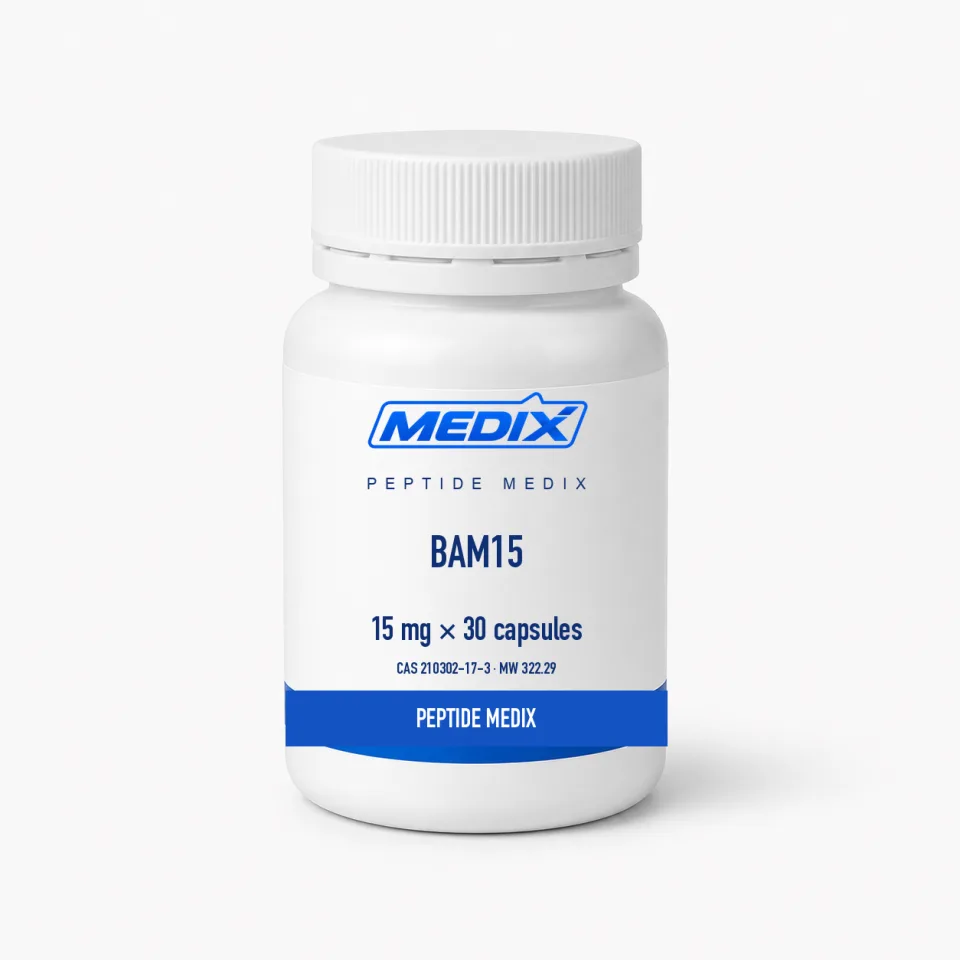
BAM15

Mitochondria-selective protonophore research capsules, 15 mg × 30

Review catalog details Secure payments
Available to order
$85.00 $100.00 15% OFF
1
Categories: bam15 , mitochondrial uncoupler , protonophore

Choose your delivery method

Standard Shipping is automatically selected at checkout. Customers can upgrade to a faster delivery option anytime.

Overview

BAM15 is a small-molecule mitochondrial protonophore from the oxadiazolopyrazine class, supplied here as 15 mg capsules in a sealed 30-count bottle. It is not a peptide. Its interest in the literature comes from a single mechanistic property: it carries protons back across the inner mitochondrial membrane, dissipating part of the proton-motive force as heat instead of letting it drive ATP synthase. Substrate oxidation therefore continues while ATP output per unit of fuel falls — the definition of chemical uncoupling.

Specifications

Brand Peptide Medix
Category Fat-Loss & Metabolic Peptides
Form Oral capsule in a sealed bottle with tamper-evident closure
Content per capsule 15 mg BAM15
Available size 30 capsules
CAS number 210302-17-3
Molecular weight 322.29 g/mol
Chemical class Oxadiazolopyrazine (furazano-pyrazine) diamine — small molecule, non-peptide
Mechanism studied Protonophore; transports protons across the inner mitochondrial membrane, uncoupling respiration from ATP synthesis
Selectivity note Reported to depolarise mitochondrial but not plasma membrane at comparable concentrations
Purity Analytically tested; certificate of analysis available
Research areas Mitochondrial bioenergetics, energy expenditure, diet-induced obesity models, hepatic steatosis models, ischaemia–reperfusion injury
Solubility Poorly water soluble; DMSO is the usual solvent for in vitro stock preparation
Storage Room temperature, sealed, dry and protected from light
Preparation required None — fixed unit content, no reconstitution step
SKU BAM15-15-MG-30-CAPSULES

Highlights

  • 15 mg of BAM15 per capsule, 30 capsules per sealed bottle
  • Oxadiazolopyrazine-class mitochondrial protonophore (chemical uncoupler)
  • Described in the literature as mitochondria-selective, unlike DNP-type uncouplers
  • Small molecule, not a peptide — no reconstitution or cold-chain handling
  • Studied in mitochondrial bioenergetics, substrate oxidation and metabolic models
  • Analytically tested material; certificate of analysis available on request
  • Room-temperature storage; ships from the United States

What's Included

  • The product option and count selected above
  • Final item and quantity confirmed in cart
  • Laboratory-research-use labeling

Research Overview

What uncoupling means

Mitochondria pump protons out of the matrix during electron transport, and the resulting electrochemical gradient drives ATP synthase. A protonophore provides an alternative return path, so the gradient partially collapses and the energy appears as heat. Respiration accelerates to compensate, oxygen consumption rises, and the cell burns more substrate for the same ATP output. Uncoupling is a normal physiological process too — uncoupling protein 1 in brown adipose tissue does the same thing endogenously.

Why selectivity mattered

The classical uncoupler DNP produced dramatic metabolic effects and, in the 1930s, fatal hyperthermia; it is not a usable research reference for whole-organism work. BAM15 was reported in the original characterisations to act on the inner mitochondrial membrane without comparable plasma-membrane depolarisation, and to increase respiration over a wider concentration range before respiratory inhibition sets in. That wider window is what makes it tractable as a tool compound.

Published rodent and cell work has examined, among other endpoints:

  • Oxygen consumption rate and proton leak in isolated mitochondria and intact cells
  • Adiposity and glucose handling in diet-induced obese mice
  • Hepatic lipid accumulation in fatty-liver models
  • Tissue injury markers in kidney and liver ischaemia–reperfusion models
  • Whether core body temperature and food intake change, since both confound interpretation
Open questions

Handling & Storage

Store the bottle sealed at room temperature, dry and out of direct light, and keep the desiccant in place if one is supplied. Because the content per capsule is fixed, no weighing or reconstitution is needed for unit-based work; for in vitro use, the compound is poorly water soluble and is normally prepared as a concentrated DMSO stock then diluted into medium, with the final solvent fraction kept low and vehicle-matched controls run alongside. Handle capsule contents with gloves in a ventilated area, avoid generating dust, and log bottle lot number and opening date so material can be traced back to its certificate of analysis.

BAM15 FAQ

What exactly does BAM15 do at the molecular level?
It shuttles protons across the inner mitochondrial membrane, bypassing ATP synthase. The proton gradient built by the electron transport chain is partially dissipated as heat, so respiration increases while ATP produced per unit of substrate falls. That is chemical uncoupling, and it is measured in the literature as an increase in oxygen consumption rate.
How is it different from DNP?
Both are protonophores, but published characterisation describes BAM15 as mitochondria-selective — depolarising the inner mitochondrial membrane at concentrations that leave plasma-membrane potential broadly intact — whereas DNP acts on both. DNP has a documented history of fatal hyperthermia and is not a usable reference compound for whole-organism research.
Do you provide a certificate of analysis?
Yes. Material is analytically tested and a lot-matched certificate of analysis is available covering identity and purity of the compound used in the capsule fill. Quote the lot number printed on the bottle label when requesting it.
How should the capsules be stored?
Sealed at room temperature, dry, and away from direct light and heat. Unlike lyophilized peptides, this compound does not require freezer storage or cold-chain shipping. Keep the bottle closed between handling sessions and record the date it was first opened.

This catalog listing is for laboratory research use only. It is not represented as a drug, food, supplement, cosmetic or diagnostic product, and it is not offered for human or veterinary use.

Customer Reviews

0 reviews
5 star
0%
4 star
0%
3 star
0%
2 star
0%
1 star
0%

Leave Your Review

Rating

No reviews yet — be the first!

Leave Your Review

Rating

Keep exploring

Related Products & Shopping Guides

Compare BAM15 with relevant categories, product topics, and practical shopping information.

Often researched together

Related research peptides, blends and lab supplies frequently ordered with BAM15.

15% OFF
SLU-PP-332 + BAM-15

Peptide Medix

SLU-PP-332 + BAM-15

slu-pp-332
$106.00 $125.00

View options and product details

15% OFF
5-Amino-1MQ

Peptide Medix

5-Amino-1MQ

5-amino-1mq

2 options

$80.00 $95.00

View options and product details

15% OFF
MOTS-c

Peptide Medix

MOTS-c

mots-c

4 options

$55.00 $65.00

View options and product details

15% OFF
5-Amino-1MQ Capsules

Peptide Medix

5-Amino-1MQ Capsules

5-amino-1mq capsules

2 options

$72.00 $85.00

View options and product details

15% OFF
Lipo-B (MIC + B12)

Peptide Medix

Lipo-B (MIC + B12)

lipo-b

2 options

$34.00 $40.00

View options and product details

15% OFF
L-Carnitine Injection

Peptide Medix

L-Carnitine Injection

l-carnitine

2 options

$38.00 $45.00

View options and product details