Research Overview
Two pathways, one molecule
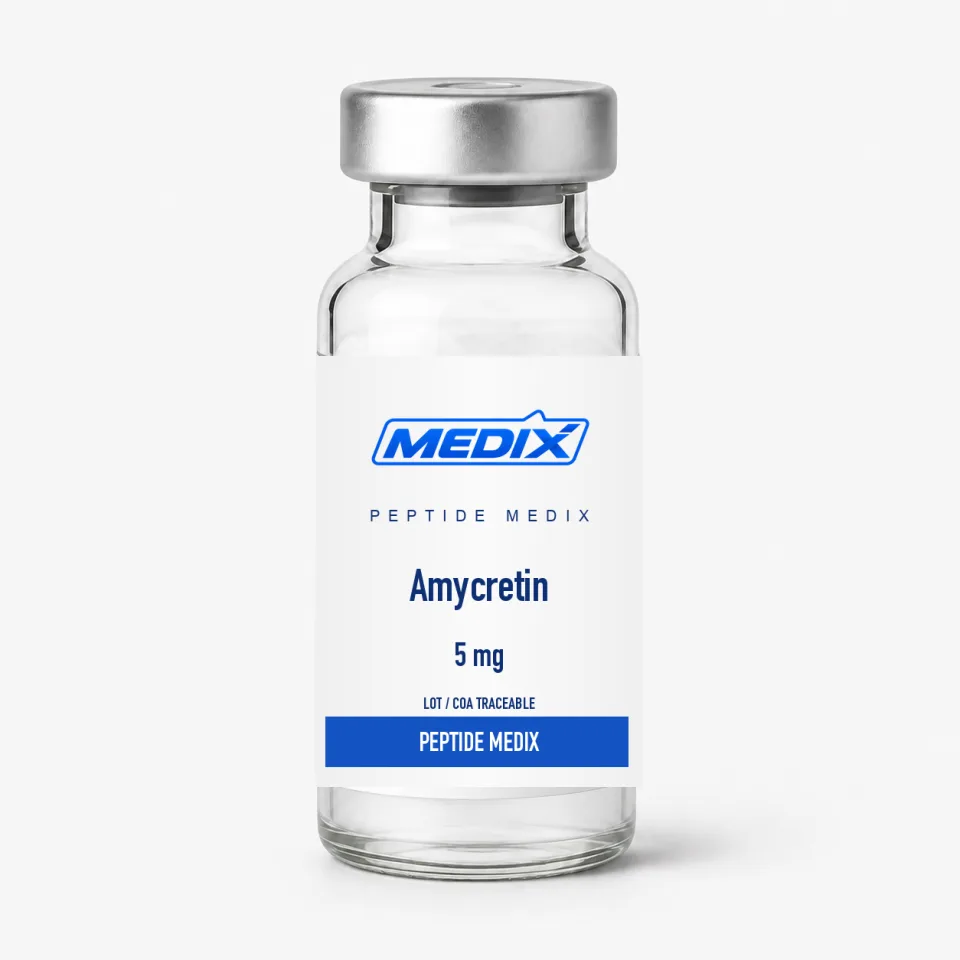
Amylin is a pancreatic beta-cell hormone co-secreted with insulin that slows gastric emptying and signals satiation through hindbrain calcitonin receptor–RAMP complexes. GLP-1 is an intestinal incretin acting at its own class B receptor to enhance glucose-dependent insulin secretion and reduce food intake. Because the two act through overlapping but non-identical circuits, combining them has been a persistent research theme. A unimolecular co-agonist pursues that combination pharmacokinetically as well as pharmacodynamically, since one molecule means one exposure profile rather than two.
What early-phase work has examined
- Glycaemic measures including glucose excursion and insulin response
- Tolerability, which for this drug class is dominated by gastrointestinal effects
Where it sits among related compounds
Retatrutide is a triple GIP/GLP-1/glucagon receptor agonist; survodutide targets GLP-1 and glucagon receptors; cagrilintide is a long-acting amylin analogue studied in combination with semaglutide. Amycretin's distinguishing feature is that the amylin arm and the incretin arm are built into the same peptide. Laboratories comparing these agents generally do so in matched assay systems, because receptor-selectivity profiles and acylation strategies differ enough that cross-study comparison is unreliable.
Assay considerations
Co-agonist characterisation normally requires separate receptor-level assays for each arm — cAMP accumulation in cells expressing the GLP-1 receptor, and in cells expressing calcitonin receptor with the relevant RAMP — before any whole-organism endpoint is interpreted. Potency at one receptor cannot be inferred from the other, and the ratio between them is the parameter that defines a co-agonist.