Research Overview
A two-part molecular design
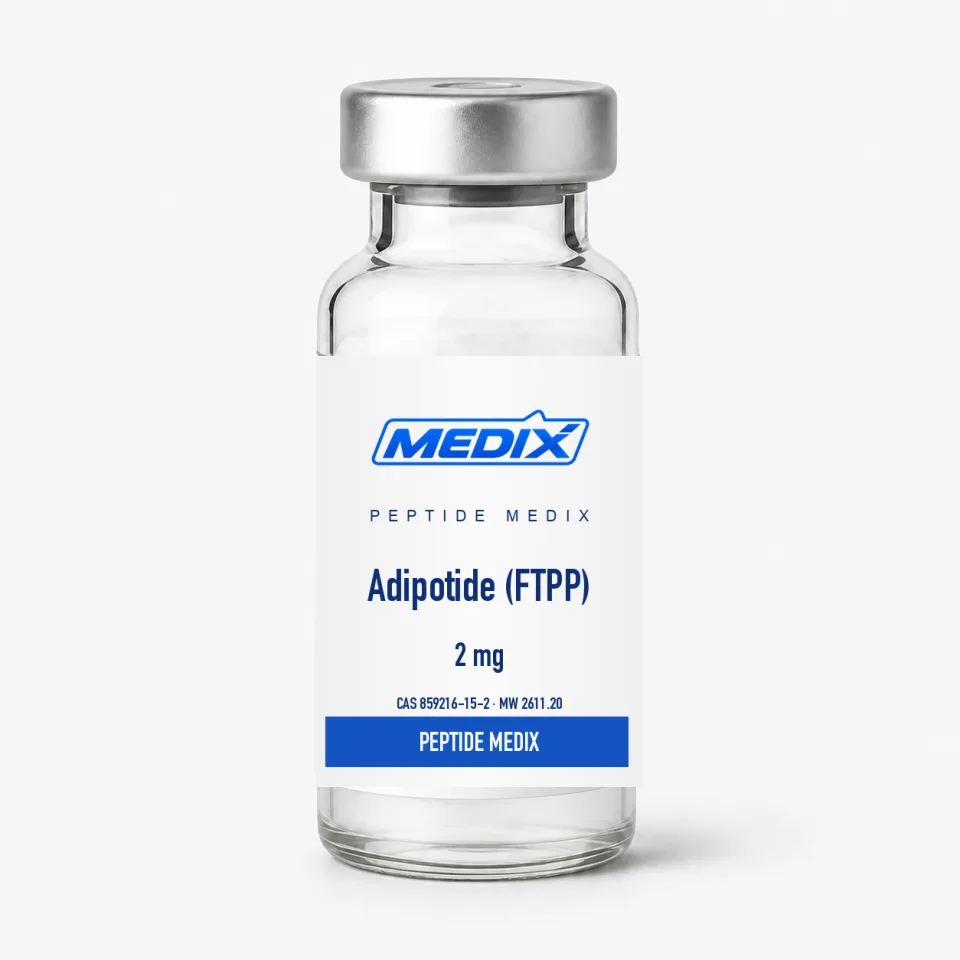
Adipotide belongs to a family of ligand-directed constructs in which a short targeting sequence is fused to a cytotoxic effector. The CKGGRAKDC motif was recovered from in vivo phage-display libraries and reported to accumulate in the vasculature that perfuses white adipose tissue, where prohibitin-1 was proposed as the binding partner. Fusing that motif to D(KLAKLAK)2 gives a molecule that is largely inert until it is internalised, at which point the amphipathic helix associates with mitochondrial membranes.
- Binding and uptake in cultured endothelial cells expressing prohibitin at the cell surface
- Adipose depot mass, vascular density and apoptotic markers in diet-induced obese rodent models
- Body-composition and metabolic endpoints in obese non-human primates, including changes in food intake
- Whether the same homing-plus-effector approach transfers to tumour vasculature, which is where the underlying chemistry originated
Reported limitations
Where it sits among metabolic research peptides
Unlike GLP-1 analogues, AOD-9604 or HGH fragment 176-191, Adipotide does not engage a metabolic receptor or signalling cascade. Comparative study designs therefore pair it with those peptides as mechanistically distinct arms rather than as interchangeable alternatives.
Analytical handling
Identity is typically confirmed by mass spectrometry alongside HPLC purity, since the construct is long enough that truncation products and incomplete cyclisation are the usual synthesis-related impurities to look for on a certificate of analysis.