Research Overview
Origin of the fragment
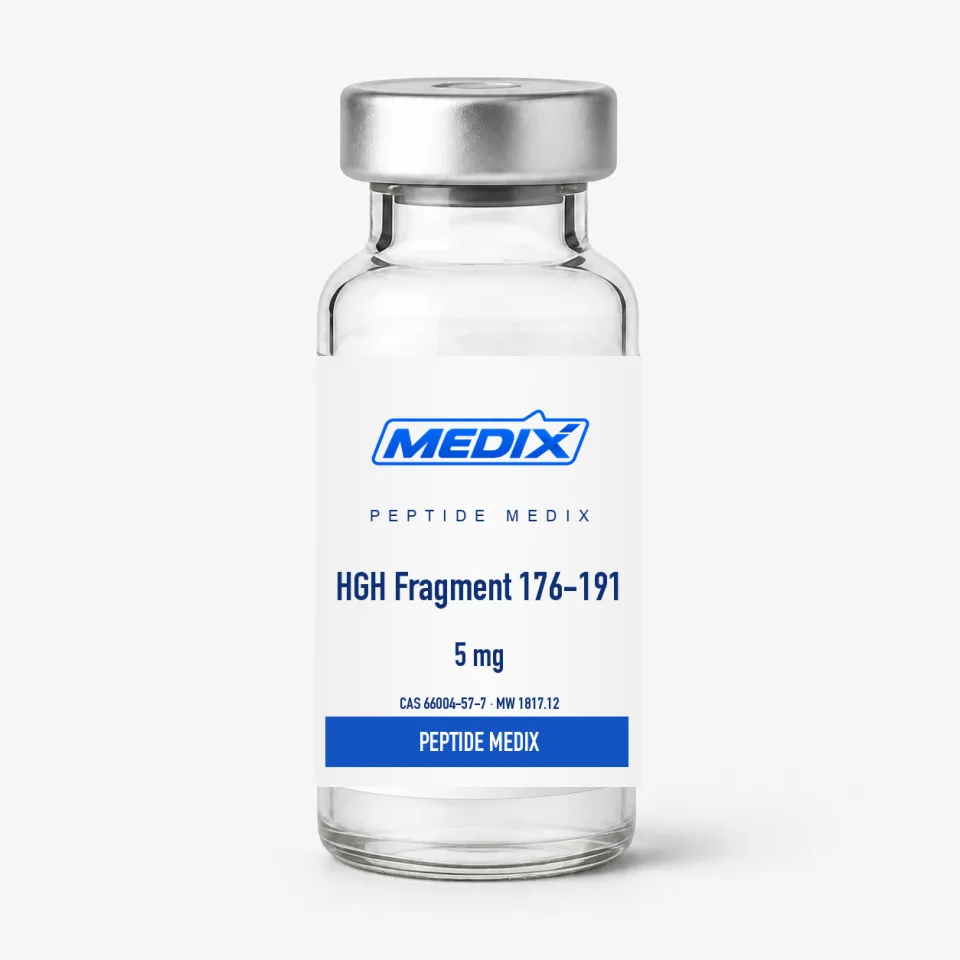
Growth hormone carries several functional domains along its 191-residue chain. Work mapping those domains suggested that the C-terminal region retained fat-metabolism activity when tested apart from the intact hormone, while the receptor-binding surfaces responsible for growth signaling did not overlap it. HGH Fragment 176-191 is the peptide that came out of that mapping and it remains the reference sequence for the series.
Adipose tissue studies
Adipocyte cultures and adipose explants are the usual test system. Investigators measure glycerol and free fatty acid release as lipolysis endpoints and quantify lipogenic enzyme expression to examine reported inhibition of fat synthesis. Rodent studies extend this to fat-pad mass, adipose-depot distribution and body-composition endpoints in diet-induced obesity models.
Separation from GH receptor signaling
- IGF-1 concentrations monitored to test whether growth signaling stays unaffected
- Insulin sensitivity and glucose-handling markers followed alongside lipid endpoints
- Direct comparison with full-length growth hormone in matched preparations
Structure-activity comparison
Because AOD-9604 is the same core segment with an added tyrosine and a Cys7-Cys15 disulfide bridge, running the two side by side isolates the contribution of cyclization. Analytical groups compare reversed-phase retention, mass-spectrometric behavior and solution stability between the linear fragment and the cyclized analog. The linear peptide is the more fragile of the pair in solution, since its free cysteines can oxidize or form intermolecular dimers, and tracking that behavior is itself a common analytical exercise.
Handling-related findings
Reported effect sizes in this literature vary widely between species, cell type and assay format. Study designs therefore usually include a well-characterized lipolytic positive control, such as a beta-adrenergic agonist, so fragment responses can be scaled against a known reference rather than interpreted in isolation.