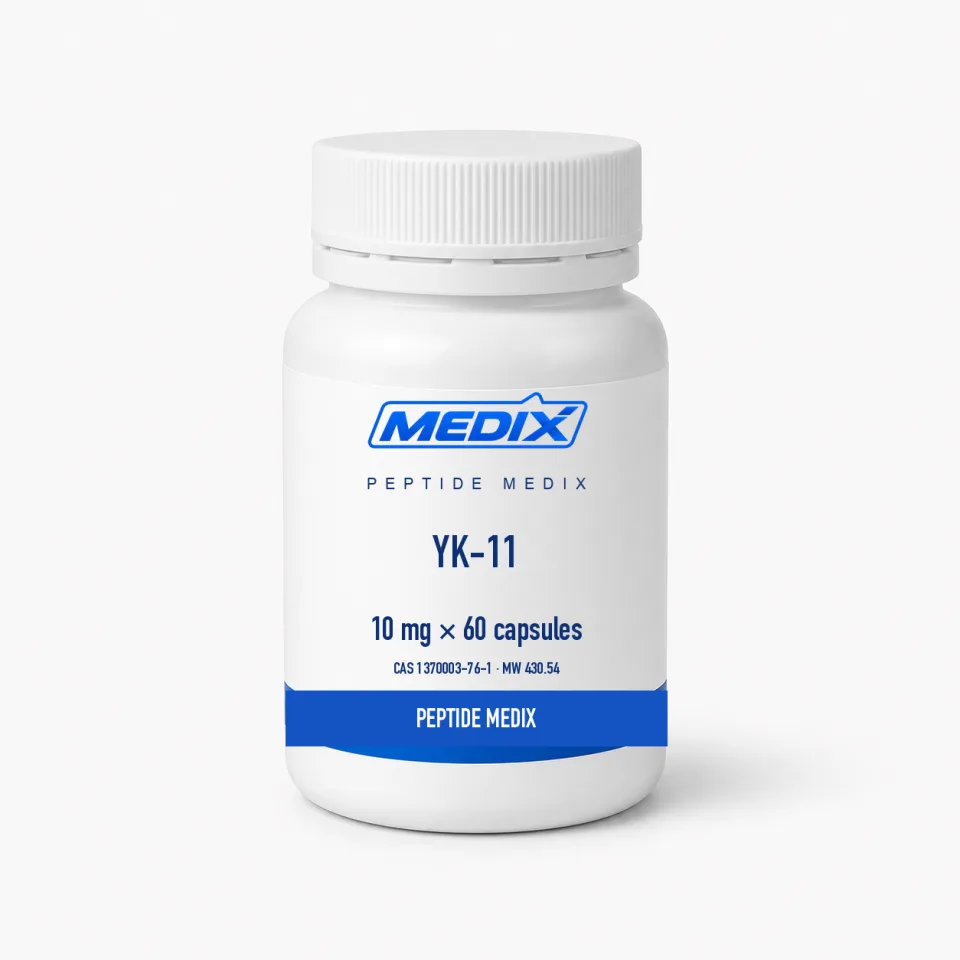
Peptide Medix product catalog

Peptide Medix

YK-11

Steroidal partial androgen receptor modulator studied in myostatin work

Review catalog details Secure payments
Available to order · 2 of 2 options available
$55.00 $65.00 15% OFF

Choose an option

1
Categories: yk-11 , sarms , steroidal sarm

Choose your delivery method

Standard Shipping is automatically selected at checkout. Customers can upgrade to a faster delivery option anytime.

Overview

YK-11 is a synthetic research compound usually grouped with the SARMs, though it sits apart from the rest of that class in one important way: its structure is steroidal. The molecule is built on a 5α-androstane scaffold derived from dihydrotestosterone and carries a gem-dimethyl malonate ester at C-17, giving a formula of C25H34O6, a mass of 430.54 g/mol and CAS number 1370003-76-1. Compounds such as RAD-140 or LGD-4033, by contrast, have no steroid nucleus at all.

It was first described by Yuichiro Kanno and colleagues in Japan around 2011, in work characterising partial agonism at the androgen receptor. The reports that drew most attention came shortly afterwards, when cultured C2C12 myotubes exposed to the compound were described as increasing follistatin expression — follistatin being an endogenous antagonist of myostatin. That single line of cell-culture evidence is the origin of the widespread description of YK-11 as a “myostatin inhibitor”, a label the published data supports only loosely and only in vitro.

We supply YK-11 as 10 mg capsules in 60-count bottles and as a 30 mL research liquid at 20 mg/mL, tested by HPLC to at least 98% with a lot-matched certificate of analysis available. YK-11 is not an approved drug in any country, is not a lawful dietary ingredient in the United States, and is offered strictly for laboratory research use.

Specifications

Brand Peptide Medix
Category SARMs
Form Oral capsules in a sealed bottle, or research liquid in a dropper bottle
Purity ≥98% by HPLC; lot-matched COA available
Available options 10 mg × 60 capsules; 30 mL liquid at 20 mg/mL
CAS number 1370003-76-1
Molecular formula C25H34O6
Molecular weight 430.54 g/mol
Compound class Steroidal selective androgen receptor modulator (partial agonist)
Core structure 5α-androstane nucleus with a gem-dimethyl malonate ester at C-17
Molecular target Androgen receptor; downstream follistatin expression studied in myotubes
Research areas Androgen receptor partial agonism, follistatin and myostatin signalling, myotube differentiation
Solubility Poorly water soluble; DMSO or ethanol used for concentrated stocks
Storage (capsules and solid) Room temperature, sealed with desiccant, away from light, heat and humidity
Storage (research liquid) Cool and dark, closure tight; refrigerate for extended study windows
Regulatory status Not an approved drug; not a lawful dietary ingredient in the US; prohibited by WADA
SKU YK-11-10-MG-60-CAPSULES

Highlights

  • ≥98% purity by HPLC with a lot-matched Certificate of Analysis available
  • Two research formats: 10 mg × 60 capsules, or 30 mL liquid at 20 mg/mL
  • Steroidal scaffold, CAS 1370003-76-1, C25H34O6, MW 430.54 g/mol
  • Unlike RAD-140 or LGD-4033, the structure is built on a 5α-androstane nucleus
  • Characterised in the literature as a partial androgen receptor agonist
  • Cell-culture work reported increased follistatin expression in C2C12 myotubes
  • Not an approved drug, not a lawful dietary supplement, prohibited in sport

What's Included

  • The product option and count selected above
  • Final item and quantity confirmed in cart
  • Laboratory-research-use labeling

Research Overview

A steroidal molecule in a non-steroidal class

The word SARM was coined for non-steroidal ligands that bind the androgen receptor without the steroid nucleus and its metabolic liabilities. YK-11 is routinely sold under that label but does not meet that structural definition: it is a dihydrotestosterone derivative bearing an unusual C-17 gem-dimethyl malonate ester. The distinction matters when interpreting results, because a steroidal backbone can in principle interact with steroid-metabolising enzymes and steroid-binding proteins in ways a purely synthetic scaffold does not.

Partial agonism and the follistatin observation

The original characterisation described YK-11 as a partial agonist: it occupies the androgen receptor ligand-binding pocket but produces a lower maximal transcriptional response than a full agonist such as DHT, and can therefore compete with and blunt full-agonist signalling in the same system. Follow-up work in differentiating C2C12 mouse myotubes reported increased follistatin expression and markers of myogenic differentiation, with the effect described as androgen receptor dependent. Because follistatin binds and neutralises myostatin, this became the basis for the compound's reputation as a myostatin inhibitor — but no direct inhibition of myostatin has been demonstrated, and the finding rests on in-vitro data.

What has and has not been studied

  • Androgen receptor binding and transactivation reporter assays in transfected cells
  • Myotube differentiation and follistatin expression in the C2C12 line
  • Anti-proliferative effects reported in some androgen-receptor-positive cancer cell lines
  • No published controlled human trials; no systematic animal toxicology in the peer-reviewed record
  • Analytical chemistry work developing detection methods for anti-doping laboratories

YK-11 has never been evaluated by a regulatory agency for any indication. The US FDA has publicly warned against SARM-labelled products and stated they do not qualify as dietary ingredients, and WADA prohibits the class at all times in sport. Independent analyses of consumer SARM products have repeatedly found mislabelling and adulteration, which is the practical reason lot-level analytical documentation is essential when the material is used as a reference standard or research input.
Handling & Storage

Store capsules in the original sealed bottle with the desiccant in place, at room temperature and away from heat, light and humidity; keep the research liquid upright, tightly closed and out of direct light, refrigerated if the study runs long. Note the lot number and the date the container is first opened so results remain traceable to the certificate of analysis. The compound is poorly water soluble, so aqueous work normally starts from a DMSO or ethanol stock diluted into medium — hold the final solvent fraction constant across every arm and include a vehicle-only control. Wear gloves, avoid raising dust from solid material, and dispose of waste under your institution's chemical hygiene plan.

YK-11 FAQ

Is YK-11 actually a SARM?
It is sold and discussed as one, but structurally it is a steroid. The molecule is a dihydrotestosterone derivative with a gem-dimethyl malonate ester at C-17, whereas compounds such as RAD-140 and LGD-4033 have no steroid nucleus. It is more accurately described as a steroidal partial androgen receptor agonist.
Does YK-11 inhibit myostatin?
Not directly, on the published evidence. Cell-culture work in C2C12 myotubes reported increased expression of follistatin, a natural myostatin antagonist. That is an indirect and in-vitro observation, and it is the sole basis for the myostatin-inhibitor label the compound is usually given.
What does partial agonist mean here?
It means YK-11 binds the androgen receptor but produces a smaller maximal transcriptional response than a full agonist like DHT. In a system already exposed to a full agonist, a partial agonist can compete for the pocket and reduce the overall signal, so context determines the observed direction of effect.
How is purity verified and is a COA supplied?
Each lot is analysed by HPLC to at least 98% purity with identity confirmation against the expected 430.54 g/mol mass. A certificate of analysis matched to the lot number printed on your bottle is available on request at any point before or after purchase.
Capsules or research liquid — which format suits a study?
Capsules give a fixed 10 mg unit with no preparation step, which suits repeated-unit protocols. The 30 mL liquid at 20 mg/mL is easier when a study needs variable amounts or dilution into a vehicle, since volume can be measured directly rather than opening multiple capsules.
What is the legal status of YK-11?
It is not approved as a medicine anywhere and cannot lawfully be marketed as a dietary supplement in the United States. WADA prohibits SARMs at all times in sport. Investigators should confirm the compound's status under their own institutional and national rules before starting work.

This catalog listing is for laboratory research use only. It is not represented as a drug, food, supplement, cosmetic or diagnostic product, and it is not offered for human or veterinary use.

Customer Reviews

0 reviews
5 star
0%
4 star
0%
3 star
0%
2 star
0%
1 star
0%

Leave Your Review

Rating

No reviews yet — be the first!

Leave Your Review

Rating

Keep exploring

Related Products & Shopping Guides

Compare YK-11 with relevant categories, product topics, and practical shopping information.

Often researched together

Related research peptides, blends and lab supplies frequently ordered with YK-11.

15% OFF
RAD-140 (Testolone)

Peptide Medix

RAD-140 (Testolone)

rad-140

2 options

$55.00 $65.00

View options and product details

15% OFF
LGD-4033 (Ligandrol)

Peptide Medix

LGD-4033 (Ligandrol)

lgd-4033

2 options

$55.00 $65.00

View options and product details

15% OFF
ACP-105

Peptide Medix

ACP-105

acp-105

2 options

$55.00 $65.00

View options and product details

15% OFF
MK-2866 (Ostarine)

Peptide Medix

MK-2866 (Ostarine)

mk-2866

2 options

$55.00 $65.00

View options and product details

15% OFF
S-23

Peptide Medix

S-23

s-23

2 options

$55.00 $65.00

View options and product details