Research Overview
A recurring collagen motif
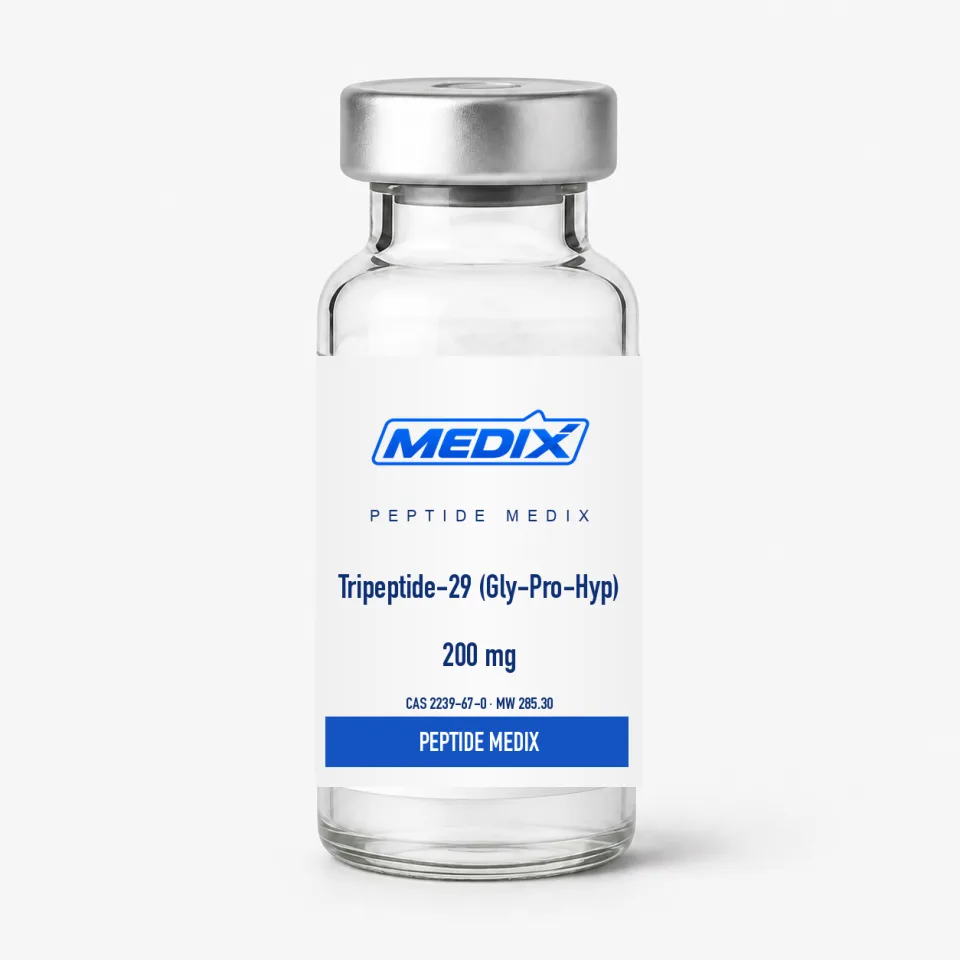
Collagen's triple helix is built around Gly-X-Y repeats, with proline and hydroxyproline frequent in the X and Y positions. Gly-Pro-Hyp is therefore both a structural motif and a common digestion product. As a purified reagent it supports work that separates the behavior of one defined tripeptide from the many sequences present in a hydrolysate.
Transport and metabolism
Small collagen-derived peptides can be measured in transport and metabolism models, including peptide-transporter and plasma-stability studies. Gly-Pro-Hyp's imino-acid bonds affect cleavage by common peptidases. Assays should distinguish intact tripeptide from Gly-Pro, Pro-Hyp and free amino acids rather than relying on total hydroxyproline.
Research uses
- LC-MS standards for collagen-hydrolysate composition and stability
- Fibroblast and matrix readouts using purified versus mixed peptide fractions
- Glycation and oxidative-stress models involving collagen-associated endpoints
- DPP-IV inhibition and substrate-resistance assays in vitro
- Model-peptide studies of hydroxyproline contributions to collagen-like conformations
Distinguishing the related small peptides
Collagen digests yield an overlapping family of short imino-acid-rich peptides, and several of them share fragment masses. Work that reports Gly-Pro-Hyp should therefore resolve it chromatographically from Pro-Hyp, Hyp-Gly and Gly-Pro rather than relying on mass alone, and should state the hydroxyproline stereochemistry. Where a purified standard is used to calibrate a hydrolysate assay, the calibration range needs to cover the concentrations actually observed in the sample.
Interpretation controls
Results from an oral collagen hydrolysate cannot be assigned to Tripeptide-29 merely because Gly-Pro-Hyp is abundant. Concentration, transport, metabolism and co-occurring peptides all matter. A purified single-peptide arm, a matched amino-acid mixture and the original hydrolysate provide a more informative comparison.