Peptide Medix product catalog

Peptide Medix

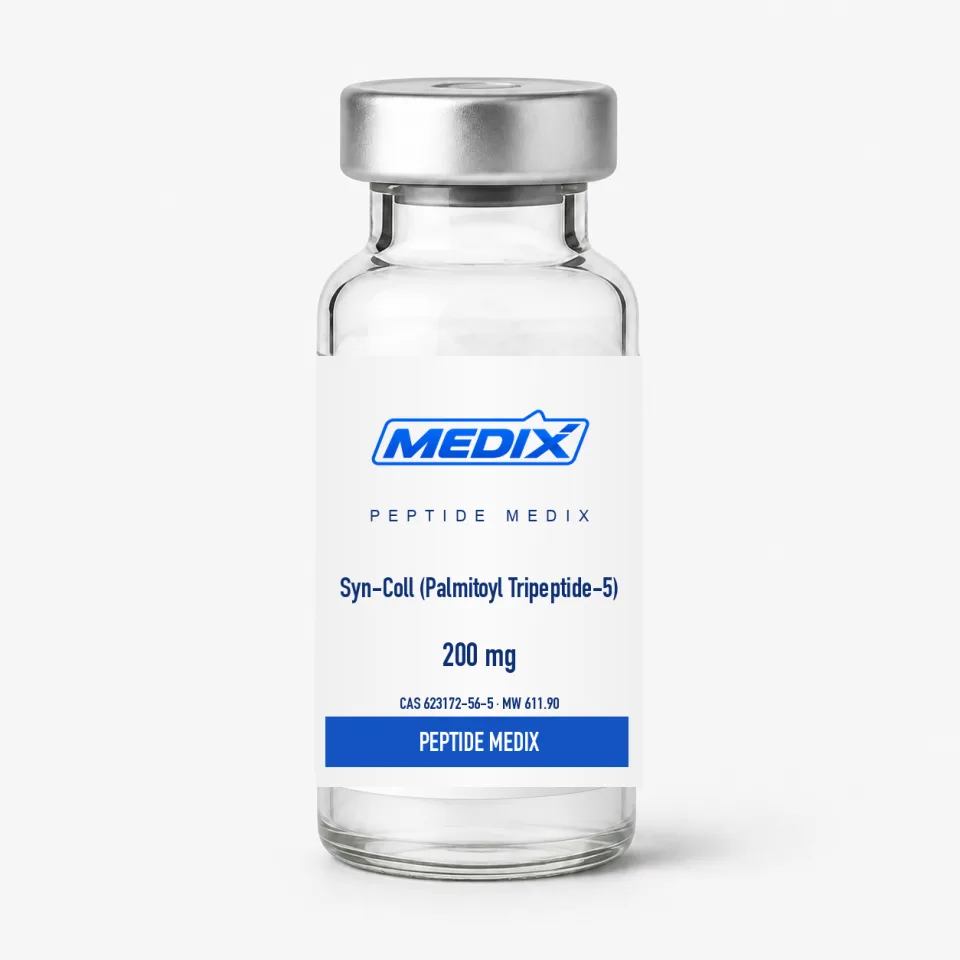
Syn-Coll (Palmitoyl Tripeptide-5)

Pal-KVK signal tripeptide for TGF-beta and matrix-model research

Review catalog details Secure payments
Available to order
$178.00 $210.00 15% OFF
1
Categories: syn-coll , palmitoyl tripeptide-5 , pal-kvk

Choose your delivery method

Standard Shipping is automatically selected at checkout. Customers can upgrade to a faster delivery option anytime.

Overview

Syn-Coll is the common trade-style name for Palmitoyl Tripeptide-5, a lipidated Lys-Val-Lys sequence written Pal-KVK. Its N-terminal C16 chain gives the peptide an amphiphilic character, while the basic lysine residues distinguish its charge and formulation behavior from other palmitoylated matrikines such as Pal-GHK and Pal-GQPR.

The compound was designed for extracellular-matrix research around transforming growth factor beta (TGF-beta) signaling and collagen-associated readouts. Studies and supplier dossiers have examined fibroblast matrix output, latent TGF-beta activation and matrix-metalloproteinase markers, but much of the evidence is formulation-specific or commercial. Direct analytical and single-agent controls are necessary before assigning an effect to Pal-KVK.

This 200 mg research vial contains Palmitoyl Tripeptide-5, formula C33H65N5O5 and molecular weight 611.90 g/mol. The peptide is HPLC tested with a lot-matched COA available. It is not a finished cosmetic and is supplied only for laboratory formulation and cell-model work.

Comparison with other lipidated matrikines is informative but should be handled carefully. Matrixyl is palmitoyl pentapeptide-4 built on the KTTKS sequence, Pal-GHK carries the copper-binding GHK motif, and Pal-GQPR is a distinct tetrapeptide; sharing a C16 chain does not imply a shared mechanism. The lysine-rich Pal-KVK core also behaves differently in anionic systems, so vehicle compatibility established for one palmitoylated peptide should be re-established here rather than carried across.

Specifications

Brand Peptide Medix
Category Cosmetic Signal Peptides
Form Lyophilized amphiphilic peptide powder, sealed glass vial
Available size 200 mg
Purity ≥99% by HPLC; lot-matched COA available
CAS number 623172-56-5
Molecular formula C33H65N5O5
Molecular weight 611.90 g/mol as the free peptide
Sequence Palmitoyl-Lys-Val-Lys-OH (Pal-KVK)
Also known as Syn-Coll, Syn-Coll peptide, Palmitoyl Tripeptide-5
Peptide class Lipidated signal tripeptide
Research areas TGF-beta signaling, fibroblast matrix output, collagen-associated markers and matrix-metalloproteinase models
Solubility Low water solubility; validate a co-solvent or surfactant vehicle
Storage −20 °C lyophilized, protected from light and moisture
SKU SYN-COLL-200-MG

Highlights

  • Palmitoyl-Lys-Val-Lys signal tripeptide, abbreviated Pal-KVK
  • Commonly known as Syn-Coll or Palmitoyl Tripeptide-5
  • C33H65N5O5; molecular weight 611.90 g/mol
  • Single 200 mg lyophilized research-vial format
  • ≥99% HPLC purity with lot-matched certificate of analysis
  • Studied in TGF-beta, fibroblast and extracellular-matrix models
  • Research use only — not a finished cosmetic or drug

What's Included

  • The vial option and size selected above
  • Final item and quantity confirmed in cart
  • Laboratory-research-use labeling

Research Overview

Pal-KVK structure

Palmitoyl Tripeptide-5 combines a hydrophobic C16 chain with a short, lysine-rich peptide. The lipid tail increases membrane and interface partitioning, while the two lysine side chains remain positively charged near neutral pH. That mixed character affects chromatography, container adsorption and compatibility with anionic formulation components.

TGF-beta research rationale

Experimental panel

  • Direct TGF-beta pathway controls or receptor inhibition where appropriate
  • Pal-GHK, Pal-GQPR and Matrixyl as sequence-distinct lipidated comparators
  • Matrix-metalloproteinase and TIMP measurements beside synthesis markers

Separating peptide effect from surfactant effect

An amphiphilic molecule with a C16 tail can alter membrane order, vehicle micellisation and the delivery of other components independently of any signalling role. A study attributing a matrix readout to Pal-KVK should therefore include a lipid-only or scrambled-sequence arm at matched amphiphilicity, so that a surfactant-like contribution can be distinguished from the sequence-specific hypothesis the peptide was designed around.

Formulation caveat

Amphiphilic peptides can remain nominally present while precipitating, adsorbing to a container or partitioning into a phase that cells do not access. A formulation study should quantify intact Pal-KVK rather than infer exposure from the amount initially weighed. Supplier-sponsored mixture data should not be assigned automatically to the standalone peptide.
Handling & Storage

Equilibrate the closed vial to room temperature before opening. Prepare a concentrated stock using a validated co-solvent or surfactant system, then dilute gradually into the experimental vehicle. Use glass or low-binding labware and check for precipitation or phase separation. Store the sealed powder at −20 °C, protected from light and humidity; hold prepared stocks at 2–8 °C only for a defined study window. Record whether molecular calculations use the free peptide or a documented counterion salt.

Syn-Coll (Palmitoyl Tripeptide-5) FAQ

What is the sequence of Syn-Coll?
The defined peptide is Palmitoyl-Lys-Val-Lys-OH, abbreviated Pal-KVK. It is cataloged as Palmitoyl Tripeptide-5 and has a free-peptide molecular weight of 611.90 g/mol.
Is Syn-Coll the same as Matrixyl?
No. Matrixyl is most commonly associated with Palmitoyl Pentapeptide-4, sequence Pal-KTTKS. Syn-Coll is Palmitoyl Tripeptide-5, sequence Pal-KVK. They are distinct compounds and need separate pages and controls.
Is it the same as Palmitoyl Tripeptide-1?
No. Palmitoyl Tripeptide-1 is Pal-GHK, while this product is Pal-KVK. They share a lipidation strategy but not the peptide sequence or research rationale.
Why is a co-solvent sometimes needed?
The C16 palmitoyl group makes the molecule poorly soluble in plain water and prone to surface adsorption or self-association. A documented co-solvent or surfactant can improve reproducibility, provided the same vehicle is used in controls.

This catalog listing is for laboratory research use only. It is not represented as a drug, food, supplement, cosmetic or diagnostic product, and it is not offered for human or veterinary use.

Customer Reviews

0 reviews
5 star
0%
4 star
0%
3 star
0%
2 star
0%
1 star
0%

Leave Your Review

Rating

No reviews yet — be the first!

Leave Your Review

Rating

Keep exploring

Related Products & Shopping Guides

Compare Syn-Coll (Palmitoyl Tripeptide-5) with relevant categories, product topics, and practical shopping information.

Often researched together

Related research peptides, blends and lab supplies frequently ordered with Syn-Coll (Palmitoyl Tripeptide-5).