Peptide Medix product catalog

Peptide Medix

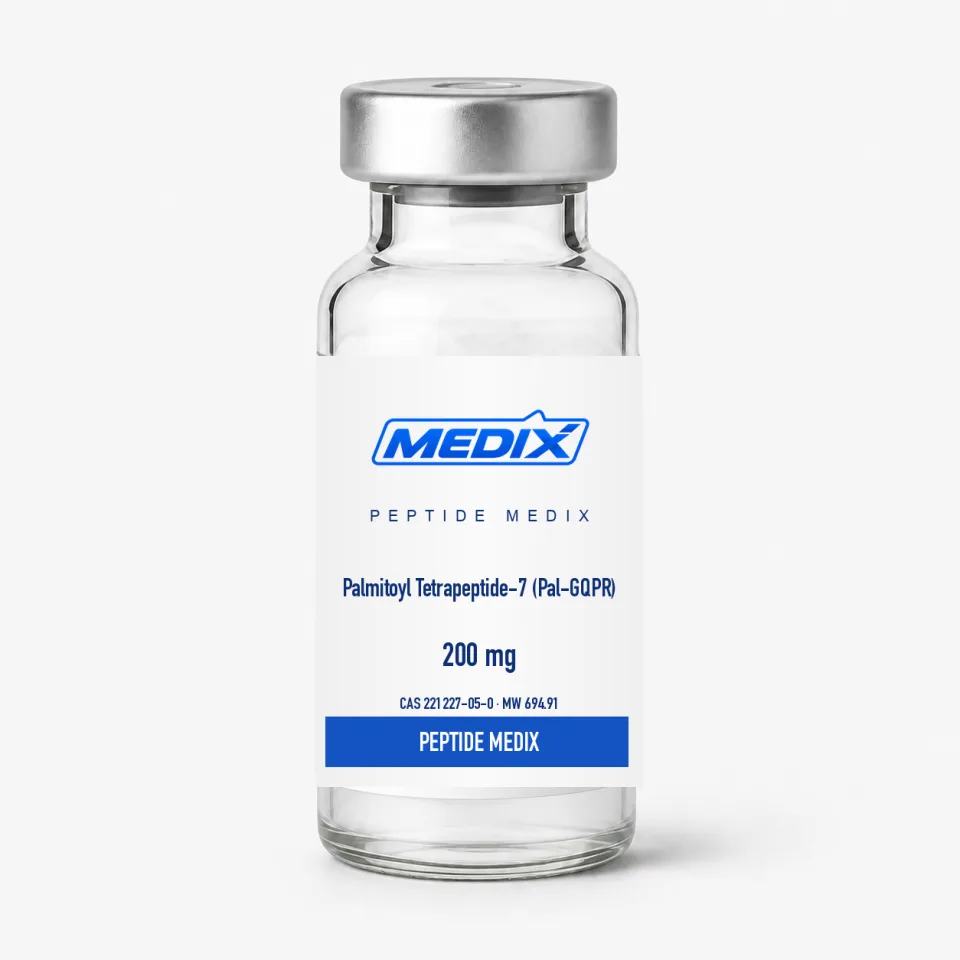
Palmitoyl Tetrapeptide-7 (Pal-GQPR)

Lipidated GQPR matrikine used in matrix, cytokine and permeation models

Review catalog details Secure payments
Available to order
$199.00 $235.00 15% OFF
1
Categories: palmitoyl tetrapeptide-7 , pal-gqpr , matrixyl 3000 peptide

Choose your delivery method

Standard Shipping is automatically selected at checkout. Customers can upgrade to a faster delivery option anytime.

Overview

Palmitoyl Tetrapeptide-7 is the N-palmitoylated form of Gly-Gln-Pro-Arg, abbreviated Pal-GQPR. The GQPR sequence is associated with an immunoglobulin G fragment, while the attached sixteen-carbon chain raises lipophilicity and changes how the peptide partitions into membranes, emulsions and other lipid-rich systems. Free GQPR is also catalogued as rigin, and it shares its C-terminal Pro-Arg motif with tuftsin (Thr-Lys-Pro-Arg), another short immunoglobulin-derived sequence — a relationship worth noting because it places the peptide outside the true matrikines, which are fragments of extracellular-matrix proteins rather than of an antibody.

This ingredient is often encountered as one half of Matrixyl 3000-type formulations alongside Palmitoyl Tripeptide-1. A standalone vial lets laboratories study Pal-GQPR independently, quantify it separately and run single-agent controls before interpreting a two-peptide blend. Published work is weighted toward formulation, fibroblast, extracellular-matrix and cytokine-marker models, with independent evidence more limited than branded mixture claims may suggest. Acylation adds roughly 238 Da of purely hydrophobic mass to the tetrapeptide, so equal-weight comparisons against the unmodified sequence deliver unequal numbers of molecules and matched-molarity designs are the meaningful ones.

The 200 mg vial contains lyophilized Pal-GQPR, CAS 221227-05-0, formula C34H62N8O7 and molecular weight 694.91 g/mol. It is HPLC tested with a lot-matched COA available and is supplied strictly as a laboratory research material, not as a finished cosmetic or drug.

Specifications

Brand Peptide Medix
Category Cosmetic Signal Peptides
Form Lyophilized amphiphilic peptide powder, sealed glass vial
Available size 200 mg
Purity ≥99% by HPLC; lot-matched COA available
CAS number 221227-05-0
Molecular formula C34H62N8O7
Molecular weight 694.91 g/mol
Sequence Palmitoyl-Gly-Gln-Pro-Arg-OH (Pal-GQPR)
Also known as Pal-GQPR, Palmitoyl-GQPR, N-Palmitoyl Rigin, Rigin
Peptide class Lipidated tetrapeptide / matrikine-associated cosmetic peptide
Research areas Fibroblast extracellular-matrix output, cytokine markers, UV-stress models, peptide permeation and formulation stability
Solubility Low water solubility; use a validated co-solvent or surfactant vehicle
Storage −20 °C lyophilized; protect from light and moisture
SKU PALMITOYL-TETRAPEPTIDE-7-200-MG

Highlights

  • Palmitoyl-Gly-Gln-Pro-Arg lipidated tetrapeptide
  • CAS 221227-05-0; C34H62N8O7; molecular weight 694.91 g/mol
  • Standalone 200 mg vial for single-agent and formulation controls
  • ≥99% HPLC purity with lot-matched certificate of analysis
  • Commonly paired with Palmitoyl Tripeptide-1 in 3000-type complexes
  • Studied in fibroblast, matrix, cytokine-marker and permeation models
  • Amphiphilic raw peptide; vehicle selection is an experimental variable
  • Research use only — not a licensed cosmetic or consumer product

What's Included

  • The vial option and size selected above
  • Final item and quantity confirmed in cart
  • Laboratory-research-use labeling

Research Overview

The GQPR core

Gly-Gln-Pro-Arg is described as a short immunoglobulin-derived sequence. N-terminal palmitoylation does not change the four-residue core, but it alters physical behavior substantially. The hydrophobic chain promotes barrier and membrane partitioning while increasing aggregation, surface adsorption and dependence on the solvent system. The unmodified peptide is water-soluble and carries a basic C-terminal arginine; acylation of the N-terminal amine leaves that side-chain charge in place and produces an amphiphile with a distinct polar head and lipid tail, so above a certain concentration the material behaves more like a surfactant than like a simple solute.

Standalone versus combination testing

Many studies and commercial discussions evaluate Pal-GQPR as part of a blend with Palmitoyl Tripeptide-1. A combination cannot reveal which peptide drives a result. Mechanistic work should include each active separately at matched molarity, the complete blend and the same vehicle without peptide. A non-acylated GQPR arm is equally informative, because it separates whatever is attributable to the sequence from whatever is attributable to the C16 chain and its surface activity.

Reported research endpoints

  • Interleukin-6 and related cytokine markers after inflammatory or UV-associated stimulation
  • Procollagen, laminin and other extracellular-matrix readouts in fibroblast models
  • Matrix-metalloproteinase expression or activity under defined stress conditions
  • Franz-cell and synthetic-membrane partitioning studies
  • Parallel viability or cytotoxicity screens, so that a fall in a marker is not mistaken for a fall in cell number
  • Reconstructed epidermis or excised-skin systems, where a barrier is actually present
Analytical considerations

Evidence quality

Handling & Storage

Warm the closed vial to room temperature before opening. Because the palmitoyl chain lowers water solubility, prepare a concentrated stock in a validated co-solvent or surfactant system and dilute gradually into the working vehicle. Use glass or low-binding labware and include a vehicle-only control. Protect the dry material at −20 °C from light and humidity; keep prepared stocks refrigerated for a defined interval and inspect for haze, separation or precipitation before each analytical sample.

Palmitoyl Tetrapeptide-7 (Pal-GQPR) FAQ

Is Palmitoyl Tetrapeptide-7 the same as Matrixyl 3000?
No. Palmitoyl Tetrapeptide-7 is one defined peptide, Pal-GQPR. Matrixyl 3000-type systems combine it with Palmitoyl Tripeptide-1 in a formulated mixture. This standalone vial supports single-agent controls and independent quantification.
What is the amino acid sequence?
The peptide core is Gly-Gln-Pro-Arg with an N-terminal C16 palmitoyl group, written Pal-GQPR. Its registered identity is CAS 221227-05-0 with molecular weight 694.91 g/mol.
Why is the peptide poorly soluble in water?
The C16 palmitoyl chain contributes a large hydrophobic surface. It improves lipid-phase partitioning but also encourages aggregation and adsorption, so the vehicle and labware must be selected and documented.
How does it differ from Palmitoyl Tripeptide-1?
Palmitoyl Tripeptide-1 uses the Gly-His-Lys core; Palmitoyl Tetrapeptide-7 uses Gly-Gln-Pro-Arg. Both carry the same type of lipid tail but represent different sequences and research questions.

This catalog listing is for laboratory research use only. It is not represented as a drug, food, supplement, cosmetic or diagnostic product, and it is not offered for human or veterinary use.

Customer Reviews

0 reviews
5 star
0%
4 star
0%
3 star
0%
2 star
0%
1 star
0%

Leave Your Review

Rating

No reviews yet — be the first!

Leave Your Review

Rating

Keep exploring

Related Products & Shopping Guides

Compare Palmitoyl Tetrapeptide-7 (Pal-GQPR) with relevant categories, product topics, and practical shopping information.

Often researched together

Related research peptides, blends and lab supplies frequently ordered with Palmitoyl Tetrapeptide-7 (Pal-GQPR).

15% OFF
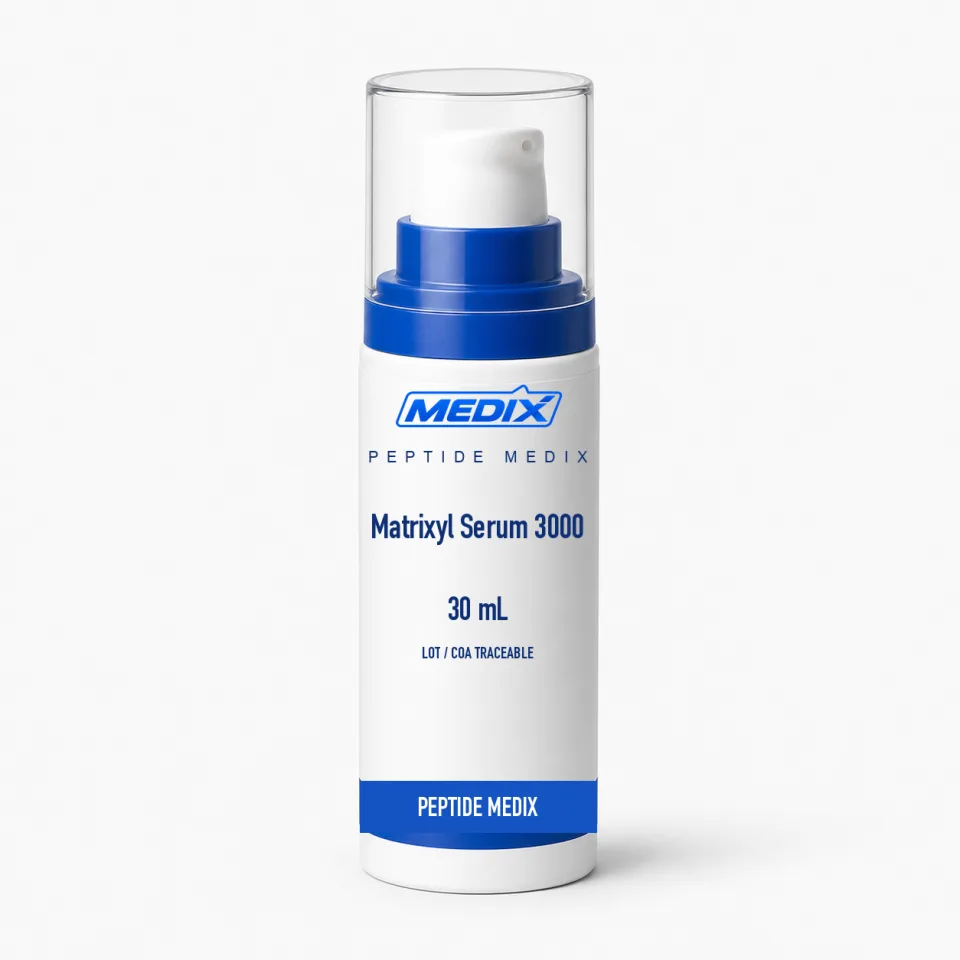
Matrixyl Serum 3000

Peptide Medix

Matrixyl Serum 3000

matrixyl serum 3000
$55.00 $65.00

View options and product details