Peptide Medix product catalog

Peptide Medix

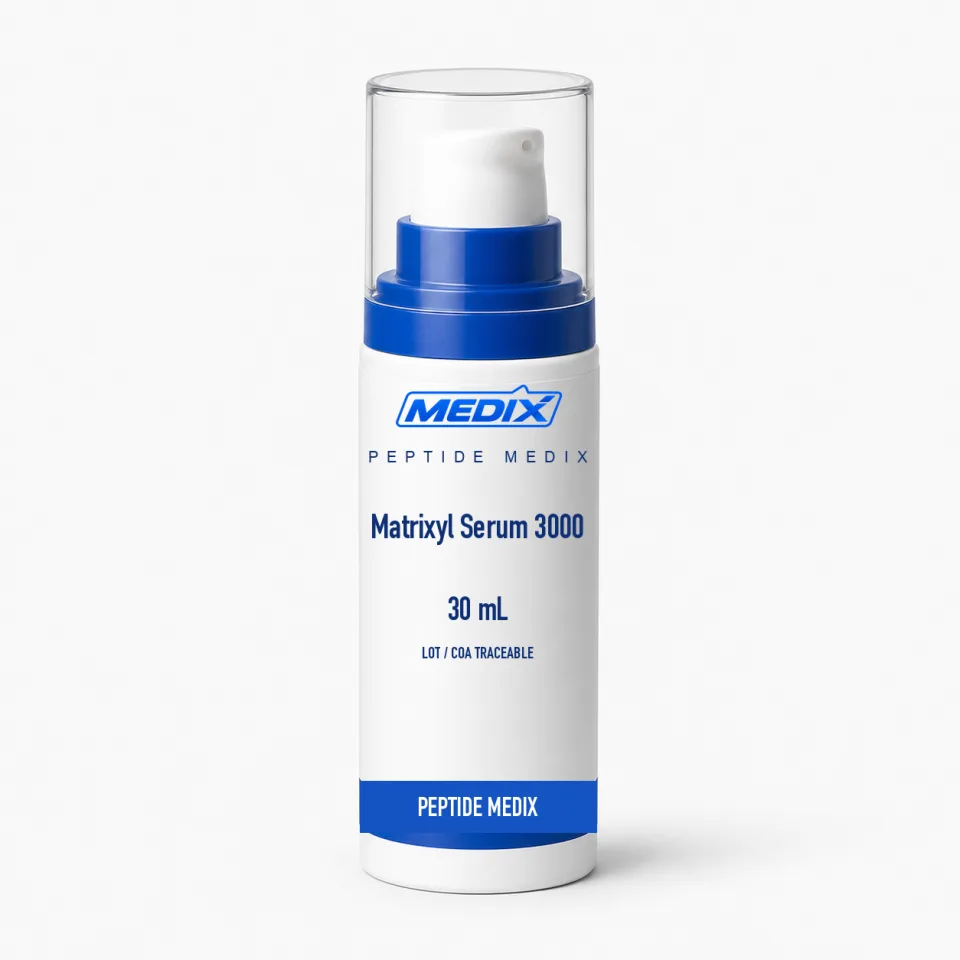
Matrixyl Serum 3000

Aqueous matrikine serum with palmitoyl tripeptide-1 and tetrapeptide-7, 30 mL

Review catalog details Secure payments
Available to order
$55.00 $65.00 15% OFF
1
Categories: matrixyl serum 3000 , matrikine peptides , palmitoyl tripeptide-1

Choose your delivery method

Standard Shipping is automatically selected at checkout. Customers can upgrade to a faster delivery option anytime.

Overview

Matrixyl Serum 3000 is a ready-to-use aqueous serum built around the 3000-type matrikine pairing: palmitoyl tripeptide-1 (Pal-Gly-His-Lys) and palmitoyl tetrapeptide-7 (Pal-Gly-Gln-Pro-Arg). Both are lipidated signal peptides, meaning a palmitic acid chain is attached to the peptide N-terminus to raise lipophilicity and improve partitioning into a lipid-rich barrier that bare hydrophilic peptides cross poorly.

The two peptides carry different parent sequences and are studied for different reasons. GHK is the tripeptide identified in human plasma in the 1970s and studied extensively in matrix and copper-binding research; GQPR derives from immunoglobulin G and appears in work on cytokine signalling in dermal models. Combining a matrix-signalling matrikine with an inflammation-associated fragment is the rationale behind the 3000-type complex, and it is why comparative studies usually test each peptide separately as well as together.

This differs from our Matrixyl vial, which supplies palmitoyl pentapeptide-4 (Pal-KTTKS) as lyophilized powder for a laboratory to formulate itself. The serum removes that step: it is a low-viscosity aqueous vehicle in a 30 mL bottle, prepared with peptide inputs released at high HPLC purity with lot-matched documentation. It is supplied for laboratory and formulation research and is not a licensed cosmetic or drug product.

Specifications

Brand Peptide Medix
Category Cosmetic Signal Peptides
Form Clear low-viscosity aqueous serum in a 30 mL bottle
Available size 30 mL
Active peptides Palmitoyl tripeptide-1 and palmitoyl tetrapeptide-7
INCI names Palmitoyl Tripeptide-1; Palmitoyl Tetrapeptide-7
Palmitoyl tripeptide-1 sequence Palmitoyl-Gly-His-Lys (Pal-GHK)
Palmitoyl tripeptide-1 CAS 147732-56-7
Palmitoyl tetrapeptide-7 sequence Palmitoyl-Gly-Gln-Pro-Arg (Pal-GQPR)
Palmitoyl tetrapeptide-7 CAS 221227-05-0
Peptide class Lipidated matrikines / collagen- and immunoglobulin-derived signal peptides
Vehicle Aqueous base with humectant and solubiliser; no added fragrance or colourant
Peptide purity input High-purity HPLC-tested peptides with lot-matched COA
Research areas Procollagen and glycosaminoglycan synthesis, ECM remodelling, cytokine markers in dermal models, skin permeation
Storage 2–8 °C preferred, protected from light; keep the closure tight
SKU MATRIXYL-SERUM-30-ML

Highlights

  • Ready-formulated 30 mL aqueous serum — no reconstitution or vehicle preparation needed
  • Built on the 3000-type pairing of palmitoyl tripeptide-1 and palmitoyl tetrapeptide-7
  • Both actives are lipidated matrikines: a palmitoyl chain raises lipophilicity for barrier partitioning
  • Pal-GHK derives from the plasma tripeptide GHK; Pal-GQPR from an immunoglobulin G fragment
  • Low-viscosity vehicle without added fragrance or colourant, suited to permeation work
  • Peptide inputs supported by lot-matched certificates of analysis
  • Complements our Matrixyl (Pal-KTTKS) vial for side-by-side matrikine comparisons
  • Research use only — not a licensed cosmetic or drug product

What's Included

  • The product option and size selected above
  • Final item and quantity confirmed in cart
  • Review the current ingredient listing before purchase

Research Overview

What a matrikine is

Matrikines are peptide fragments released when extracellular matrix proteins are degraded, and which then act as signals back onto the cells that built the matrix. The concept is what gives this class its research interest: a fibroblast can read fragments of its own surroundings as information about turnover. Synthetic matrikines reproduce those fragments deliberately, and the palmitoyl modification is a formulation strategy layered on top of the biology rather than part of it.

The two peptides in this serum

  • Palmitoyl tripeptide-1 (Pal-GHK) — the lipidated form of glycyl-histidyl-lysine, studied in fibroblast cultures for effects on collagen and glycosaminoglycan synthesis. Unlike GHK-Cu it is supplied without a coordinated copper ion, so copper-dependent chemistry does not apply.
  • Palmitoyl tetrapeptide-7 (Pal-GQPR) — derived from an immunoglobulin G sequence and examined in dermal models for effects on interleukin release under inflammatory stimulation.

Why lipidation is used

Short hydrophilic peptides partition poorly into the stratum corneum, whose intercellular lipid lamellae favour lipophilic species. Attaching a sixteen-carbon palmitoyl chain shifts the partition coefficient substantially and also promotes self-assembly at interfaces. Permeation studies on this class generally report that lipidation improves penetration relative to the bare peptide, though absolute delivered fractions remain low and depend heavily on vehicle composition.

Typical study designs

Work with a formulated serum usually falls into two categories. In-vitro cell studies apply defined peptide concentrations to fibroblast monolayers or reconstructed skin equivalents and read out procollagen I, fibronectin, glycosaminoglycans or cytokine markers. Permeation studies use Franz diffusion cells with excised skin or synthetic membranes and quantify the peptide in receptor fluid and in tissue layers by LC-MS. Because the serum contains two actives, each should be quantified independently rather than as a combined figure.

Interpreting combination products

A two-peptide formulation cannot show which component drives an effect. Studies that intend to make mechanistic claims run single-peptide arms in the same vehicle alongside the combination, so that additivity, synergy or redundancy can actually be distinguished rather than assumed from the pairing.
Handling & Storage

Store the bottle refrigerated where practical, protected from light, with the closure tight. Lipidated peptides in aqueous vehicles can form micellar aggregates on cooling, so inspect for cloudiness or separation and allow the serum to reach room temperature before sampling; gentle inversion redisperses transient haze. Do not dilute with strongly acidic or high-ionic-strength buffers without checking stability first, as both can precipitate lipidated species. Draw working aliquots with a clean pipette rather than dispensing directly from the bottle to avoid contaminating the stock. Record lot number and open date. Research use only.

Matrixyl Serum 3000 FAQ

How does this differ from our Matrixyl vial?
The vial supplies palmitoyl pentapeptide-4 (Pal-KTTKS) as lyophilized powder for a laboratory to formulate. This serum is a ready-made aqueous preparation built on a different pairing — palmitoyl tripeptide-1 and palmitoyl tetrapeptide-7 — so the peptides and the workflow both differ.
Is palmitoyl tripeptide-1 the same as GHK-Cu?
No. Both are built on the Gly-His-Lys sequence, but palmitoyl tripeptide-1 is lipidated and supplied without a coordinated copper ion, whereas GHK-Cu is the copper(II) complex of the bare tripeptide. The copper is central to GHK-Cu's chemistry and is absent here.
Why are the peptides palmitoylated?
Short hydrophilic peptides partition poorly into the lipid lamellae of the stratum corneum. A sixteen-carbon palmitoyl chain raises lipophilicity and improves that partitioning, which is a formulation strategy for delivery rather than a change to the underlying signalling sequence.

This catalog listing is for laboratory research use only. It is not represented as a drug, food, supplement, cosmetic or diagnostic product, and it is not offered for human or veterinary use.

Customer Reviews

0 reviews
5 star
0%
4 star
0%
3 star
0%
2 star
0%
1 star
0%

Leave Your Review

Rating

No reviews yet — be the first!

Leave Your Review

Rating

Keep exploring

Related Products & Shopping Guides

Compare Matrixyl Serum 3000 with relevant categories, product topics, and practical shopping information.

Often researched together

Related research peptides, blends and lab supplies frequently ordered with Matrixyl Serum 3000.

15% OFF
Argireline Serum 10%

Peptide Medix

Argireline Serum 10%

argireline serum
$55.00 $65.00

View options and product details

15% OFF
GHK-Cu Face Serum

Peptide Medix

GHK-Cu Face Serum

ghk-cu serum

2 options

$68.00 $80.00

View options and product details