Research Overview
Redox chemistry and the electron transport chain
Fibroblast and senescence models
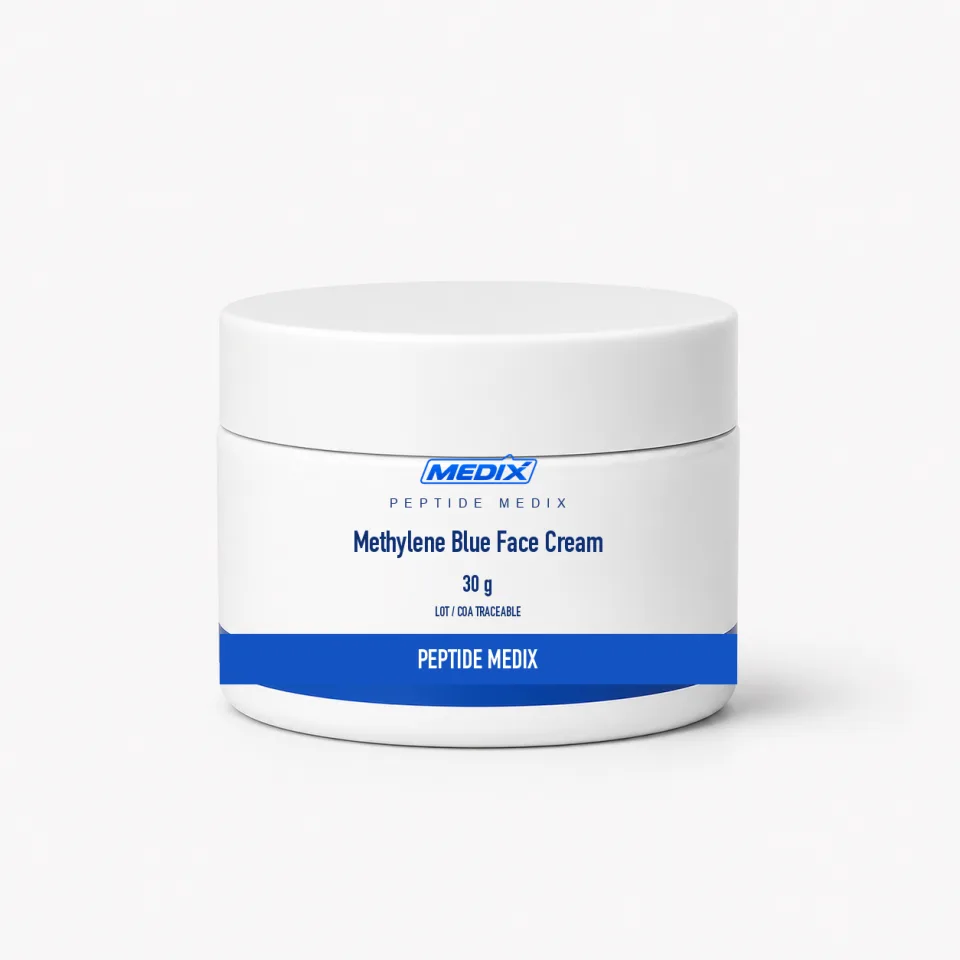
Cell-culture studies have reported that low-concentration methylene blue reduces reactive oxygen species in human fibroblasts and delays markers of replicative senescence, with associated changes in mitochondrial enzyme activity. Related work has extended into skin-equivalent models. These findings are model-specific in vitro observations and do not establish an outcome for topical use.
Why the concentration is kept tint-free
The dye is intensely coloured, and above roughly 0.05% on skin it produces visible blue staining that persists. For research formats this is a practical problem as much as a cosmetic one: visible colour interferes with photographic scoring, colorimetry and any optical endpoint. Sub-staining concentrations keep those measurements usable.
Known interaction caution
Methylene blue has monoamine oxidase inhibitory activity, a property that is well documented in the systemic pharmacology literature and that underlies serotonin-related interaction warnings for medicinal use. It is noted here because it is a genuine attribute of the molecule that anyone working with it should be aware of, not because this research preparation is intended for any human application.
Analytical notes
Methylene blue is readily quantified by absorbance near 660 nm, which makes assay and stability measurement straightforward. In an emulsion, partitioning between phases and adsorption to packaging are the usual complications, so stability work should account for both rather than measuring bulk concentration alone.