Research Overview
Why adamantane
The adamantane cage is a compact, extremely lipophilic hydrocarbon that medicinal chemists attach to small molecules and peptides to slow metabolic clearance and improve partitioning into lipid-rich compartments. In peptide chemistry it is one of several strategies — alongside N-terminal acetylation and C-terminal amidation — used to convert a fragile fragment into something that survives longer in a biological matrix.
Family context
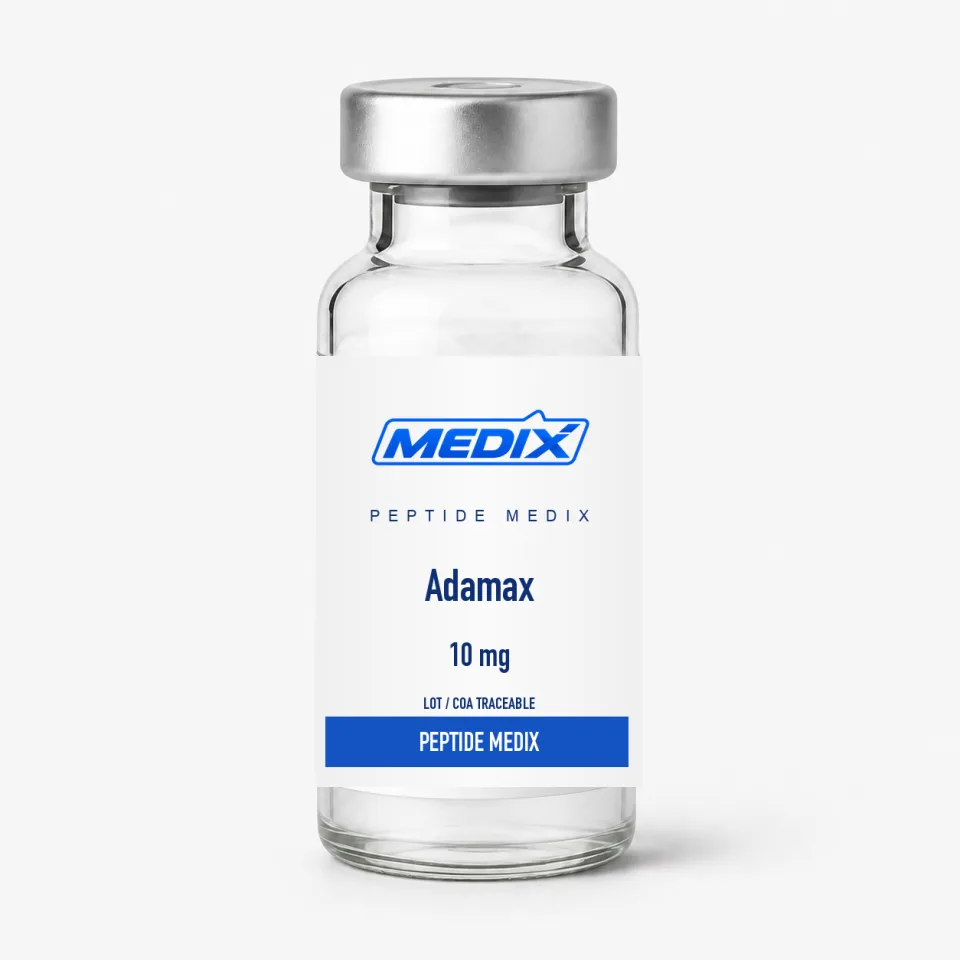
Adamax is positioned relative to Semax, the ACTH(4-10) analog extended with Pro-Gly-Pro and studied for reported effects on BDNF and NGF expression, monoaminergic markers and behavioral endpoints in rodents. Suppliers describe Adamax as a stability-oriented analog within that lineage, which makes side-by-side comparison with Semax and with the acetylated amidated variant the most informative way to work with it.
Typical laboratory workflow
- Analytical confirmation of identity and purity before any biological assay
- Solubility and formulation screening, since the adamantane group changes dissolution behavior
- Comparative stability testing in plasma or homogenate against unmodified family members
- Neurotrophic marker assays in cultured neurons run in parallel with reference compounds
Evidence status
Analytical practice
Confirm identity before use. Compare the observed mass on the lot certificate of analysis against your expected structure and document any discrepancy, since secondary descriptions of this compound are inconsistent. In comparative panels, hold the co-solvent fraction constant across every arm including vehicle controls, and record lot numbers with results so that later work can be traced to a specific analytical record.