Research Overview
GPRPA structure
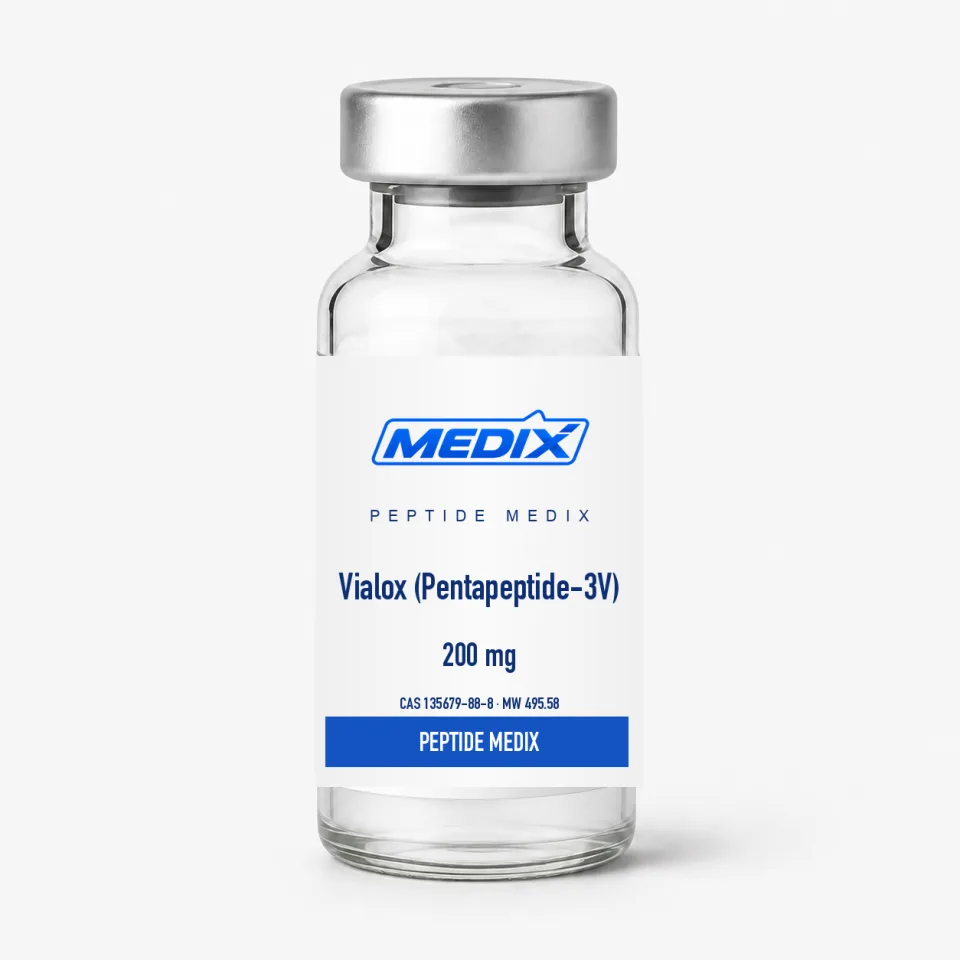
Vialox is a compact proline-rich peptide rather than a protein toxin. Proline limits backbone rotation and can favor recurring turns, while arginine supplies a guanidinium group capable of ionic interactions. Those properties motivate receptor-binding hypotheses but do not prove a specific binding site without direct pharmacology.
Postsynaptic research hypothesis
Reviews commonly describe Vialox as a competitive antagonist candidate at nicotinic acetylcholine receptors on the postsynaptic side of neuromuscular signaling. That places its proposed action downstream from SNARE-related peptides such as Argireline. Receptor subtype, tissue source and assay conditions must be reported because nicotinic receptors are a diverse family.
Comparison design
- Receptor-expressing cells with agonist concentration-response controls
- Syn-AKE as a chemically distinct waglerin-inspired comparator
- Argireline or SNAP-8 for presynaptic/SNARE-oriented comparisons
- Botulinum toxin only as a separate protein-mechanism reference, never as an equivalent
Choosing an appropriate assay
Nicotinic acetylcholine receptors are a diverse family with distinct subunit compositions, and antagonism at one subtype does not generalise to another. A study testing the postsynaptic hypothesis needs a defined receptor-expressing system, a stated subunit composition, an agonist concentration-response curve and a positive antagonist control, since a shift in a downstream contraction readout alone cannot localise an effect to the receptor.
Evidence limits
Most visible-outcome claims come from formulations rather than purified-peptide receptor studies. A reduced contraction or topography signal may reflect receptor antagonism, cytotoxicity, vehicle effects or measurement variability. The standalone peptide should be quantified in the test system and interpreted only within the measured model.