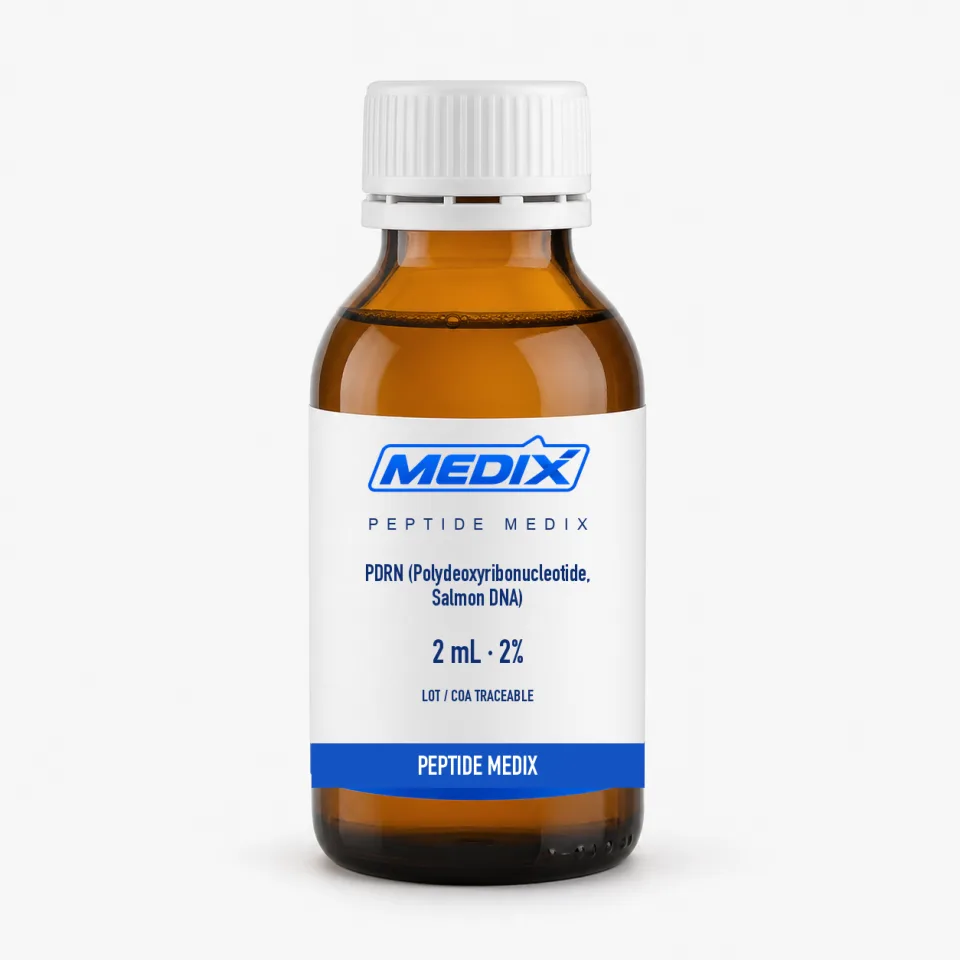
Peptide Medix product catalog

Peptide Medix

PDRN (Polydeoxyribonucleotide, Salmon DNA)

2% polydeoxyribonucleotide solution from salmon DNA, 2 mL and 5 mL vials

Review catalog details Secure payments
Available to order · 2 of 2 options available
$68.00 $80.00 15% OFF

Choose an option

1
Categories: pdrn , polydeoxyribonucleotide , salmon dna

Choose your delivery method

Standard Shipping is automatically selected at checkout. Customers can upgrade to a faster delivery option anytime.

Overview

PDRN stands for polydeoxyribonucleotide: a mixture of short DNA fragments, typically cited in the range of roughly 50 to 1,500 kilodaltons, produced by controlled extraction and enzymatic fragmentation of DNA from salmonid gonadal tissue. It is not a peptide and not a single defined molecule — it is a characterised polymer preparation, which is why lot documentation describes a fragment-size distribution and purity rather than a formula and molecular weight.

Salmon DNA is used because its nucleotide sequence composition is close enough to human DNA to be handled by the same salvage enzymes, while the source material is abundant and the purification process removes protein and peptide contaminants that would otherwise complicate an assay. Our material is supplied as a ready-to-sample 2% aqueous solution in sealed 2 mL and 5 mL vials, so no reconstitution step is required and the concentration is fixed and known.

Specifications

Brand Peptide Medix
Category Cosmetic Signal Peptides
Form Clear aqueous solution in a sealed glass vial; supplied ready to sample
Available sizes 2 mL at 2%; 5 mL at 2%
Concentration 2% w/v (20 mg/mL polydeoxyribonucleotide)
Active Polydeoxyribonucleotide (PDRN), a mixture of low-molecular-weight DNA fragments
Source material DNA purified from salmonid (Oncorhynchus) gonadal tissue
Fragment size Commonly cited at approximately 50–1,500 kDa; a distribution rather than a single mass
Chemical class Nucleic acid polymer — deoxyribonucleotide chains, not a peptide
Proposed mechanisms Adenosine A2A receptor agonism; nucleotide supply to the purine salvage pathway
Research areas Angiogenic signalling, fibroblast proliferation, extracellular matrix and collagen synthesis, inflammatory markers, wound models
Related preparation PN (polynucleotide) preparations use longer chains from the same source chemistry
Appearance Clear, colourless to very faintly opalescent liquid, free of visible particulates
Storage 2–8 °C, upright, protected from light; do not freeze
SKU PDRN-2-ML-2

Highlights

  • 2% polydeoxyribonucleotide in a ready-to-sample aqueous solution — no reconstitution needed
  • Two vial sizes: 2 mL and 5 mL, both sealed and lot-numbered
  • Purified from salmonid DNA and enzymatically fragmented to a defined size distribution
  • Lot-matched certificate of analysis reporting identity, concentration and purity
  • Studied for adenosine A2A receptor agonism and purine salvage-pathway nucleotide supply
  • Research areas include angiogenesis, fibroblast activity, matrix synthesis and inflammatory markers
  • Distinct from peptide actives — a nucleic acid polymer preparation, not an amino acid chain

What's Included

  • The product option and size selected above
  • Final item and quantity confirmed in cart
  • Review the current ingredient listing before purchase

Research Overview

What the material is

Proposed mechanisms

Two routes appear consistently in the literature. The first is receptor-mediated: PDRN preparations have been reported to act as agonists at the adenosine A2A receptor, with A2A antagonists blunting the observed effects in several experimental systems. The second is metabolic: as fragments are degraded, the released nucleotides and nucleosides can enter the salvage pathway, providing precursors for cells that would otherwise rely on de novo purine synthesis.

Reported research areas

  • Angiogenesis assays, where VEGF expression and endothelial tube formation are common endpoints.
  • Fibroblast cultures examining proliferation, migration and collagen or matrix-protein output.
  • Rodent wound and burn models measuring closure rate and histological organisation.
  • Inflammatory studies looking at cytokine expression consistent with A2A-mediated signalling.
  • Dermatological and aesthetic formulation science, where PDRN and longer-chain PN preparations are compared.
Evidence limits

Handling & Storage

Store vials refrigerated at 2–8 °C, upright and shielded from light, and do not freeze — freeze–thaw cycling can alter the fragment-size distribution that defines the material. Let a vial equilibrate to room temperature before opening so condensation does not enter it, and swab the closure with 70% isopropyl alcohol before any draw. The solution is supplied at a fixed 2%, so dilute into buffer or vehicle rather than concentrating; use aseptic technique and a fresh sterile tip or needle for each withdrawal. Inspect for cloudiness, colour change or particulates before use, and record the lot number so results can be tied to a specific size profile.

PDRN (Polydeoxyribonucleotide, Salmon DNA) FAQ

What is PDRN?
PDRN, or polydeoxyribonucleotide, is a mixture of short DNA fragments purified from salmonid DNA and cut to a defined size range, commonly cited as roughly 50 to 1,500 kDa. It is a nucleic acid preparation rather than a peptide, and it is characterised by fragment-size distribution and purity rather than by a molecular formula.
Why is salmon DNA used as the source?
Salmonid gonadal tissue is an abundant, well-characterised DNA source whose nucleotide composition is close enough to human DNA to be processed by the same salvage enzymes in experimental systems. The purification process is designed to strip protein and peptide contaminants that would otherwise confound results.
How does PDRN differ from PN (polynucleotide) preparations?
Both come from the same source chemistry. PN preparations retain longer chains and are studied more for their physical, gel-forming and biostimulatory properties, while PDRN is fragmented further and is studied more for receptor and salvage-pathway activity. Fragment length is the practical difference.
Does the product need reconstitution?
No. It is supplied as a ready-to-sample 2% aqueous solution — 20 mg/mL — in a sealed vial, so the concentration is fixed and known. Laboratories dilute it into buffer or vehicle as their protocol requires rather than preparing it from a powder.
Is a certificate of analysis available?
Yes. Each lot carries a matched certificate of analysis reporting identity, concentration and purity for that specific batch. Because PDRN is a preparation rather than a single molecule, we recommend recording the lot number alongside experimental data so results can be traced to its size profile.
How should PDRN be stored?
Refrigerated at 2–8 °C, upright and protected from light. Do not freeze the solution: freeze–thaw cycles can shift the fragment-size distribution that defines the material. Vials should be kept sealed until use and drawn with aseptic technique.

This catalog listing is for laboratory research use only. It is not represented as a drug, food, supplement, cosmetic or diagnostic product, and it is not offered for human or veterinary use.

Customer Reviews

0 reviews
5 star
0%
4 star
0%
3 star
0%
2 star
0%
1 star
0%

Leave Your Review

Rating

No reviews yet — be the first!

Leave Your Review

Rating

Keep exploring

Related Products & Shopping Guides

Compare PDRN (Polydeoxyribonucleotide, Salmon DNA) with relevant categories, product topics, and practical shopping information.

Often researched together

Related research peptides, blends and lab supplies frequently ordered with PDRN (Polydeoxyribonucleotide, Salmon DNA).

15% OFF
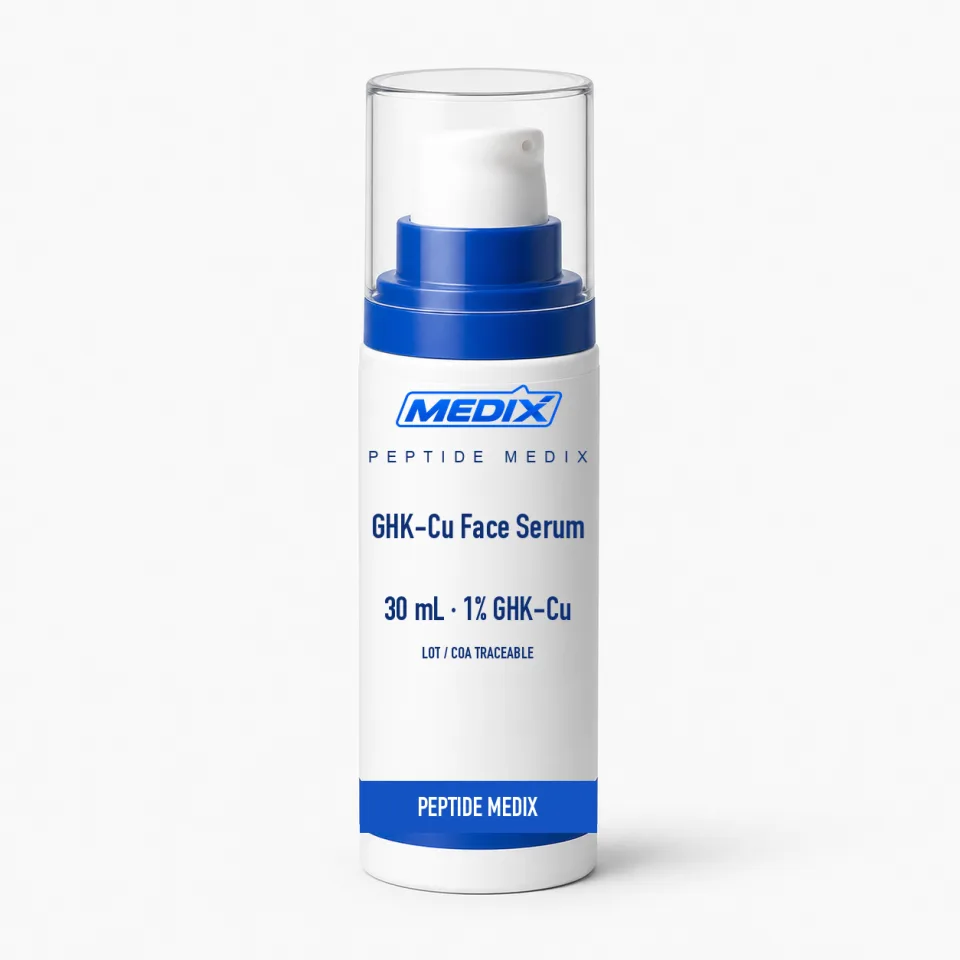
GHK-Cu Face Serum

Peptide Medix

GHK-Cu Face Serum

ghk-cu serum

2 options

$68.00 $80.00

View options and product details