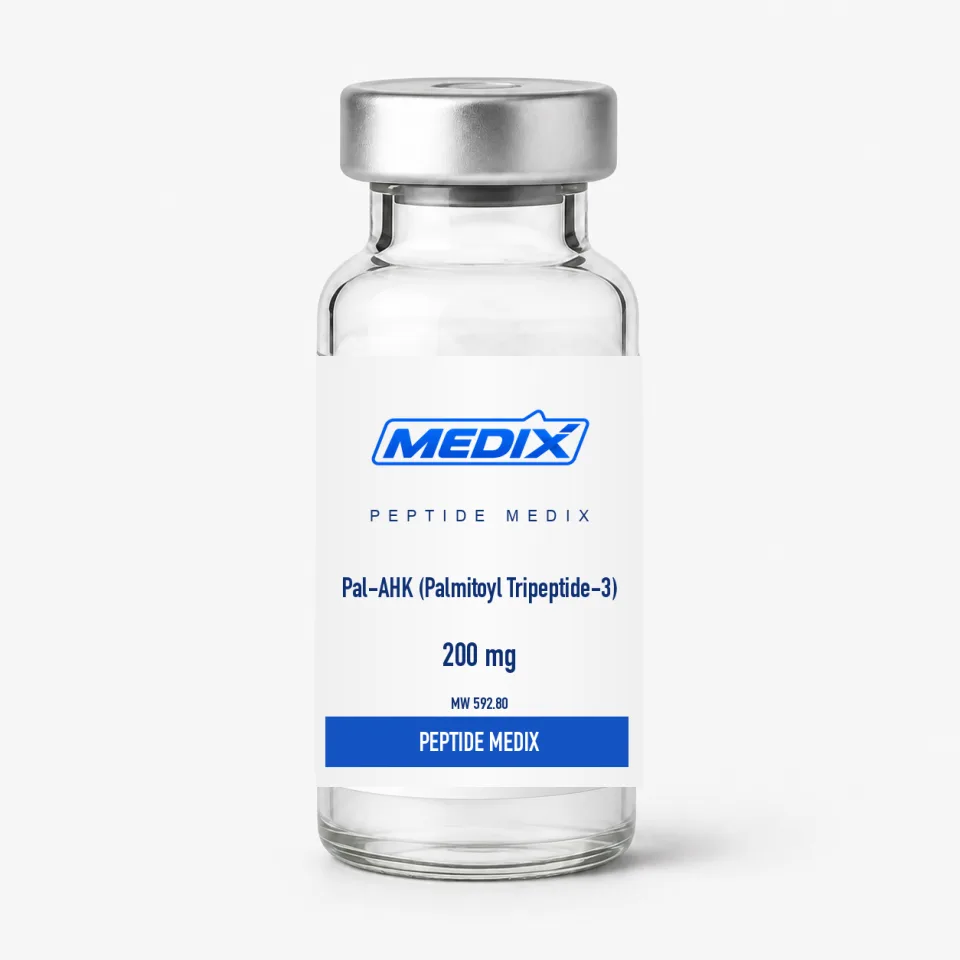
Peptide Medix product catalog

Peptide Medix

Pal-AHK (Palmitoyl Tripeptide-3)

Lipidated Ala-His-Lys tripeptide for follicle and formulation research

Review catalog details Secure payments
Available to order
$178.00 $210.00 15% OFF
1
Categories: pal-ahk , palmitoyl tripeptide-3 , hair peptides

Choose your delivery method

Standard Shipping is automatically selected at checkout. Customers can upgrade to a faster delivery option anytime.

Overview

Pal-AHK is the N-palmitoylated form of the tripeptide Ala-His-Lys, commonly cataloged as Palmitoyl Tripeptide-3. A sixteen-carbon fatty-acid chain is attached to the peptide's N terminus, changing a small water-soluble tripeptide into an amphiphilic molecule that partitions more readily into lipid phases and interfaces. Palmitic acid is a fully saturated C16 fatty acid and the linkage it forms is a stable amide, so the lipid behaves as a structural part of the molecule rather than a removable additive.

The underlying AHK sequence is closely related to the copper-binding peptide AHK-Cu. In the free tripeptide the terminal amine and the histidine imidazole are what make copper coordination possible, and acylating that terminal amine removes one of those anchors. Pal-AHK is supplied without coordinated copper and is studied mainly as a lipidated signal peptide in dermal-papilla, follicle and topical-delivery models. Evidence specific to Pal-AHK is much thinner than the literature for AHK-Cu or GHK-Cu, so experiments should not transfer mechanisms or outcomes from those compounds without direct controls.

The 200 mg vial contains lyophilized Pal-Ala-His-Lys with formula C31H56N6O5 and molecular weight 592.80 g/mol. Because the material is amphiphilic rather than freely water-soluble, dissolution behaviour deserves as much attention as the weighed mass. The material is HPLC tested with a lot-matched COA available and is supplied only for laboratory formulation and cell-model research—not as a cosmetic, drug or personal-use product.

Specifications

Brand Peptide Medix
Category Hair Research Peptides
Form Lyophilized amphiphilic peptide powder, sealed glass vial
Available size 200 mg
Purity ≥99% by HPLC; lot-matched COA available
Molecular formula C31H56N6O5
Molecular weight 592.80 g/mol
Sequence Palmitoyl-Ala-His-Lys-OH (Pal-AHK)
Also known as Pal-AHK, Palmitoyl AHK, Palmitoyl Tripeptide-3
Peptide class N-terminally lipidated signal tripeptide
Copper status No coordinated copper added; not AHK-Cu
Research areas Dermal-papilla cell models, follicle biology, extracellular-matrix signaling and topical peptide partitioning
Solubility Poorly water-soluble; commonly evaluated with a validated co-solvent or surfactant vehicle
Storage −20 °C lyophilized, protected from light and moisture
SKU PAL-AHK-200-MG

Highlights

  • Palmitoyl-Ala-His-Lys, also cataloged as Palmitoyl Tripeptide-3
  • C16 lipid tail creates an amphiphilic peptide for partition and permeation research
  • Formula C31H56N6O5; molecular weight 592.80 g/mol
  • Single 200 mg lyophilized raw-peptide vial
  • ≥99% HPLC purity with lot-matched certificate of analysis
  • Studied in dermal-papilla, follicle and topical-formulation models
  • No coordinated copper added; distinct from AHK-Cu
  • Research use only — not a finished hair or skin product

What's Included

  • The vial option and size selected above
  • Final item and quantity confirmed in cart
  • Laboratory-research-use labeling

Research Overview

What palmitoylation changes

Relationship to AHK-Cu

Both molecules use the Ala-His-Lys core, but AHK-Cu is a copper(II) coordination complex and Pal-AHK is a lipidated copper-free peptide. Copper binding in the short His-containing tripeptides depends on the amino-terminal nitrogen together with the imidazole side chain, so a correctly N-palmitoylated peptide is not expected to chelate copper in the same geometry, and the two materials differ in mass, charge, colour and solubility. A study comparing them should control peptide molarity, copper concentration and vehicle separately. Similar names do not imply equal solubility, target engagement or biological response.

Research questions

  • Dermal-papilla cell viability, proliferation and apoptosis markers
  • Follicle-organ culture and extracellular-matrix expression endpoints
  • Partitioning between water, oil and interfacial phases in model formulations
  • Aggregation state and apparent solubility limit in the actual assay buffer
  • Franz-cell or membrane-permeation comparison with unmodified AHK
  • Single-agent comparisons with AHK-Cu, GHK-Cu and Pal-GHK

Analytical and vehicle controls

Ala-His-Lys carries no strong chromophore beyond the histidine imidazole, so ultraviolet detection is weak and quantification generally leans on low-wavelength absorbance, evaporative or charged-aerosol detection, or mass spectrometry. The tripeptide also has two amine sites—the terminal alpha-amino group and the lysine side chain—so where the lipid sits is an identity question worth confirming rather than assuming. Co-solvents and surfactants used to keep the peptide dissolved have their own effects on cells and on barrier models, so each arm needs a vehicle-matched control at the same concentration and an established positive control to read the assay against.

Evidence limit

Much of the discussion around Pal-AHK extrapolates from non-palmitoylated AHK or copper-peptide studies. That extrapolation is a hypothesis, not a demonstrated equivalence. Use compound-specific data, matched vehicle controls and analytical confirmation that the amphiphilic peptide remains in solution during the assay. Where an observation is reported only for a formulated blend, the contribution of this single peptide is not separable without a matched blend that omits it.
Pal-AHK (Palmitoyl Tripeptide-3) FAQ

Is Pal-AHK the same as AHK-Cu?
No. Pal-AHK is Ala-His-Lys with an N-terminal palmitoyl chain and no added copper. AHK-Cu is the copper(II) complex of the unlipidated tripeptide. They differ in mass, solubility, color and coordination chemistry.
Why is Pal-AHK assigned to Hair Peptides?
Current specialist catalogs and the limited research discussion place it primarily beside AHK-Cu in dermal-papilla and follicle-model work. The category reflects research context, not a claim that the raw peptide produces a hair outcome.
Does Pal-AHK have a standardized CAS number?
No universally reliable CAS identity was confirmed for the exact Pal-Ala-His-Lys-OH form, so this catalog intentionally identifies it by sequence, formula and molecular weight rather than adding an uncertain registry number.

This catalog listing is for laboratory research use only. It is not represented as a drug, food, supplement, cosmetic or diagnostic product, and it is not offered for human or veterinary use.

Customer Reviews

0 reviews
5 star
0%
4 star
0%
3 star
0%
2 star
0%
1 star
0%

Leave Your Review

Rating

No reviews yet — be the first!

Leave Your Review

Rating

Keep exploring

Related Products & Shopping Guides

Compare Pal-AHK (Palmitoyl Tripeptide-3) with relevant categories, product topics, and practical shopping information.

Often researched together

Related research peptides, blends and lab supplies frequently ordered with Pal-AHK (Palmitoyl Tripeptide-3).

15% OFF
GHK-Cu (Copper Peptide)

Peptide Medix

GHK-Cu (Copper Peptide)

ghk-cu

5 options

$25.00 $30.00

View options and product details

15% OFF
PTD-DBM

Peptide Medix

PTD-DBM

ptd-dbm

2 options

$97.00 $115.00

View options and product details

15% OFF
Zinc Thymulin

Peptide Medix

Zinc Thymulin

zinc thymulin
$85.00 $100.00

View options and product details