Research Overview
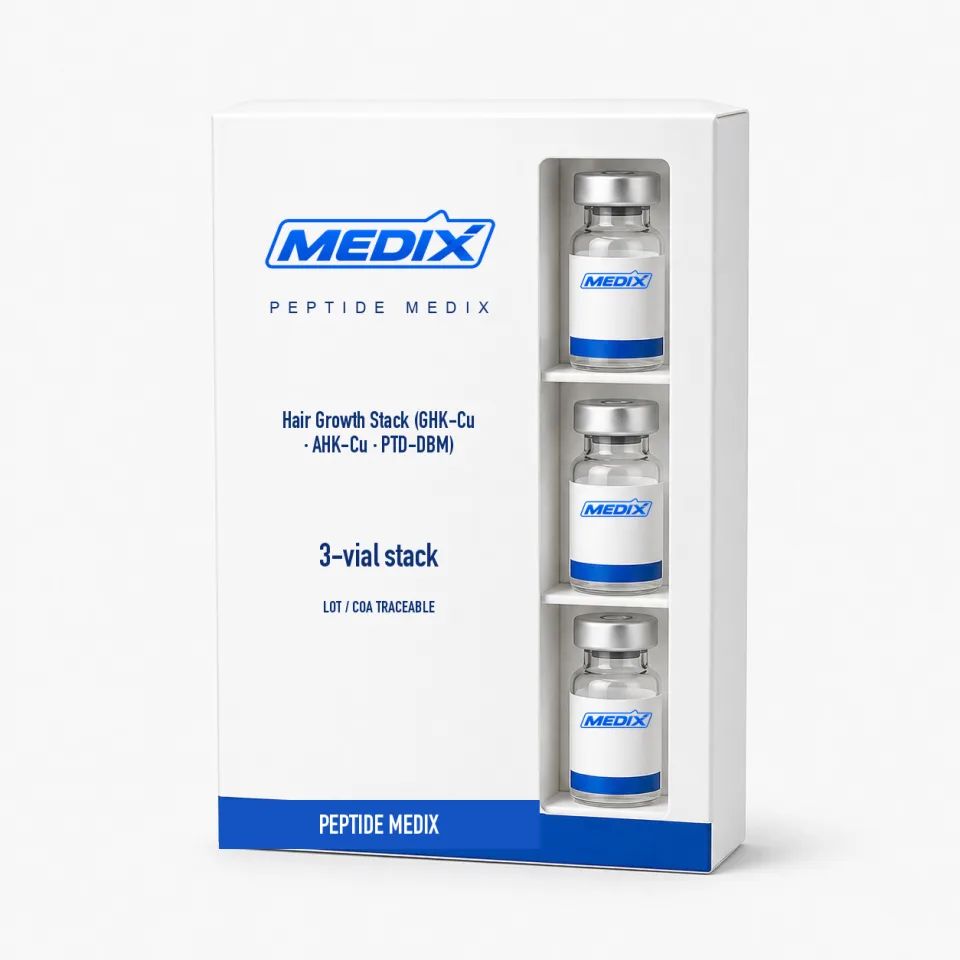
GHK-Cu
GHK is a tripeptide first isolated from human plasma that binds copper(II) with high affinity; the resulting blue complex is the form used in nearly all published work. Studies report effects on collagen and glycosaminoglycan synthesis, on metalloproteinase and TIMP expression, and on VEGF output in dermal cell cultures. In follicle-specific work it is examined in dermal papilla cell models and in studies of follicle size and anagen-phase markers.
AHK-Cu
AHK-Cu substitutes alanine for glycine at the N-terminus, retaining the histidine imidazole and lysine amine that form the copper coordination site. It is studied largely in hair-focused assays, where reports describe increased dermal papilla cell viability and VEGF expression in culture. Comparing it directly against GHK-Cu is a common design, since the two differ by a single methyl group yet are formulated and marketed separately in cosmetic science.
PTD-DBM
PTD-DBM is a designed construct rather than a natural sequence: a protein transduction domain provides cell entry, and the fused Dishevelled-binding motif from CXXC5 competes with the endogenous CXXC5–Dishevelled interaction that restrains Wnt/beta-catenin signalling. Published mouse work reported follicle neogenesis and wound-associated hair regrowth, often in combination with valproic acid as a second Wnt-activating input.
Why the three are stacked
- They engage separate mechanisms — copper-dependent matrix signalling versus a protein–protein interaction in the Wnt pathway.
- Separate vials allow concentration-response work on each peptide and true single-agent controls.
- The copper peptides need pH-aware handling that a shared formulation would compromise.