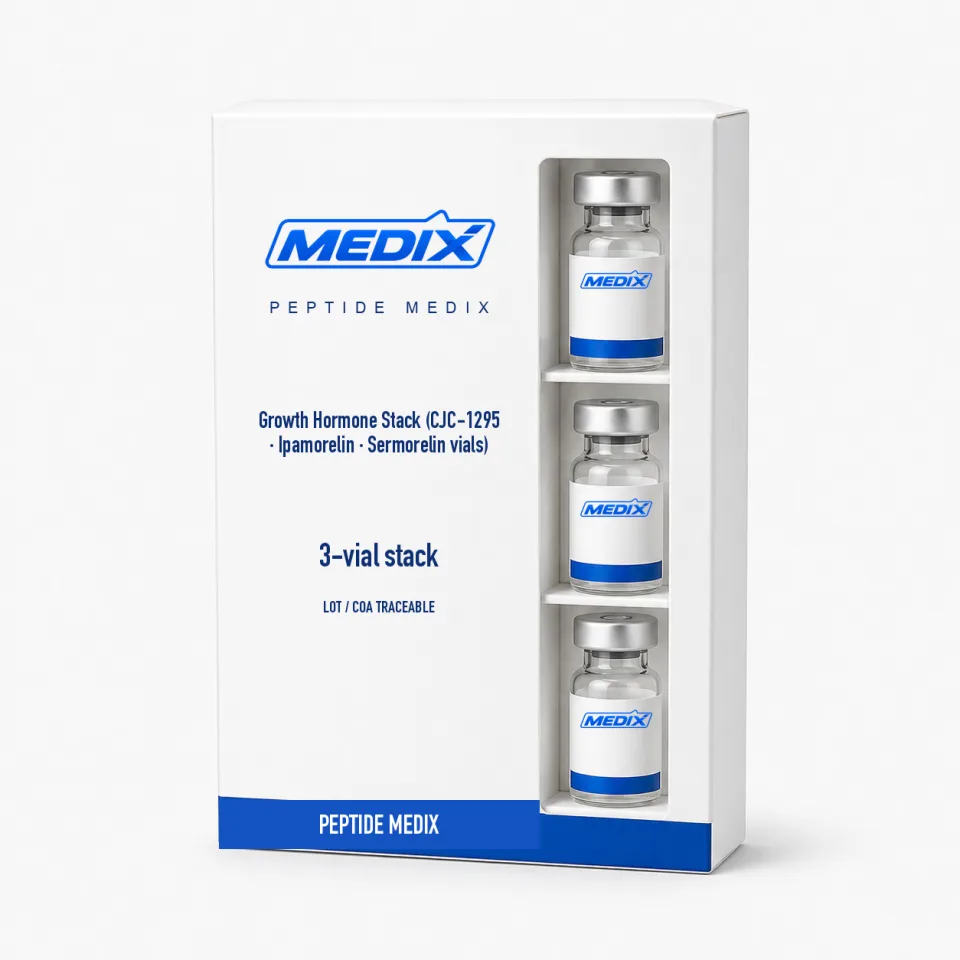
Research Overview
Two mechanisms, three molecules
The pituitary somatotroph responds to at least two distinct receptor inputs. The GHRH receptor is a class B G-protein-coupled receptor engaged by hypothalamic GHRH and by its synthetic analogues. GHS-R1a, the ghrelin receptor, is a separate class A receptor identified through the study of growth hormone secretagogues before its endogenous ligand was known. This kit puts two molecules on the first receptor and one on the second, which is the arrangement most comparative pituitary studies use.
Sermorelin and CJC-1295 without DAC
Sermorelin is GHRH(1-29) amide, the truncated fragment that retains activity at the receptor. It is rapidly cleaved in plasma, primarily by dipeptidyl peptidase-4 at the N-terminus. CJC-1295 without DAC applies four substitutions to that same backbone specifically to slow that degradation. Because they share a sequence and differ in stability, the pair is well suited to studies isolating the effect of half-life from the effect of receptor binding. Note that the no-DAC form lacks the drug affinity complex that gives full CJC-1295 its much longer circulating presence.
Ipamorelin
Ipamorelin is a pentapeptide containing two non-standard residues, Aib and D-2-Nal, with a C-terminal amide. Its published characterisation emphasised selectivity: in the animal models reported, growth hormone release occurred at concentrations that did not appreciably move cortisol or prolactin, in contrast to earlier secretagogues such as GHRP-6.