Research Overview
Design of the four substitutions
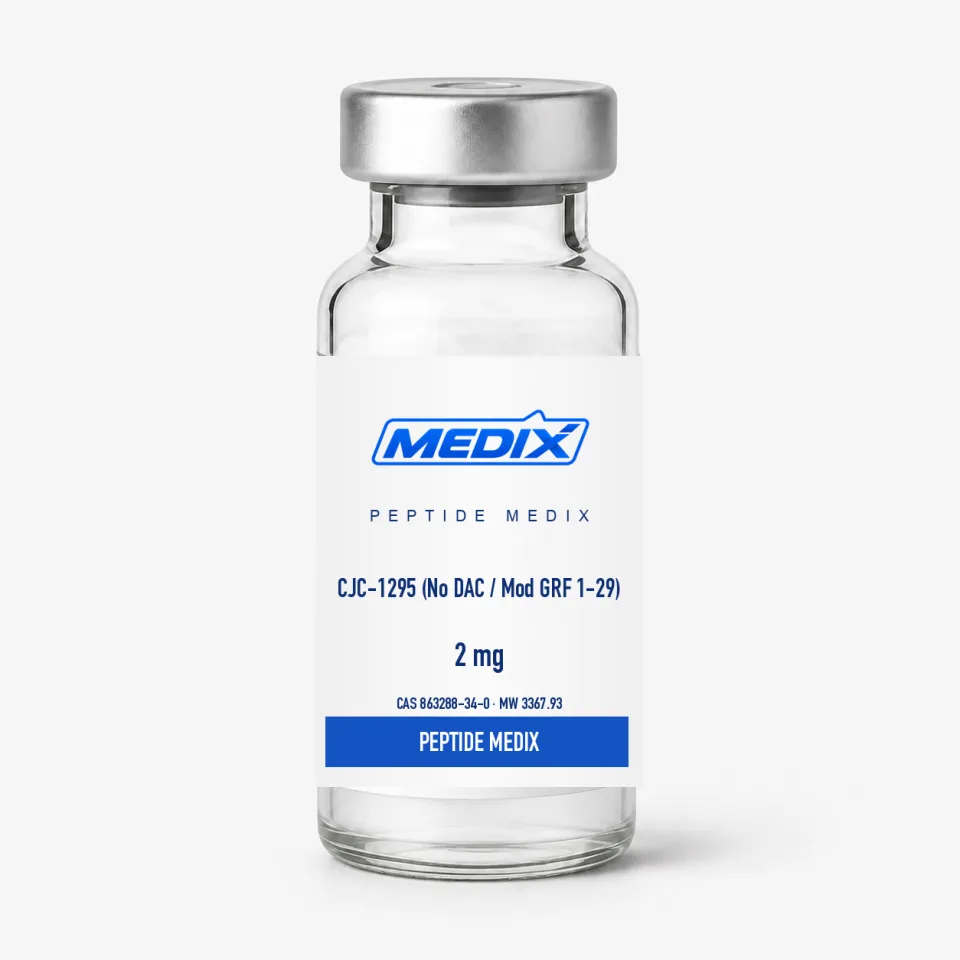
Each substitution in Modified GRF 1-29 addresses a specific liability of the native fragment. The D-alanine at position 2 is studied for its resistance to dipeptidyl peptidase-4, which otherwise removes the first two residues within minutes in serum. Glutamine at position 8 replaces an asparagine prone to deamidation, alanine at 15 is examined for its effect on helical stability, and leucine at 27 substitutes a methionine that is readily oxidised during handling and storage.
Receptor signalling
Laboratories use the peptide as a GHRH receptor agonist in pituitary cell cultures and membrane preparations, tracking cyclic AMP accumulation, protein kinase A activation and immunoassayed growth hormone release. Its short residence time makes it a useful probe for the desensitisation and resensitisation behaviour of the receptor.
With and without DAC
- Head-to-head comparison with the DAC-conjugated version, where albumin binding produces prolonged rather than transient receptor exposure
- Combination models with ipamorelin, GHRP-2 or GHRP-6 to examine whether GHRH-R and GHS-R1a signals converge
- Benchmarking against sermorelin to quantify what the four substitutions contribute to in vitro stability
Analytical and stability work
The compound also appears in analytical method development — reversed-phase HPLC gradients, LC–MS identity confirmation and forced-degradation studies that compare oxidation and deamidation profiles against the unmodified sequence. Reported findings come from cell-based and animal research and should not be read as evidence about effects in humans. Because the peptide is inexpensive relative to its longer-acting counterpart and behaves predictably on reversed-phase columns, it is also used as a system suitability standard when laboratories qualify new instrumentation or train personnel on peptide handling and reconstitution technique.