Peptide Medix product catalog

Peptide Medix

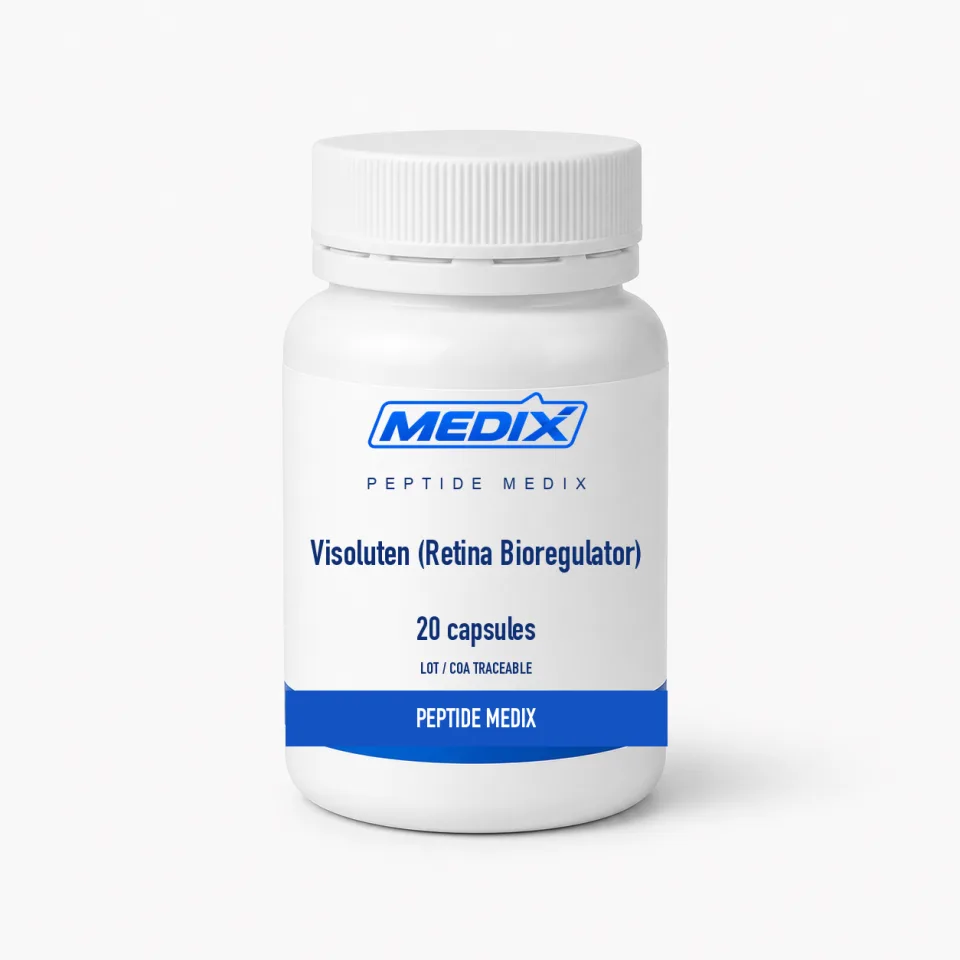
Visoluten (Retina Bioregulator)

Retina-derived peptide complex in capsules, from the Cytomax bioregulator range

Review catalog details Secure payments
Available to order · 2 of 2 options available
$72.00 $85.00 15% OFF

Choose an option

1
Categories: visoluten , retina bioregulator , khavinson bioregulators

Choose your delivery method

Standard Shipping is automatically selected at checkout. Customers can upgrade to a faster delivery option anytime.

Overview

Visoluten is the retina-associated member of the natural peptide bioregulator range developed within the Russian gerontology programme associated with Vladimir Khavinson. Unlike the synthetic tripeptides in the same family — Pinealon, Cartalax, Vesugen and their relatives — Visoluten is not a single defined sequence. It is a low-molecular-weight peptide complex prepared by controlled extraction and fractionation of bovine retinal tissue, then supplied in capsule form.

That distinction shapes everything about how the material is used. A defined tripeptide can be specified by sequence, formula and HPLC purity; a tissue-derived peptide complex is instead characterised by source tissue, extraction method, total peptide content and molecular-weight cut-off, typically in the region of a few kilodaltons or less. Bioregulator researchers work with these complexes on the premise that a tissue-specific mixture of short peptides carries information relevant to the tissue it came from — the founding idea of the whole programme, which began with organ extracts before the synthetic single-sequence generation followed.

Specifications

Brand Peptide Medix
Category Khavinson Bioregulators
Form Capsules containing a lyophilized peptide complex with excipient carrier
Available sizes 20 capsules, 60 capsules
Product type Natural peptide bioregulator (tissue-derived peptide complex)
Source tissue Bovine retinal tissue
Preparation Controlled extraction and fractionation to a low-molecular-weight peptide fraction
Composition Peptide complex of undefined individual sequences; specified by total peptide content, not by a single formula
Molecular weight Polydisperse low-molecular-weight fraction; no single molecular mass applies
Also known as Retina peptide bioregulator, Cytomax retina complex
Bioregulator branch Natural extract range (Cytomax), as distinct from the synthetic peptide range (Cytogen)
Associated tissue Retina and visual neural tissue
Research areas Retinal ageing models, photoreceptor and pigment epithelium biology, tissue-derived peptide complexes, comparative bioregulator studies
Storage 2–8 °C or cool room temperature in the sealed original container, protected from light, heat and humidity
Documentation Lot documentation available on request
SKU VISOLUTEN-20-CAPSULES

Highlights

  • Retina-derived low-molecular-weight peptide complex, not a single synthetic sequence
  • Member of the natural (Cytomax) branch of the Khavinson bioregulator range
  • Supplied in capsules — 20-capsule and 60-capsule packs
  • Characterised by source tissue, extraction method and peptide content rather than by sequence
  • Companion products in the range target other tissues: Endoluten (pineal), Cerluten (brain)
  • Studied in retinal ageing, photoreceptor and neural-tissue models
  • Lot documentation available; ships from the United States
  • Research use only — not a drug, supplement or ophthalmic product

What's Included

  • The product option and count selected above
  • Final item and quantity confirmed in cart
  • Laboratory-research-use labeling

Research Overview

Natural versus synthetic bioregulators

The bioregulator programme runs on two parallel tracks. The natural track — the range Visoluten belongs to — uses peptide fractions extracted from specific animal organs, on the premise that each tissue yields a characteristic mixture of short peptides. The synthetic track isolates and reproduces individual sequences from those fractions, giving defined molecules such as Epitalon, Pinealon and Cartalax. Natural preparations are less chemically tractable but retain whatever combination effects a mixture may carry; synthetic ones are reproducible and easier to attribute mechanistically. Comparative studies between the two branches are a recurring theme in the literature.

Why retinal tissue

Characterisation challenges

  • No single sequence, formula or molecular weight applies — the material is inherently a mixture
  • Lot-to-lot consistency depends on source tissue and extraction control rather than synthetic reproducibility
  • Attribution of any observed effect to a specific peptide is not possible without further fractionation
  • Appropriate controls include a matched extract from an unrelated tissue, not merely a vehicle control
  • Analytical characterisation typically reports total peptide content and molecular-weight distribution

Evidence quality

Handling & Storage

Keep capsules in the sealed original container, protected from light, heat and humidity — a refrigerator at 2–8 °C or a cool, dry cabinet both work, but avoid warm storage and repeated temperature swings. Peptide complexes in capsule form are hygroscopic, so do not decant into secondary containers or leave the pack open in a humid room. For analytical work, capsule contents are normally emptied and extracted into aqueous buffer, with the excipient carrier accounted for separately in mass calculations. Record lot number, pack size, receipt date and opening date; because this is a tissue-derived mixture rather than a synthetic sequence, lot tracking matters more here than for defined peptides.

Visoluten (Retina Bioregulator) FAQ

Why is no amino acid sequence listed?
Because Visoluten is not a single peptide. It is a low-molecular-weight fraction extracted from retinal tissue — a mixture of short peptides whose individual sequences are not separately specified. Products in the synthetic branch of the range, such as Pinealon or Cartalax, do have defined sequences.
What is the difference between natural and synthetic bioregulators?
Natural preparations like Visoluten are tissue extracts fractionated to a low-molecular-weight peptide range. Synthetic bioregulators are single, chemically defined sequences reproduced by solid-phase synthesis. The synthetic branch is reproducible and mechanistically attributable; the natural branch retains whatever mixture effects may exist.
What documentation is supplied?
Lot documentation is available on request. For a tissue-derived complex this reports source tissue, total peptide content and molecular-weight distribution rather than the HPLC purity figure used for the synthetic peptides elsewhere in this catalogue — a single purity percentage is not meaningful for a mixture.
How should Visoluten be stored?
In the sealed original container, protected from light, heat and humidity, either refrigerated at 2–8 °C or in a cool dry cabinet. Peptide complexes are hygroscopic, so avoid decanting into secondary containers and keep the pack closed between uses.
Is it related to any eye medicine?
No. It carries no approved indication in the United States or elsewhere in this catalogue's markets, is not an ophthalmic preparation, and is not sterile or formulated for ocular contact. It is research material derived from retinal tissue, nothing more.
How strong is the published evidence?
Limited. Most work on tissue-derived peptide bioregulators comes from a small number of institutions, largely in regional journals, with sparse independent replication. Tissue-specificity claims remain unestablished outside those groups, so cross-tissue extract controls are advisable in any study design.

This catalog listing is for laboratory research use only. It is not represented as a drug, food, supplement, cosmetic or diagnostic product, and it is not offered for human or veterinary use.

Customer Reviews

0 reviews
5 star
0%
4 star
0%
3 star
0%
2 star
0%
1 star
0%

Leave Your Review

Rating

No reviews yet — be the first!

Leave Your Review

Rating

Keep exploring

Related Products & Shopping Guides

Compare Visoluten (Retina Bioregulator) with relevant categories, product topics, and practical shopping information.

Often researched together

Related research peptides, blends and lab supplies frequently ordered with Visoluten (Retina Bioregulator).

15% OFF
Pinealon

Peptide Medix

Pinealon

pinealon
$63.00 $75.00

View options and product details

15% OFF
Bronchogen

Peptide Medix

Bronchogen

bronchogen
$63.00 $75.00

View options and product details

15% OFF
Cardiogen

Peptide Medix

Cardiogen

cardiogen
$63.00 $75.00

View options and product details

15% OFF
Cartalax

Peptide Medix

Cartalax

cartalax
$63.00 $75.00

View options and product details