Peptide Medix product catalog

Peptide Medix

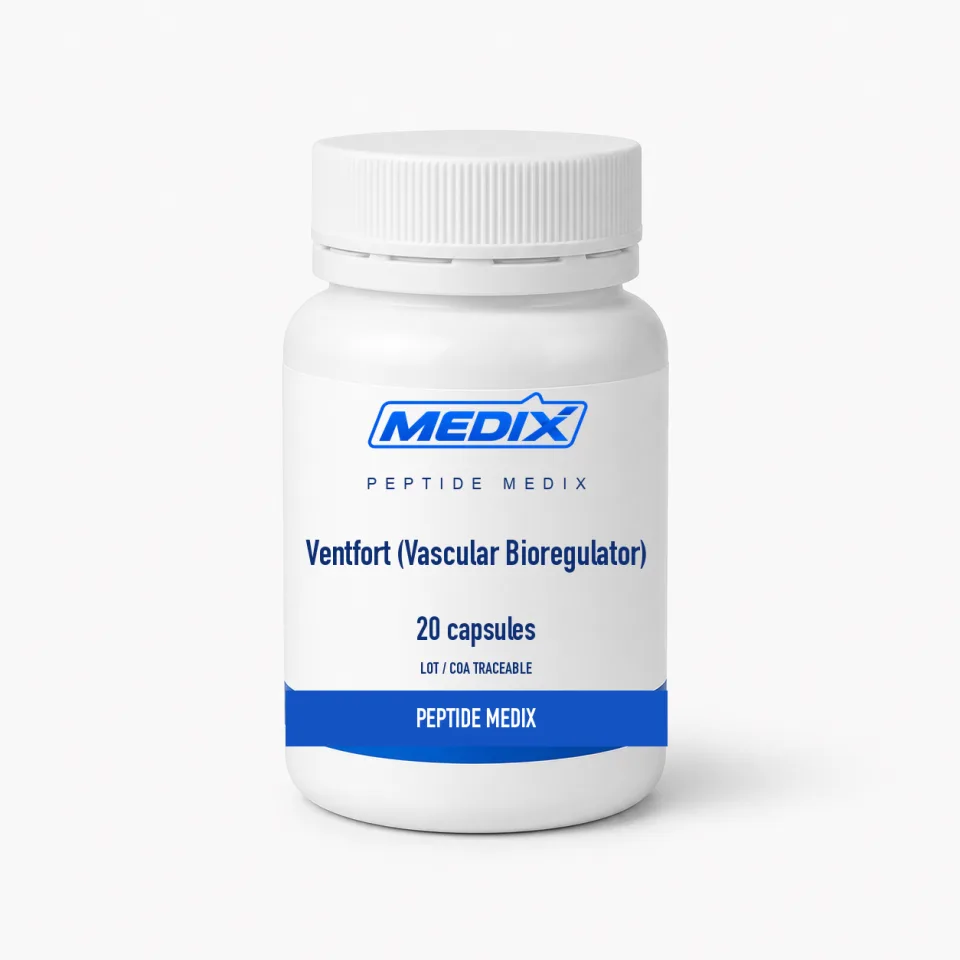
Ventfort (Vascular Bioregulator)

Vessel-derived peptide complex in capsules, from the Khavinson cytomax series

Review catalog details Secure payments
Available to order · 2 of 2 options available
$72.00 $85.00 15% OFF

Choose an option

1
Categories: ventfort , khavinson bioregulators , vascular peptides

Choose your delivery method

Standard Shipping is automatically selected at checkout. Customers can upgrade to a faster delivery option anytime.

Overview

Ventfort is the vascular member of the natural peptide bioregulator series developed at the St Petersburg Institute of Bioregulation and Gerontology under Vladimir Khavinson. Unlike the synthetic short peptides in the same programme, it is a tissue-derived preparation: a low-molecular-weight peptide complex obtained by fractionating vessel-wall tissue from young animals, then purified and encapsulated. It is therefore a mixture characterised by fraction profile rather than a single sequence with a formula and molecular weight.

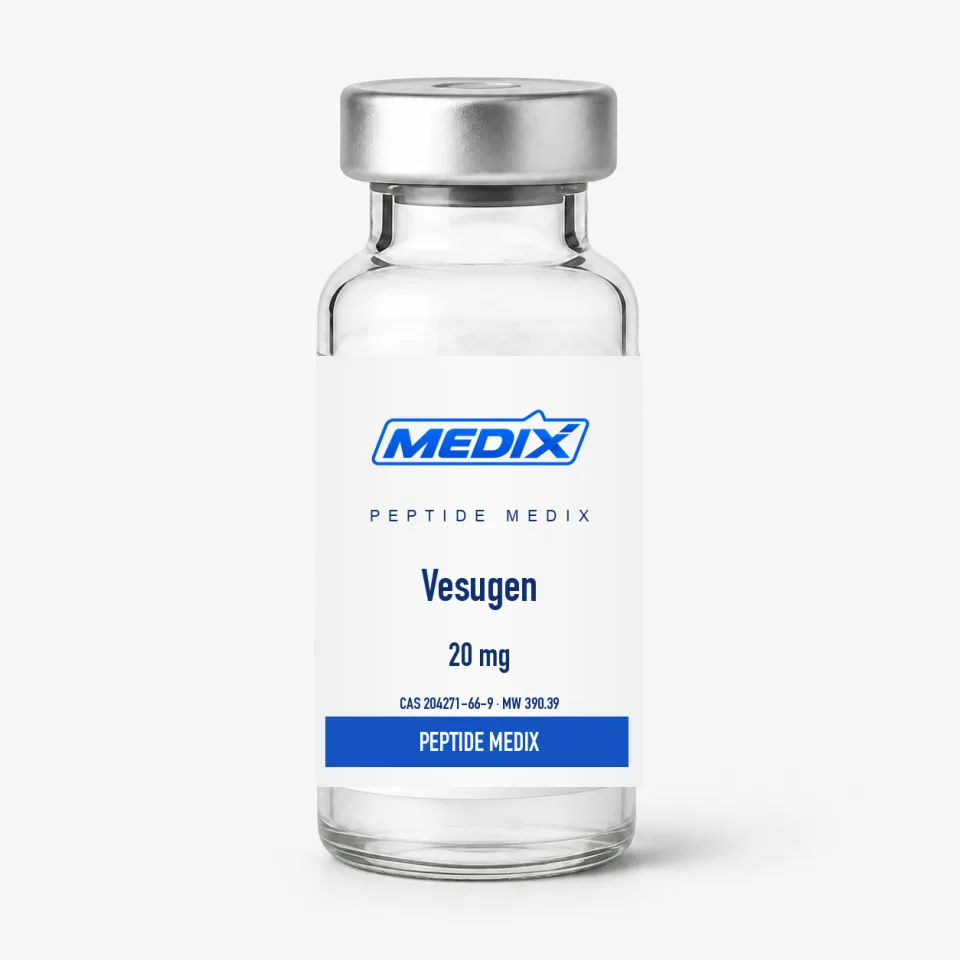
The organisation of the series is worth understanding before designing an experiment with it. Each organ preparation — vascular, cardiac, pineal, thymic and so on — was studied first as an extract, and in several cases a defined short peptide was later identified and synthesised as a research surrogate. Ventfort occupies the extract position for vascular tissue, while Vesugen supplies the corresponding defined tripeptide, Lys-Glu-Asp. Comparing the two is one of the more common study designs in this area.

Specifications

Brand Peptide Medix
Category Khavinson Bioregulators
Form Oral research capsules in a sealed bottle with tamper-evident closure
Available counts 20 capsules, 60 capsules
Product type Tissue-derived peptide complex (mixture), not a single-sequence peptide
Source material Vessel-wall tissue of young animals, fractionated and purified
Composition Water-soluble low-molecular-weight peptide fractions with associated amino acids
Molecular weight range Peptide fractions typically below approximately 10 kDa
Series Khavinson natural peptide bioregulators (cytomax line)
Tissue association Vascular endothelium and vessel wall
Synthetic counterpart Vesugen (Lys-Glu-Asp, KED) — the defined tripeptide assigned to vascular tissue
Research areas Endothelial cell models, vessel-wall structure, vascular ageing, gene and protein expression endpoints
Analytical documentation Identity and fraction-profile testing per lot; documentation available on request
Storage Room temperature, dry, sealed and protected from light
Options 2 listed
SKU VENTFORT-20-CAPSULES

Highlights

  • Vascular member of the Khavinson tissue-derived peptide bioregulator series
  • Supplied as oral research capsules in sealed 20-count and 60-count bottles
  • Peptide complex from fractionated vessel-wall tissue — a mixture, not a single sequence
  • Low-molecular-weight peptide fractions, characterised by fraction profile rather than formula
  • The extract counterpart to Vesugen, the synthetic Lys-Glu-Asp vascular tripeptide
  • Lot documentation covering identity and fraction testing available on request
  • Room-temperature stable in the sealed bottle — no cold chain required

What's Included

  • The product option and count selected above
  • Final item and quantity confirmed in cart
  • Laboratory-research-use labeling

Research Overview

What the preparation is

Ventfort belongs to the cytomax line of tissue-derived peptide preparations. Production involves extracting vessel-wall tissue, removing high-molecular-weight protein and lipid material, and retaining a water-soluble low-molecular-weight peptide fraction. Because the result is a mixture, characterisation reports fraction distribution and identity markers rather than a CAS number, formula or sequence — a point that shapes how findings should be compared between lots and between suppliers.

The peptide bioregulator hypothesis

The theoretical framework behind the series proposes that very short peptides derived from a given tissue can interact with DNA and chromatin-associated proteins and thereby influence the expression of genes relevant to that tissue. Supporting work has reported sequence-dependent binding of short peptides to oligonucleotides and changes in expression markers in cell culture. The hypothesis remains debated, and independent replication outside the originating research group is limited.

Vascular research context

  • Endothelial cell cultures examining proliferation, viability and expression markers.
  • Isolated vessel preparations and rodent models of age-related vessel-wall change.
  • Comparative studies of the extract against the defined synthetic tripeptide Vesugen.
  • Ageing biology work in which several organ-specific preparations are assayed in parallel.

Evidence limits

Most of the primary literature is published in Russian-language journals, with small sample sizes and few blinded or independently replicated designs. Batch-to-batch variability is an inherent feature of tissue-derived preparations, so investigators should record lot numbers as an experimental variable and, where the question allows, run the defined synthetic peptide alongside the extract as a controlled comparator.
Handling & Storage

Keep the bottle closed, dry and at room temperature away from heat and direct light, leaving any desiccant in place; peptide fractions are hygroscopic, so avoid repeated opening in humid conditions and do not decant capsules into unsealed containers. For in vitro work, open a capsule and take the contents into water or a physiological buffer, then centrifuge or filter to remove insoluble excipient before adding the supernatant to culture; note that the soluble fraction, not the whole capsule content, is what enters the assay. Record the lot number at the start of a study so that fraction-profile documentation can be matched to the data, and prepare working solutions fresh.

Ventfort (Vascular Bioregulator) FAQ

What is Ventfort?
Ventfort is the vascular preparation in the Khavinson series of tissue-derived peptide bioregulators. It is a low-molecular-weight peptide complex obtained by fractionating vessel-wall tissue, supplied here as research capsules. It is a mixture characterised by fraction profile, not a single peptide with a defined sequence.
How does Ventfort differ from Vesugen?
Ventfort is the tissue extract; Vesugen is the defined synthetic tripeptide Lys-Glu-Asp assigned to vascular tissue in the same programme. Vesugen can be specified to ≥99% purity with a formula and molecular weight, while Ventfort is documented by fraction profile. Laboratories often study the pair side by side.
Why is there no sequence or molecular weight listed?
Because the material is a mixture of peptide fractions rather than one molecule. Analytical documentation reports identity markers and the distribution of low-molecular-weight fractions, generally below about 10 kDa. Assigning a single formula or sequence to a preparation of this kind would be inaccurate.
What documentation comes with a lot?
Each lot carries documentation of identity and fraction-profile testing, available on request before or after ordering. Because tissue-derived preparations vary between batches more than synthetic peptides do, we recommend recording the lot number alongside experimental data.
How is it prepared for laboratory work?
For in vitro use, capsule contents are taken into water or a physiological buffer, then clarified by centrifugation or filtration so that insoluble excipient is removed before the soluble fraction is added to the assay. Working solutions are best prepared fresh, and the preparation route should be recorded in the protocol.
How strong is the evidence behind the bioregulator series?
Most primary studies come from a small number of Russian laboratories, are published in Russian-language journals, and use small samples with limited independent replication. The proposed mechanism — short peptides influencing tissue-specific gene expression — is a hypothesis under investigation rather than an established one.

This catalog listing is for laboratory research use only. It is not represented as a drug, food, supplement, cosmetic or diagnostic product, and it is not offered for human or veterinary use.

Customer Reviews

0 reviews
5 star
0%
4 star
0%
3 star
0%
2 star
0%
1 star
0%

Leave Your Review

Rating

No reviews yet — be the first!

Leave Your Review

Rating

Keep exploring

Related Products & Shopping Guides

Compare Ventfort (Vascular Bioregulator) with relevant categories, product topics, and practical shopping information.

Often researched together

Related research peptides, blends and lab supplies frequently ordered with Ventfort (Vascular Bioregulator).

15% OFF
Vesugen

Peptide Medix

Vesugen

vesugen
$63.00 $75.00

View options and product details

15% OFF
Cardiogen

Peptide Medix

Cardiogen

cardiogen
$63.00 $75.00

View options and product details

15% OFF
Bronchogen

Peptide Medix

Bronchogen

bronchogen
$63.00 $75.00

View options and product details

15% OFF
Cartalax

Peptide Medix

Cartalax

cartalax
$63.00 $75.00

View options and product details

15% OFF
Chonluten

Peptide Medix

Chonluten

chonluten
$63.00 $75.00

View options and product details